Thursday, April 12, 2012

Hornet Rendezvous With Enterprise

Early April 13, 1942, USS Hornet, her flight deck crammed with 16 US Army B-25's, sailed north of Midway Island on a westerly course, near the international date line. She was screened by a cruiser and a division of destroyers and accompanied by a fleet oiler. Lookouts scanned the horizon, alert for ships of the Japanese Navy.

"Surface ship broad on the port bow," the lookout reported to the officer of the deck.

"Very well." In fact, Hornet's search radar had been tracking the approaching task force for more than an hour. It was Task Force 16, USS Enterprise accompanied by four destroyers, two cruisers and a fleet oiler, with Vice Admiral William F. Halsey embarked in Enterprise. Halsey assumed operational command of the entire force.

The crews were not yet sure what their task would be. Halsey removed all doubt: "This force is bound for Tokyo."

It had been four months and six days since the attack on Pearl Harbor.

They were still six days short of their planned launch, and there would be several refuelings. Destroyers had to refuel every three days and the cruisers also needed to keep their tanks topped off. The carriers had enough fuel for a 12,000 mile cruise, but they needed to have plenty of Av Gas for the airplanes.

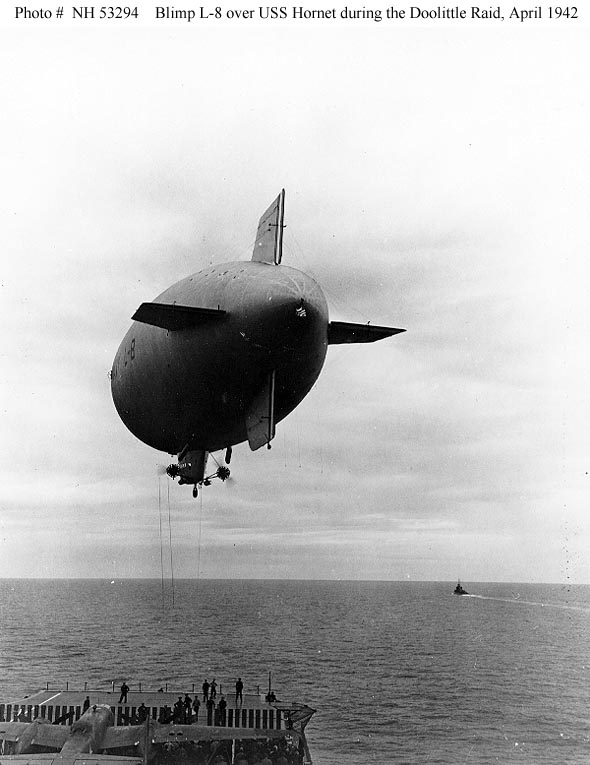
Hornet had already undergone one extraordinary replenishment after leaving San Francisco. Two days out, a navy blimp had been sent to deliver a cargo of vital parts for the Army's B-25's.

http://www.navsource.org/archives/02/020838a.jpg

Here, USS Hornet in the distance and USS Enterprise in the foreground, with her navy fighters spotted on the flight deck for quick launch in case of need.

Wednesday, April 11, 2012

We're Number One! [In Low Wage Jobs]

Here's an interesting and discouraging graph, courtesy of economist Mark Thoma.

 He used the graph in a talk at University of Oregon Monday night.


Low+wage+2[1]

Figures Don't Lie - But Liars Figure

At the Pentagon about budget time, cynical staff officers often observed, "figures don't lie, but liars figure."

We see the same phenomenon at election time, but it seems more and more that liars continue to figure, day in and day out, year in and year out.

Tony Tharp has posted on his web site a helpful antidote to at least some of the lying figures. He also provides a link to his source, here.

Monday, April 9, 2012

Titanic

A hundred years ago, April 10, 1912, RMS Titanic departed from Southampton, England, stopping first at Cherbourg, France, then at Queenstown, Ireland, on her maiden voyage to New York.

She never made it.

Election Preparations

Voters don't need to know how much work goes into preparing for an election. They just need to show up and vote. It should be comforting, though, to know that great effort goes into insuring that their votes are accurately recorded and counted.

Today, and for several more days, the Pamlico County Board of Elections is conducting logic and accuracy testing of our voting machines. The state requires us to test 10% of our machines. In Pamlico County, we test every machine used in the election.

Testing pays off. We have never had a calibration problem with any of our voting machines on election day.

Sunday, April 8, 2012

Pacific War - April 8, 1942

On this day seventy years ago, American and Filipino forces defending the Bataan peninsula on the Philippine island of Luzon surrendered to the invading Japanese forces. Within days, the 70,000 surviving prisoners would be subjected to the Bataan "death march."

At Pearl Harbor, the US carrier Enterprise, escorted by two cruisers and four destroyers and accompanied by a fleet oiler, steamed past Ford Island and into the Pacific. Vice Admiral William F. Halsey was embarked and commanded the task force. The ships set battle readiness condition three, with guns manned and most watertight doors and hatches either closed or ready to close at a moment's notice. Lookouts scanned the water for hostile periscopes and the sky for enemy aircraft. Enterprises fighters were spotted on the flight deck, ready for quick takeoff if needed.

The crews shared rumors (scuttlebutt) about their destination, but no one seemed to have a definitive answer.

Enterprise hadn't been exactly quiescent up until this point. On December 7, Enterprise, then located about 215 miles west of Pearl Harbor, had launched eighteen aircraft at dawn to run a scouting patrol to the east and northeast and then recover at Ford Island landing field. The commanding officer of the Enterprise air group flew into the attacking Japanese aircraft. Thirteen of the planes landed safely, despite Japanese air attacks and friendly anti-aircraft fire. Nine planes were sent out to search 30 degrees either side of north, out to a distance of 175 miles. Had Admiral Nagumo decided to launch a third attack wave, it is possible that the Enterprise air group might have located the Japanese force. But he had already decided to leave the area.

Weeks later, on January 23, 1942, Enterprise provided air support for a landing of about 5,000 marines at Pago Pago in Samoa, then proceeded to the first US attack on Japanese-held territory. On February 1, Enterprise and her embarked air group attacked Japanese bases in the Northern Marianas, including Kwajalein. Meantime, Yorktown struck targets in the Southern Marianas and Gilberts. It had not quite been two months since Pearl Harbor.

Three weeks later, Enterprise attacked Japanese fortifications and the airfield on Wake Island. It had been two and a half months since Pearl Harbor. On the 4th of March, Enterprise attacked Japanese forces on Marcus Island. It was three months since Pearl Harbor and Enterprise had four times engaged Japanese military forces in hostile action.

On the 8th of April, 1942, when Bataan fell, the outgunned American and Filipino defenders had held out against an experienced Japanese Army for four months.   Enterprise  was on her way to another attack on Japanese forces. This would make five times in four months.

Saturday, April 7, 2012

Get Out And Register - Then Get Out And Vote

Is voting a right or a privilege?

By law, it is a right. Every American citizen has the right to vote. One can also view it as a privilege, but it is a privilege that belongs to every citizen.

More importantly, it is a duty. In a democracy, if you don't take the trouble to vote, you are arguably a freeloader.

Don't be a freeloader. Do your duty and vote.

The first step in voting is to make sure you are registered and that the information is up to date.

How to register? You can do it when you get a driver's license or at any public service agency. But in Pamlico County, it is most convenient to drop by the Board of Elections office the next time you are in Bayboro.

The next election is the May 8 primary. Voter registration for that election closes at 5:00 PM April 13. If you miss that deadline, you can still vote using same-day registration during one-stop, but you can't change any previous party registration after April 13.

If you have questions, call the Board of Elections and ask our Elections Director, Ms. Lisa Bennett. She'll walk you through it.

Friday, April 6, 2012

Seventy Years Ago - Army And Navy In Phillipines

While US Army pilots were training at Eglin Field in Florida for the Doolittle raid, US Army and Navy units were fighting a rear guard action in the Phillipines. On March 11, US Navy motor Torpedo Boat (MTB) Squadron 3, commanded by the Navy Lieutenant J.D. Bulkeley, transported General Douglas MacArthur from the island of Corregidor to Mindanao in the southern Phillipines.

The MTB squadron remained in the Phillipines after MacArthur went on to establish his headquarters in Australia. The squadron's exploits were described in a book and film by the title of They Were Expendable.

The film, directed by John Ford, is one of my favorite WWII movies. Ford, who served in the navy during the war, captured the feel of military service with a high degree of technical and dramatic accuracy (though with some embellishment). Robert Montgomery, who played the Lieutenant Bulkeley figure in the movie, had commanded a PT boat during the war. Three other actors playing MTB squadron personnel also had served in the war (Marion Morrison -AKA John Wayne- not among them. He never wore his country's uniform except in make-believe.)

Another WWII movie among my favorites is Thirty Seconds Over Tokyo.  Both movies were based on actual events and depicted with a high degree of accuracy.


Rights And Obligations

Our public discourse might be greatly improved if each of us were to give greater effort and support to the rights of others than to our own. And if we were to give greater emphasis to our own duties and obligations than to those of others; that would also be a good thing.

Just a thought.

2012 Elections

Just returned from two days of training in Durham on Board of Elections matters.

We reviewed a number of matters concerning the responsibilities of county boards of elections to insure the fairness, honesty and integrity of the election process. The training emphasized the goal of increasing voter participation and of making elections voter friendly.

I'll share some of the information we received over the coming weeks.

Wednesday, April 4, 2012

US Navy Carrier Launches Army Airplanes

We have been following the planning and execution of one of the most remarkable operations during WWII, the launch of 16 US Army B-25's to attack Japan.

This was neither the first nor the last time that US Army aircraft took off from Navy aircraft carriers.

In October 1940, soon after USS Wasp (CV-7) completed her sea trials, she loaded 24 Curtiss P-40 fighters from the Army Air Corps' 8th Pursuit Group and nine North American O-47A reconnaissance aircraft from the 2nd Observation Squadron. Proceeding to sea on October 12, Wasp flew off the Army planes in a test designed to compare the take-off runs of standard Navy and Army aircraft. That experiment, the first time that Army planes had flown from a Navy carrier, foreshadowed the use of the ship in the ferry role later in World War II.

In 1941, as the US became more involved in shipping war materials to Great Britain, the Navy started so-called "Neutrality Patrols" to protect shipping. That June, as the United States became more heavily involved and the situation in Britain became more difficult, the United States made plans to occupy Iceland. Wasp played an important role in the move.

That July, while Wasp lay alongside Pier 7, NOB Norfolk, 32 Army Air Forces (AAF) pilots reported on board "for temporary duty". At 06:30 the following day, the ship's cranes hoisted on board 30 P-40Cs and three PT-17 trainers from the AAF 33rd Pursuit Squadron, 8th Air Group, Air Force Combat Command, home-based at Mitchel Field, New York.

The carrier's assignment was to ferry the army planes to Iceland because of a lack of British aircraft to cover the American landings. The American P-40s would provide the defensive fighter cover necessary to watch over the initial American occupying forces. Wasp slipped out to sea on 28 July, and joined Task Force 16—consisting of the battleship Mississippi, the heavy cruisers Quincy and Wichita, and five destroyers, bound for Iceland. On August 6, Wasp launched the P-40s and three trainers.

In April and May, 1942, Wasp carried Royal Air Force Supermarine Spitfires to within about a hundred miles of the island of Malta, then under German attack and launched the planes to reinforce Malta's defenses. On the second delivery run, one Spitfire had a fuel problem and had to return to Wasp for a landing.

Meantime, on May 10, 1942, the carrier USS Ranger  launched 68 US Army P-40's to fly to Accra, on the African Gold Coast, on the initial leg of their voyage to China to reinforce the Flying Tigers. In July, she launched another 72 P-40's at Accra for the same purpose.

In these operations as well as others during the early months of WWII, Army and Navy forces worked well together. Even before the war, coordination between the two services was close and effective, including collaboration on the most sensitive US communications intelligence effort.

Tuesday, April 3, 2012

Drug Overdose

Did you know that death from prescription drug overdose now exceeds all other accidental deaths, including automobile accident?

We learned that bit of information at last night's meeting of Pamlico County's Board of Commissioners. Ms. Tanya Roberts of ACT Now NC briefed the commissioners on Project Lazarus, which among other measures, is establishing a safe procedure for citizens to dispose of unneeded or out of date prescription medicine. The Pamlico County Sheriff has agreed to establish a medication drop box in the Sheriff's office.

The box, which will be under 24-hour surveillance, will solve the problem of disposal. The procedure will be described by pharmacists in a notice provided to everyone picking up a prescription.

Monday, April 2, 2012

Courage, WWII Style

Seventy years ago today, on April 2, 1942, USS Hornet (CV-8) got underway from San Francisco, enroute to a planned launch point 450 miles from Tokyo. At that point, some six thousand miles west of the Golden Gate, the ship intended to launch sixteen Army B-25 twin-engine bombers to attack Japan.

The plan was to launch the aircraft before dawn on April 19, drop bombs on the targets early that morning, and proceed to air strips in China ten hours after launch. The targets selected to be bombed were in Tokyo, Yokohama, Yokosuka, Nagoya, Kobe and Osaka.

By today's standards, the B-25 was a primitive aircraft. It had a very crude radio navigation system dependent on a homing transmitter at an airfield. Otherwise, it would navigate over water with a bubble sextant and printed air navigation tables. The planes did not have any autopilot. The pilot and co-pilot would fly the plane by hand the entire distance of the mission, over 2,000 miles.

They expected to encounter antiaircraft fire and enemy fighter aircraft. To increase the plane's range, two defensive machine guns had been removed, including the tail gun.

Each plane had a five-man crew.

It was not a suicide mission, but every man knew he might not return.

The leader of the mission, LCol Jimmy Doolittle, was an aeronautical engineer with a doctorate in engineering, and one of the most experienced and valuable staff officers in the Army Air Corps. He had to fight for the right to lead the aircraft into combat.

The mission didn't proceed exactly as planned.

More about this later.

Friday, March 30, 2012

More Thoughts On Trayvon Martin

Here's a thought-provoking op-ed from the New York Times tying the Trayvon Martin killing to the rapid growth of gated communities and the fear that feeds them.

The author, Rich Benjamin, suggests taking a broader view than just race toward "stand your ground" laws. "Those reducing this tragedy to racism," he observes,  "miss a more accurate and painful picture. Why is a child dead? The rise of “secure,” gated communities, private cops, private roads, private parks, private schools, private playgrounds — private, private, private —exacerbates biased treatment against the young, the colored and the presumably poor."

But it is clearly about fear - unreasoning, irrational fear, fed by clever marketing.

Earlier, I referred to "stand your ground" as a lynch law. Some seem to think of lynching as a racist phenomenon. I don't. Out West, there were many lynchings of alleged robbers, horse thieves, rapists and other miscreants who were white.

Henry Fonda's "The Ox-Bow Incident" is only one of many western movies depicting the theme.

What is common about lynchings, whomever the victims, is that private citizens take the law into their own hands. More to the point, lynchings demonstrate a contempt for the rule of law itself. "Stand your ground" laws are founded on contempt for professional law enforcement.

Thursday, March 29, 2012

A Case Of Serious Planning

When twenty-two B-25 aircraft left Eglin Field on March 25 seventy years ago, the Doolittle raid had been in planning since December 21, 1941, two weeks after the attack on Pearl Harbor. On that day, President Roosevelt met with his Joint Chiefs of Staff and expressed the desire to bomb Japan as soon as possible.

Both Army and Navy planners went into high gear. Three weeks later, a navy captain proposed launching Army twin-engine bombers from a navy aircraft carrier. The question became: which bomber? The two services considered the B-18, an obsolescent medium bomber, its successor the B-23 Dragon, the Martin B-26 Marauder and the B-25B. The B-25B, though untried in battle, met the requirements best.

Even so, the B-25 needed extensive engineering modifications to meet the range and bomb load requirements for the mission.

February 3rd, 1942, two B-25's successfully flew from the flight deck of USS Hornet (CV-8).  It was not quite two months since Pearl Harbor.

Less than a month later, two dozen crews and modified aircraft began three weeks' intensive training in simulated carrier deck takeoffs, low-level and night flying, low-altitude bombing and over-water navigation. This training in itself was a major accomplishment. When the 22 remaining aircraft flew to California, it had been three months since President Roosevelt charged the Joint Chiefs of Staff with the mission.

In the meantime, USS Hornet was preparing for a voyage halfway around the world, into hostile waters.

Hornet left Norfolk March 4 for the Panama Canal and then on to Pearl Harbor to join Yorktown, Saratoga and Enterprise in the Pacific. Her immediate orders were to head to San Diego. She arrived on March 20, mooring at the carrier berth on North Island. She had steamed more than 6,000 nautical miles from Norfolk.

Preparing for combat, Hornet's  Air Group 8 squadrons were provided with upgraded aircraft. Fighting 8 (VF-8) received the F4F-4 Wildcat. Bombing 8 (VB-8) and Scouting 8 (VS-8) received the SBD-3 Dauntless. Torpedo 8 (VT-8) remained stuck with the antiquated TBD-1 Devastator due to a delay in the delivery of the new TBF-1 Avenger. Hornet spent the next week qualifying the pilots for carrier launches and landings.

On March 28, Hornet tied up at North Island again to give her crew a final weekend of liberty in the US mainland. Captain Mitscher received a new set of Top Secret orders that would take the brand new ship on a very circuitous route to Pearl Harbor. Two days later Hornet sailed north, heading towards Alameda Naval Air Station, where she arrived on March 31 and moored at pier 2.

The Doolittle Raid

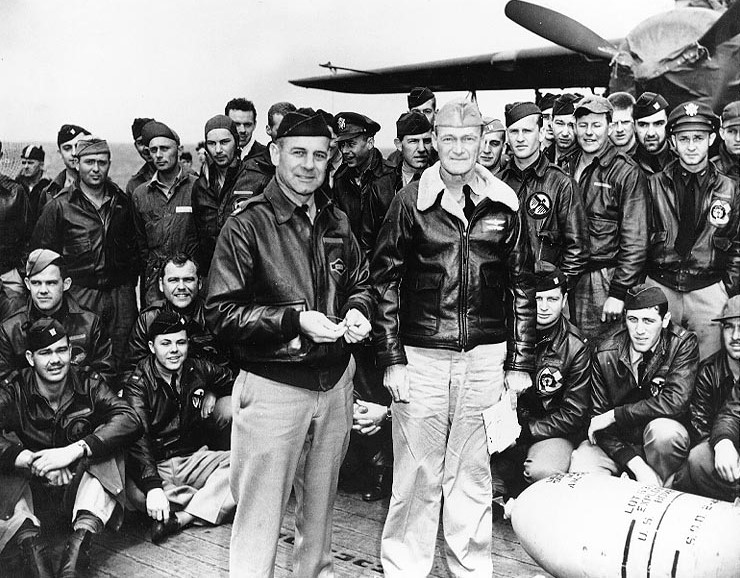
Meanwhile, twenty-two USAAF B-25 Mitchell bombers arrived at Alameda. On March 31 and April 1, with Hornet’s aircraft stored in the hangar deck, sixteen of the bombers were craned aboard and tethered to the flight deck. Shortly thereafter, 134 Army pilots and aircrew, led by LtCol Jimmy Doolittle, boarded the ship and Hornet slipped out to a mooring in SF Bay to spend the night. At mid-morning on April 2, Hornet and her escorts (Task Force 16.2) steamed under the Golden Gate Bridge, beginning the legendary mission known as the Doolittle Raid.

http://www.history.navy.mil/photos/images/h53000/h53295.jpg

It was less than four months since the attack on Pearl Harbor.

Two dozen aircraft had been re-engineered. 

Two dozen Army air crews had been trained in new techniques.

A brand new aircraft carrier (USS Hornet) had changed from one ocean to another, loaded newly delivered modern aircraft, qualified pilots and aircrew to operate from the new aircraft carrier.

16 B-25's were tied down on the flight deck of a ship for which they were not designed.

The sixteen Army air crews had never taken off from an aircraft carrier.

It would be five thousand miles before Hornet would reach  the launch point.
http://www.maritimequest.com/misc_pages/doolittle_raid/03_doolittles_raiders.jpg


Wednesday, March 28, 2012

Economic Consequences of Republicans

There was a major Republican takeover of state governments in 2010. Subsequent job losses were most severe in a handful of GOP-controlled states. North Carolina is among the states with severe job losses among government workers. The losses would not have been so severe and unemployment would have been lower, except for the legislature's override of Governor Perdue's budget veto.

That same budget attacked Pamlico County by imposing ferry tolls on our highways.

The Nation has an excellent article analyzing the economic consequences of the takeover. Well worth reading.

Rents Are Too D**n High

We keep hearing charges that "Oriental needs to be more friendly to business."

The truth is that the biggest obstacles to businesses in Oriental are:
1. Real estate is too expensive, resulting in business rentals that are too high;
2. We don't have enough customers - a permanent population of 900 just doesn't support many businesses.

Still, one of our present commissioners has emotionally charged a previous board with failure to adopt "the one thing" that would allow us to recruit more businesses, namely conditional zoning.

Balderdash!

Actually, when I first read the provisions in North Carolina General Statutes about conditional zoning, I thought it was worth investigating. We arranged to have a professional urban planner from the Easter Carolina Council brief us on the purposes and procedure. All of his examples came from larger towns and cities.

It pretty quickly became apparent to me that conditional zoning may be a good thing in towns with a number of specialized business districts with restrictive zoning categories. That isn't characteristic of Oriental.

We have only five zones, three of which are residential and two multi-use zones, with both business and residential uses. Scrutiny of the allowed uses within MU and MU-1 reveals that neither is very restrictive. For that matter, neither are our three residential zones. We allow business use in residents, so long as the use does not exceed 400 square feet.

So why the push for conditional zoning? The only possible use of such zoning would be to convert some portion of our residential zones to commercial use. Do we have such a critical shortage of commercial space that we need to expand into our residential zones?

I just rode my bicycle up Broad Street to the town limits. back down Midyette Street to the water and across Hodges. That route takes one along most of the area set aside for MU and MU-1 uses.

What did I find? At least four dozen properties for sale or lease and vacant lots. We seem to have no shortage of places to do business.

What we need are more customers. And lower rents.

http://www.townoforiental.com/vertical/Sites/%7B8227B748-6F08-4124-B0ED-02789B9A2F82%7D/uploads/%7BFCE657D6-9A99-4A8F-AB8D-BF73A767CEA7%7D.JPG

Long Range Planning For Town Of Oriental

About five years ago, the Town of Oriental's Board of Commissioners established a Long Range Planning Committee. I suggest that it is time to abolish the LRPC. Or, perhaps rename it the Long Running Planning Committee. Or perhaps the Interminable Planning Committee.

It may be time for the Town Board to declare the LRPC victorious and return all of its functions to the Town's Planning Board, to which they properly belong, anyhow.

It has been two and a half years since the original Long Range Planning Committee (of which I was a member) created its Long Range Vision Statement. The Town Board approved it October 9, 2009. A summary of the vision statement is posted on the wall at Town Board meetings. It is fine, as far as it goes. In fact, it is a good basis for planning, though I think it leaves out a thing or two.

What was supposed to happen next is that the town would work from the Vision statement and prepare a Comprehensive Plan.

North Carolina General Statutes stipulate that the town must have a comprehensive plan, but does not spell out exactly what that is. For at least one statutory purpose, the town's Growth Management Map meets the requirement for a Comprehensive Plan.

The effort for a more elaborate Comprehensive Plan has evolved into a kind of search for the Holy Grail of planning.

More than two years ago, Planning Board member Jim Barton made an excellent start to the preparation of a Comprehensive Plan. That effort fell apart for reasons that have never been entirely clear.

What is clear is that recent efforts of the LRPC II have detracted from planning efforts that need to be undertaken. For example, the Town needs to replace its decades-old Thoroughfare Plan (which is certainly a component of the elusive Comprehensive Plan) with a Comprehensive Transportation Plan. The reason is, that a CTP is necessary should the town seek Department of Transportation funding for bicycle paths, pedestrian pathways, etc. It would be best to task the Planning Board with development of a CTP (in conjunction with the DOT transportation planning department) and get on with it.

I think a long range plan without any specific mention of annexation does not meet the planning needs of the town.

What the town doesn't need the LRPC to do is to keep bringing up certain solutions in search of a problem as, for example, "Conditional Zoning" and "Smart Growth." Neither makes any sense without a plan for growth through annexation.

I'll have more to say about Conditional Zoning in the future.


Monday, March 26, 2012

ALEC Target: Public Schools

ALEC doesn't like public schools. "The mission of ALEC’s Education Task Force," their web site proclaims, "is to promote excellence in the nation’s educational system, to advance reforms through parental choice, to support efficiency, accountability, and transparency in all educational institutions, and to ensure America’s youth are given the opportunity to succeed." Of course, their principal target is public school teachers and their unions.

Speaking of transparency, last year I was able to view the titles of ALEC-sponsored legislation drafted to achieve conservative goals in state legislatures. It was pretty easy to see, for example, which of the many bills pushed through North Carolina's legislature by the new Republican majority had originated in ALEC, because they used the same title. "Faithful Presidential Electors," for example, absorbed a lot of legislative attention. When was the last time you heard of a presidential elector not voting for the presidential candidate to whom he was pledged? It's pretty rare.

Anyhow, a lot of Alec's bills deal with public schools and particular the charter movement. After all, "our schools are failing and we have to do something." Today I wasn't able to find ALEC's list of bills.

Fortunately, the Center For Media And Democracy has established a web site to expose ALEC's legislative agenda: http://www.alecexposed.org
The site provides a road map to ALEC's agenda. It verifies, for example that voter ID laws came right out of ALEC's game plan. As did Wisconsin's anti labor provisions, its assault on public workers, and the rest of Governor Walker's radical agenda.

A lot of this session's bills in the North Carolina legislature likewise had nothing to do with the concerns of North Carolinians - and a lot to do with the concerns of ALEC's corporate sponsors.


National Lobbyists At NC Legislature

I have mentioned the American Legislative Exchange Council (ALEC). This innocuous-sounding organization is working assiduously to transform our form of government through changes to state laws.

It turns out that ALEC actually drafted Florida's "Stand Your Ground" law that has become so notorious in the wake of the Trayvon Martin killing.

NY Time columnist Paul Krugman informs us in today's blog, Lobbyists, Guns and Money, how such things happen.

Has he been reading my blog? Probably not, but regular readers will recall that I called attention nearly a year ago to ALEC's influence on the newly-elected North Carolina state legislature here and here and here.

Apparently this legislature is interested mostly in serving their constituents at ALEC's headquarters instead of in their own districts.

Sunday, March 25, 2012

Doolittle Update - 70 Years Ago

In February, 1942, the US Army Air Corps ferried two dozen B-25 medium bombers to a factory in Minneapolis to be modified for a very secret and hazardous mission. Everyone from the squadrons wanted to go, but only 24 crews were picked. The 24 crews selected picked up the modified bombers in Minneapolis and flew them to Eglin Field, Florida, beginning 1 March 1942.

They went through three weeks of intensive training in simulated carrier deck takeoffs, low-level and night flying, low-altitude bombing and over-water navigation. Lieutenant Henry Miller, USN, from nearby Naval Air Station Pensacola supervised their takeoff training. and accompanied the crews to the launch. One aircraft was heavily damaged in a takeoff accident and another scratched from the mission because of a nose wheel shimmy.

On 25 March 1942, 70 years ago today, the remaining 22 mission-ready B-25s took off from Eglin for McClellan Field, California. Two days later, they touched down at  Sacramento Air Depot for final modifications.

The North American B-25 Mitchell (named in honor of Air Power pioneer, Army General Billy Mitchell) was an untried aircraft. None had ever flown in combat. A total of 16 B-25s flew to Naval Air Station Alameda, California, on March 31.

The aircraft would push their design capabilities to the limit:

B-25B Specifications and Data:
Manufacturer: North American Aviation
First Flight August 19, 1940
Number Built: 119 (actually it was supposed to be 120, but one crashed before delivery to the US Army Air Forces)
Powerplant(s): Wright cyclone R-2600-9 14 cylinders each
Weight (empty) 20,000 pounds
Maximum Horsepower (per engine) 1,700
1,350 HP at 13,000 feet
Maximum Speed 322 mph
300 Miles per Hour at 15,000 feet
Initial Rate of Climb 1,704 feet per minute
Ceiling 23,500 feet
Maximum Range 1,300 miles (with 694 gallons of fuel and a 3,000-pound bomb load)

   [These planes had been modified, increasing fuel to 1,141 gallons and a 2,000-pound bomb load]
Gross Take-off Weight 26,208 pounds
Maximum Take-off Weight 28,460 pounds
Span 67 feet 7 inches
Wing Area 610 square feet
Length 52 feet 11 inches (without broomsticks :-) )
Height 15 feet 9 inches
Normal Bomb load 2,400 pounds
Various combinations of bombs could be carried. Total weight depended on amount of fuel carried and other variables
Normal range 2,000 miles
Crew: 5

http://www.doolittleraider.com/first_joint_action_files/image013.jpg


Saturday, March 24, 2012

Foreseeable Consequences Of Bad Law

A couple of days ago, I called Florida's "stand your ground" law a "lynch law" and took issue with the idea that Florida's legislators couldn't have foreseen such events as the killing of Trayvon Martin.

Now we have explicit confirmation from the then Chief of Police in Miami that he and other police chiefs in Florida opposed the law and explained the reasons to the legislature. "Trying to control shootings by members of a well-trained and disciplined police department," former Chief John Timoney explains, "is a daunting enough task. Laws like “stand your ground” give citizens unfettered power and discretion with no accountability. It is a recipe for disaster"

I don't believe my characterization of the law as "lynch law" is inaccurate. You don't have to have a mob to have a lynching. What you do need is one or more citizens who decide to take the law into their own hands. It seems I wasn't the only person to make the connection between "stand your ground" and lynching. Here are some cartoons that make the point better than I did.

This law gives victims no protection, either through criminal or civil law. It needs to be revoked. In the meantime, why would any tourist visit Florida and risk an encounter with an armed person?

I wonder if the State of Florida even has the power under its own constitution or the US Constitution to deprive injured citizens from the ability to seek redress in the courts.

Friday, March 23, 2012

Are Liberals And Conservatives Different Species?

In 1960, F.A. Hayek, one of present-day conservatives' favorite economists, published an essay entitled "Why I Am Not A Conservative." Bottom line: conservatives fear change and welcome authority; liberals are open to change and oppose coercion.

Hayek seems to be on to something deeply embedded in the character of conservatives and liberals. Recent research seems to show that young children who are easily startled usually grow up to be conservative. In fact, both fear and revulsion seem to feed into what I think it is fair to call the conservative syndrome. Two years ago, Nicholas Kristoff called attention to research tending to show that the roots of political judgment may lie in the way our brains are wired.

"Researchers have found, for example," Kristoff reports, "that some humans are particularly alert to threats, particularly primed to feel vulnerable and perceive danger. Those people are more likely to be conservatives." Here is a link to research by professors Smith, Oxley, Hibbing and Alford. More recent research seems to indicate that attitudes toward moral issues are likewise built in to our personalities. A recent book by Professor Haidt of the University of Virginia lends further weight to such research.

I admit I have always thought that when Republicans and other conservatives tell us we should be afraid of something, they are cynically preying on people's irrational fears. Maybe I've been wrong. Maybe they are genuinely afraid and think everyone else must be, too. Domination by fraidy-cats.


Thursday, March 22, 2012

Elections Matter

Elections are a necessary condition for a thriving democracy. But elections aren't enough. Democracy needs citizen involvement.

Our ongoing controversy over ferry tolls illustrates that elections matter.

We are beginning this year's election season. Nationally, the focus is on the election of a president. That is clearly important. But let's not let the election of a president suck all of the political oxygen out of the air. Local and state elections are where the rubber meets the road. Or tolls the ferry, as the case may be.

This is also an Olympic year.

Just keep in mind that if politics were an Olympic event, it would be a team sport, not an individual event.

Wednesday, March 21, 2012

Modern Republican Economics

Bruce Bartlett, senior policy advisor in the Reagan and Bush I administrations and staffer for Jack Kemp and Ron Paul, describes the origin of modern Republican fiscal policy in the Economix section of today's New York Times.

Bartlett makes it pretty clear what former Vice President Dick Cheney meant when he said "Reagan proved deficits don't matter." That comment didn't refer to the economic effect of deficits, but the political effect. Bartlett's article provides detailed background to the "two Santa's" theory of Republican politics.

Irving Kristol, who was well-connected in Republican circles, immediately embraced the "two Santas" idea - that the GOP needed to be the "tax-cut" Santa. "I was not certain of its economic merits," he later confessed, "but quickly saw its political possibilities."

Bartlett's article doesn't address the related "starve the beast" policy. I look forward to future revelations on that score.

Lynch Law

Trayvon Martin was lynched last month in Sanford, Florida. He was 17.

Trayvon's offense: he was in the wrong neighborhood. Oh, yes, he was black.

Trayvon's killer claimed he was acting in self defense. That might have ordinarily been hard to claim, since Trayvon Martin was unarmed, was walking on foot and George Zimmerman, Trayvon's killer, stalked him first in an SUV and later on foot, armed with a 9-mm pistol.

Zimmerman is apparently claiming self-defense under Florida's "stand your ground" law, passed in 2005. The New York Times' Andrew Rosenthal excuses Florida's lawmakers. "I doubt the legislators who passed Stand Your Ground," Rosenthal observed,  "had this scenario in mind, or at least I hope not." He quotes Florida state Senator Oscar Brayon, now demanding hearings into the law, who said: “I don’t think they planned for people who would go out and become vigilantes or be like some weird Batman who would go out and kill little kids like Trayvon.”

Excuse me? That's exactly what they had in mind. And it's been working. In the first five years of the law,  according to the Tampa Bay Times, "justifiable homicide" has tripled, and was invoked in 93 cases, involving 65 deaths.

It was the obvious intent of the law (though maybe not of everyone who voted for it) to empower private citizens to arm themselves and act as policeman, judge, juror and executioner with impunity. We should call such laws by their proper name: Lynch Law.

What's unusual in this case is that there is a recorded conversation between Zimmerman and Martin, heard over a cell phone, as well as recorded conversations over the 911 system. Still, it may be hard to get a conviction.

By the way, the code words surrounding this issue don't fool me. I grew up in the South. My grandparents' home in Holmes County, MS was a regular armory, with a loaded firearm behind every door. My grandfathers, at least one of them a KKK member, both took part in lynchings and race riots in the 1920's.

We need to get beyond our tribalism, our fears and insecurities, and be Americans.

I don't doubt that Zimmerman had worked himself into a state of apprehension, fear and anger. All the more reason to rely on professionals instead of vigilantes.

Tuesday, March 20, 2012

Three Weeks' Training For Thirty Second Attack

Seventy years ago, while my father's outfit was being organized in Mobile to be shipped overseas, a smaller group was preparing at Eglin Field Florida (about a hundred miles to the east) for a different overseas movement.

Under command of LCol Jimmy Doolittle, a small group of US Army aviators was learning how to take off from an aircraft carrier. Twenty-five B-25 medium bombers, each with a crew of five, were put through their paces by a Navy lieutenant. The task: launch fully-loaded B-25's with a 2,000 lb bomb load on a 2,400 mile mission.

Details to be disclosed later.

All of the aviators were volunteers. The training began three months after Pearl Harbor.

DOT Ferry Toll Hearing Footnote

Tonight's DOT public hearing on ferry tolls is the second such public hearing in Pamlico County.

We almost didn't have any.

Until Town Dock intervened.

Melinda Penkava, who can be very insistent, called DOT to get an explanation as to why DOT was holding no public hearing in the county most directly affected.

"There's no place in Pamlico County large enough for a crowd of 200," she was told. "Oh, yes, there is," she replied.

So DOT, whose planners developed Pamlico County's Comprehensive Transportation Plan, including addressing public transportation requirements associated with Pamlico County Community College, apparently knew nothing about the college's Delamar Center.

What else don't they know about Pamlico County?

Thank Goodness for Melinda Penkava.

Monday, March 19, 2012

DOT Ferry Hearing March 19, 2012

Do you know what a "Senior Public Involvement Officer" is? I tried to find out this evening on the NC DOT web site, to no avail.

Why do I want to know? Mr. Jamille A. Robbins, who chaired tonight's DOT public hearing on "NCDOT Proposed Temporary Rules Changes for Ferry Tolling" is one.

I was unsuccessful in finding a job description or explanation of Mr. Robbins' title.

But he must be powerfully influential. When the last questioner of the evening asked Mr. Robbins what DOT had done to carry out the governor's direction to seek economies within the DOT budget to equal the legislature's directed $5 million in revenue and then directed the question to the four DOT "suits" in the front row, Mr. Robbins explained they (the "suits") were present only as "observers" and couldn't speak. The four remained silent as Mr. Robbins attempted to explain the difficulties in figuring such things out while disgruntled attendees headed for the exits.

It reminded me of a mobile that a colonel of my acquaintance hung over his desk. The mobile consisted of a collection of fingers pointing in various directions, shifting with the wind. It looked something like this:


What was the hearing for? "To solicit comments regarding the request to amend, adopt or repeal portions of the NC Administrative Code per the temporary rules process."

What next? "Following the hearing and comment period, the NCDOT must adopt the proposed temporary rule change." In other words, nothing said tonight will have any effect whatsoever on the rule.

After the temporary rules are adopted, then the Rules Review Commission (RRC) will review the proposed changes. The RRC can either approve or object (not reject). If the RRC objects, NCDOT can either rewrite or not rewrite. If they do not rewrite and resubmit the rule, it will not become effective.

More importantly, if the RRC approves the rule, people opposing the rule may file an action for declaratory judgment in Wake County Superior Court.

I hope someone has started drafting such an action. Several of tonight's public comments included observations pertinent to a request for declaratory judgment, including an interesting account by Jim Barton of the legislative history of NC 306.

Representatives of other affected counties, including Beaufort, Craven and Hyde counties, provided very powerful inputs to the hearing.

A number of speakers pointed out that this ferry tax was enacted by Republican state legislators. The consensus seemed strong that Republican legislators had thrown Eastern North Carolina under the bus. The entire region east of I-95 knows what has happened and from what was said, they intend to remember that in November.