Wednesday, May 9, 2012

South Avenue Contract

Here Is The Proposed South Avenue Contract


NORTH CAROLINA
PAMLICO COUNTY
AGREEMENT
THIS AGREEMENT (“Agreement”) is made and entered into this ____ day of May,
2012, by and between the TOWN OF ORIENTAL, a North Carolina municipal corporation,
party of the first part (“Town”), and G. CHRISTOPHER FULCHER and wife DEBORAH
WILLIS FULCHER, citizens and residents of Pamlico County, North Carolina (“Fulcher”) and
BAY CITY LODGE, INC., a North Carolina corporation (“Bay City”), parties of the second
part, all hereinafter collectively are referred to as the “Parties.”
W I T N E S S E T H:
THAT WHEREAS, the Town is considering closing the right of way of Avenue A and a
portion of the western terminus of the right of way of South Avenue at Raccoon Creek, said
rights of way being more specifically described in Exhibit A attached hereto and incorporated
herein by reference (the “Street R/W”), and identified on the survey attached hereto as Exhibit D
as “Exhibit A Street Closings”); and, because there exist plats or maps showing Neuse Front
Street, Avenue B and Main (or Maine) Street, the term “Street R/W” shall include any and all
streets or rights of way or remnants thereof in the area west of the portion of Wall Street that
extends from the southern margin of South Avenue to the Neuse River and westwardly, South of
South Avenue, to Raccoon Creek (all the property of Fulcher or entities controlled by Fulcher);
and
WHEREAS, if the Town closes the Street R/W, Fulcher and Bay City desire to convey to
the Town in fee simple certain real property located in the Town, said property being more
specifically described in Exhibit C attached hereto and incorporated herein by reference (the
“Property”) and to convey and dedicate a street right of way for public use to the Town a parcel
of land more specifically described in the attached Exhibit B; both of which are identified on the
survey attached hereto as Exhibit D as “Exhibit B Rededicated Portion South Avenue” and
“Exhibit C To be Conveyed to Town of Oriental” respectively; and
WHEREAS, the Parties hereto desire to reduce their respective obligations regarding the
Street R/W and the Property to writing in the event the Town closes the Street R/W.
Page 1 of 8
NOW, THEREFORE, IT IS MUTUALLY AGREED by and among the Parties as
follows:
1.
Definitions
1.1.
Certain terms having specific definitions are used in this Agreement, and these
terms and definitions, unless the context clearly indicates to the contrary, are as set forth in this
Section 1. The defined terms appearing in this Section are set forth in the Agreement in the
exact capitalized form as they appear between the quotation marks. When the same term is used
in this Agreement with the meaning as assigned herein, it shall appear in the identical capitalized
form. Otherwise, the meaning shall be as used in the context of the sentence in which it appears
and not necessarily that as defined herein.
1.1.1. “Agreement” – means this Agreement among the Town and Fulcher and
Bay City.
1.1.2. “Bay City” – means Bay City Lodge, Inc., a North Carolina corporation
with its principal, office and place of business in Oriental, Pamlico County, North Carolina.
1.1.3
“Deed(s)” – means one or more general warranty deeds conveying the
Property from Fulcher and Bay City to the Town in fee simple (Exhibit C parcel) or as public
street right of way (Exhibit B parcel).
1.1.4. “Fulcher” - means G. Christopher Fulcher and wife Deborah Willis
Fulcher, citizens and residents of Pamlico County, North Carolina.
1.1.5.
“Property” – means the real property owned by Fulcher and a portion of
the real property owned by Bay City located in the Town of Oriental, Pamlico County, North
Carolina, more specifically described on Exhibit C attached hereto and incorporated herein by
reference.
1.1.6. “Street Dedication” - means the real property identified on the attached
Exhibit B and being a portion of the real property conveyed to Fulcher and/or Bay City as a
result of the Town closing the Street R/W that Fulcher and/or Bay City shall dedicate to the
Town for use as a public street in the event the Street R/W is closed by the Town.
1.1.7. “Street R/W” – means the real property identified on the attached Exhibit
A, together with any streets or rights of way or remnants thereof in the area west of the portion of
Wall Street that extends from the southern margin of South Avenue to the Neuse River and
westwardly, South of South Avenue, to Raccoon Creek (all of the property of Fulcher or entities
Page 2 of 8
controlled by Fulcher) of the Town, whether or not shown on Exhibit D, and excluding any and
all utility easements that may exist, or that may be retained by the Town, within the area
identified on the attached Exhibit A.
1.1.8
“Town” - means the Town of Oriental, a municipal corporation duly
established and existing pursuant to the laws of the State of North Carolina.
2.
Town Obligations
2.1.
The Town shall consider closing the Street R/W in compliance with North
Carolina law no later than July 31, 2012.
2.2.
The Town shall cause a survey of the Street R/W (not necessarily showing all
remnants or platted streets), the Street Dedication and the Property to be prepared.
2.3.
If the Board of Commissioners determines that it is not in the best interest of the
Town to close the Street R/W, none of the Parties shall have any further obligations to the others
under this Agreement.
2.4.
If the Board of Commissioners closes the Street R/W, the Town shall accept the
Deed(s) from Fulcher and Bay City for the Property, and cause the same to be recorded.
2.5.
If the Board of Commissioners closes the Street R/W, the Town shall also accept
the dedication of the Street Dedication and cause the same to be recorded.
2.6.
If the Board of Commissioners closes the Street R/W, the Town shall also relocate
the two existing structures identified on Exhibit D onto the Property at the Town’s sole cost and
expense no later than ninety (90) days after the recordation of the Deed(s) to the Property.
2.7.
If the Board of Commissioners closes the Street R/W, the Town shall also execute
an agreement with Fulcher and Bay City, and any related waivers, to establish the use of and
access to the riparian corridors as illustrated on Exhibit D.
2.8.
The Town shall have no obligation to pay for, fund, or finance the purchase of the
Property, or any of Fulcher’s or Bay City’s obligations hereunder.
2.9.
The Town shall be responsible for the costs and expenses associated with its
obligations under this Agreement.
2.10.
It is specifically understood and agreed between the Parties that every obligation
assumed herein by the Town is subject to the limitation “to the extent that it may legally do so.”
Page 3 of 8
3.
Fulcher and Bay City Obligations
3.1.
Fulcher and Bay City shall prepare and execute the Deed(s) to convey the
Property to the Town, and deliver the same to the Town Manager who shall hold the Deed(s) in
trust pending the Board of Commissioners’ decision to close the Street R/W. If the Board of
Commissioners closes the Street R/W, the Town Manager shall cause the Deed(s) to be recorded.
If the Board of Commissioners determines that it is not in the best interest of the Town to close
the Street R/W, the Town Manager shall return the Deed(s) to Fulcher and Bay City within ten
(10) days of the Board’s decision.
3.2.
Fulcher and/or Bay City shall also prepare and execute a street dedication to
dedicate the Street Dedication to the Town for use as a public street, and deliver the same to the
Town Manager who shall hold the same in trust pending the Board of Commissioners’ decision
to close the Street R/W. If the Board of Commissioners closes the Street R/W, the Town
Manager shall cause the Street Dedication to be recorded. If the Board of Commissioners
determines that it is not in the best interest of the Town to close the Street R/W, the Town
Manager shall return the Street Dedication to Fulcher and/or Bay City within ten (10) days of the
Board’s decision.
3.3.
If the Town Manager records the Deed(s) to the Property, Fulcher shall cause the
removal the dolphin at the channel end terminus of the partially completed dock or pier located
on the Property no later than thirty (30) days after recordation of the Deed(s). Fulcher may keep
the piles from the dolphin, and shall in any event remove them from the Property unless the
Parties otherwise agree in writing.
3.4.
If the Town Manager records the Deed(s) to the Property, Fulcher shall install
appropriate pilings to extend the partially completed dock or pier located on the Property to the
maximum permitted length while maintaining the existing width of the said dock or pier no later
than forty-five (45) days after recordation of the Deed(s).
3.5.
If the Town Manager records the Deed(s) to the Property, Fulcher and Bay City
shall transfer all existing permits associated with the Property to the Town to the greatest extent
possible no later than ten (10) days after such recordation of the Deed(s), or as soon thereafter as
practicable.
3.6.
If the Town Manager records the Deed(s) to the Property, Fulcher and/or Bay City
shall execute any and all documents necessary and appropriate to transfer the Bay River
Page 4 of 8
Metropolitan Sewerage District sewer tap located adjacent to the Property to the Town no later
than thirty (30) days after recordation of the Deed(s), so that the Town may locate the sewer tap
to the Property.
3.6.
If the Town Manager records the Deed(s) to the Property, Fulcher and Bay City
shall also execute an agreement with the Town, and any related waivers, to establish the use of
and access to the riparian corridors as illustrated on Exhibit D.
3.7.
Within three (3) years of recording the Deed(s), and only in the event the Town
adopts an ordinance allowing property owners to waive side setbacks for Town parks while
Fulcher and/or Bay City (or any entity or entities whose majority interest[s] are owned or
controlled by them or either of them) directly or indirectly owns the real property to the
immediate south of the Property, Fulcher and Bay City agree to waive any side setbacks along
the southern line of the Property to the greatest extent possible.
3.8.
Fulcher and Bay City shall be responsible for the costs and expenses associated
with their respective obligations under this Agreement.
4. Miscellaneous
4.1. If any of the provisions of this Agreement shall be held by a court of competent
jurisdiction to be unconstitutional or unenforceable, the decision of such court shall not affect or
impair any of the remaining provisions of this Agreement, and the parties shall, to the extent they
deem to be appropriate, take such actions as are necessary to correct any such unconstitutional or
unenforceable provision. It is hereby declared to be the intent of the parties to this Agreement
that this Agreement would have been approved and executed had such an unconstitutional or
unenforceable provision been excluded therefrom.
4.2.
This Agreement shall be enforceable by each party hereto by all remedies
available at law or in equity, including but not limited to specific performance. Failure or delay
to exercise any right, remedy or privilege hereunder shall not operate as a waiver of such right,
remedy or privilege nor prevent subsequent enforcement thereof.
4.3.
This Agreement shall be executed by the Parties hereto in triplicate originals, each
of which, when executed, shall constitute one and the same Agreement and one of which shall be
retained by each party.
4.4.
This Agreement shall be governed in accordance with the laws of the State of
North Carolina.
Page 5 of 8
4.5.
Each party agrees that from and after the date of execution hereof, each will, upon
the request of the other, execute and deliver such other documents and instruments and take such
other actions as may be reasonably required to carry out the purpose and intent of this
Agreement.
4.6.
This Agreement may not be modified or amended except by subsequent written
agreement authorized and executed by each party.
4.7.
This Agreement is solely for the benefit of the identified parties to the Agreement
and is not intended to give any rights, claims, or benefits to third parties or to the public at large.
4.8.
No party hereto may assign this Agreement without the express written consent of
the others, which consent shall not be unreasonably withheld.
IN WITNESS WHEREOF, the Town of Oriental has caused this Agreement to be
signed and executed in its behalf by its Mayor, and duly attested by its Town Clerk or Deputy
Clerk; and Bay City Lodge, Inc. has caused this Agreement to be signed and executed by its
president or vice president, after due authorization by its Board of Directors; and G. Christopher
Fulcher and wife Deborah Willis Fulcher have signed and executed this Agreement, all in
triplicate, on the day and year first above written.
TOWN OF ORIENTAL
By:
William R. Sage, Mayor
ATTEST:
______________Oriental Town Clerk
BAY CITY LODGE, INC.
By: ________________________________
G. Christopher Fulcher, President
Page 6 of 8
G. Christopher Fulcher
____________________________________
Deborah Willis Fulcher
STATE OF NORTH CAROLINA—COUNTY OF PAMLICO
I, _____________________________________________________,the undersigned Notary
Public of the County and State aforesaid, certify that Robert J. Maxbauer, personally known
to me or identified by satisfactory evidence, personally came before me this day and
acknowledged that he is the Town Clerk for the Town of Oriental a North Carolina municipal
corporation, and that William R. Sage is Mayor of the Town of Oriental, and, by authority
duly given and as the act of such entity duly approved and authorized by the Oriental Board
of Commissioners, they both voluntarily signed the foregoing instrument in its name on its
behalf as its act and deed.
Witness my hand and Notarial stamp or seal, this the _____ day of May 2012
My Commission Expires:
Notary Public
Page 7 of 8
STATE OF NORTH CAROLINA—COUNTY OF PAMLICO
I, _____________________________________________________,the undersigned Notary
Public of the County and State aforesaid, certify that G. Christopher Fulcher, personally
known to me or identified by satisfactory evidence, personally came before me this day and
acknowledged that he is the President of Bay City Lodge, Inc., a North Carolina corporation,
and that by authority duly given and as the act of such entity, he voluntarily signed the
foregoing instrument in its name on its behalf as its act and deed.
Witness my hand and Notarial stamp or seal, this the _____ day of May 2012
My Commission Expires:
Notary Public
STATE OF NORTH CAROLINA—COUNTY OF PAMLICO
I, the undersigned Notary Public of the County and State aforesaid, hereby certify that G.
Christopher Fulcher and wife Deborah Willis Fulcher, personally known to me or identified
by satisfactory evidence,, personally came before me this day and acknowledged, their due
and voluntary execution of the foregoing instrument for the purposes therein stated.
Witness my hand and Notarial stamp or seal, this the _____ day of May 2012
My Commission Expires:
Notary Public
Page 8 of 8


2012 NC Elections: Second Primary

Based on the results of yesterday's primary election in North Carolina, it looks like there may be a second primary. Such primaries are often called "runoff" primaries. They are scheduled when no single candidate in a partisan election receives 40% or more of the vote.

The schedule depends on whether there is a federal office requiring a runoff or if there are only state offices. We will receive the official notification after next week's canvass of votes and learn whether any candidates have requested a second primary.

My guess is that there will be a second primary and that there will be one or more federal offices involved.

This year, unlike the runoff in 2010, it appears that both the Republican and Democratic parties will have a second primary, and that it will probably be scheduled for July 17, 2012. The county board of elections will notify the public as soon as we have the official word.

Two years ago, I tried the explain second primaries here. On that occasion, we also had an "instant runoff" for a judicial election. We have no advance information so far that there will be an instant runoff.

I also advocated that North Carolina dump the runoff. It is costly and pointless and few voters turn out.

Stay tuned.

Tuesday, May 8, 2012

May 8, 1942: Queen Of The Flattops Sunk

Over the night of May 7, 1942, the skies cleared over Task Force 17 and the carriers Yorktown and Lexington. The heavy overcast that had for the past two days concealed the two carriers from Japanese reconnaissance moved instead over the Japanese carriers Shokaku and Zuikaku. Shortly after 6:00 am on the 8th, TF 17 launched scout planes to search for the Japanese force and the Japanese launched aircraft searching for the Americans.

At 0820, the Americans spotted the Japanese carriers through the clouds. Two minutes later, Japanese pilots sighted TF 17. The two carrier forces were about 210 miles apart. By 0915, the Japanese had launched a strike on TF 17 and TF 17 had launched a strike against the Japanese carriers.

At 10:57, Yorktown airplanes attacked Shokaku, striking the ship with two 1,000 lb bombs. A half hour later, Lexington aircraft struck Shokaku again. heavily damaged, Shokaku withdrew from the battle. Zuikaku, concealed beneath heavy rain squalls, suffered less damage.

Meanwhile, about 10:55, Lexington's radar detected the incoming Japanese air raid. The attack began at 11:13. Lexington was hit by two torpedoes, rupturing a large tank holding highly volatile aviation fuel, and damaging the port section of the fire main. Two bomb hits did further damage, but fires were contained by about 12:30.

Attackers also damaged Yorktown, hit in the center of her flight deck by a single 550 lb  semi-armor-piercing bomb which penetrated four decks before exploding, causing severe damage.

Both sides lost many aircraft in the ensuing melee. For different reasons, the two Admirals decided to withdraw from the battle. The Japanese no longer had the ability to provide air cover for the invasion of Port Moresby.

Both US carriers remained operational. Damage control parties in Lexington had fires under control and the ship operational. Shortly before 1:00, though, the ship suffered a series of explosions when sparks ignited fuel vapors. By 3:30 the fires had become uncontrollable. A little after 5:00 the crew began to abandon ship.

After the crew was evacuated, the destroyer Phelps fired five torpedoes into the blazing ship. Lexington sank just before 8:00 pm in 2,400 fathoms in the Coral Sea.

The Japanese never captured Port Moresby. Despite heavy fighting in the Solomons, Japan never succeeded in establishing a base at Guadalcanal.

Japan's Greater East Asia Co-Prosperity Sphere never expanded in the Pacific beyond its extent as of May 8, 1942.

It had been five months since Pearl Harbor.

Journalist Stanley Johnston was aboard Lexington for her voyage to the South Pacific and her subsequent battles, including her sinking on May 8, 1942. His book Queen of The Flattops is a classic of wartime journalism. It was a book of the month club selection after the war. I was about ten years old when I read it. I still recommend it to anyone who wants to get a feel for what it was like to go to sea on an aircraft carrier early in WWII.

Primary Election May 8

Don't forget to vote today.

Let every citizen vote.

Let every vote be counted.

Monday, May 7, 2012

May 7, 1942: Coral Sea Confusion

As dawn broke in the Coral Sea, Japanese and American commanders, seeking the wherebouts of their opponents, launched scout planes. Erroneous reports, misidentifications and a lot of to-ing and fro-ing.

Japanese scouts spotted the fleet oiler Neosho and her escorts, mistaking them for a carrier and a cruiser. The Japanese admiral launched an attack with all available aircraft. Neosho was sunk. American planes spotted the Port Moresby invasion force, with a small escort carrier, Shoho. Lexington aircraft attacked and sunk Shoho, thinking it was one of the main Japanese carriers, Shokaku or Zuikaku.

Japanese planes finally found American carriers after dark when some returning planes tried to land on an American carrier. They learned their error when they were fired on by antiaircraft guns.

A frustrating day for both sides.

Sunday, May 6, 2012

America's World War II Readiness

One of the reasons I have been posting information about the early months after the Japanese attack on Pearl Harbor is to examine that aspect of the "standard narrative" that claims the United States was "unprepared" for war.

I'm not even sure what someone might mean by that claim. Unprepared in what way? Unprepared by service? Unprepared across all military platforms or only some of them? Inadequate logistics? Inadequate training? Poor morale?

Years ago, reading details of the Japanese attack on Pearl Harbor, I was struck by the fact that on a peaceful Sunday morning in a tropical paradise, when attacked without warning, the sailors on those ships during holiday routine manned their battle stations and managed to fire their antiaircraft weapons during an attack that lasted only five minutes. Their defensive fire during the second attack wave was so improved that Admiral Nagumo considered that as one reason not to launch a third wave.

Those sailors were prepared. During the cold war era, I would have been satisfied if all stations reported manned and ready within five minutes after sounding general quarters.

There were specific shortcomings in intelligence and weapons. The most notorious was the failure of our Mark 14 submarine torpedoes to perform as designed. It was clearly penny wise and pound foolish to build marvelous fleet submarines at great expense and then scrimp on testing their principal weapon.

But for the most part our ships and planes were superbly designed and built and their crews well trained.

A really good area for comparison between the United States and Japan is to look at their respective pilot training programs. Here is a very illuminating article on that subject. In brief, though Japan started the war with superb, experienced pilots, our pilots were very good and flew well-designed, rugged airplanes. The zeros were more maneuverable than their US Navy and Army counterparts at the outset, but they were also flimsier.

My conclusion is that we were quite well prepared for WWII.

Battle Of The Coral Sea: Chart


May 6, 1942: Coral Sea

On 6 May, VADM Fletcher combined Lexington (TF 11) and the cruiser/destroyer force into TF 17 (Yorktown). He believed the Japanese carriers were well to the north near Bougainville. Reconnaissance patrols failed to locate any of the Japanese naval forces, because they were located beyond scouting range.


At 10:00, a Kawanishi reconnaissance flying boat from Tulagi sighted TF 17 and notified its headquarters. Takagi received the report at 10:50. At that time, Takagi's force was about 300 nmi (350 mi; 560 km) north of Fletcher, near the maximum range for his carrier aircraft. He concluded, based on the sighting report, TF 17 was heading south and increasing the range. Furthermore, Fletcher's ships were under a large, low-hanging overcast which Takagi and Hara felt would make it difficult for their aircraft to find the American carriers. Takagi detached his two carriers with two destroyers under Hara's command to head towards TF 17 at 20 knots and to be in position to attack at first light.

American B-17 bombers based in Australia and staging through Port Moresby attacked the approaching invasion forces, including Gotō's warships, several times during the day on 6 May without success. MacArthur's headquarters radioed Fletcher with reports of the attacks and the locations of the Japanese invasion forces. MacArthur's fliers' reports of seeing a carrier (Shōhō) about 425 nmi (489 mi; 787 km) northwest of TF17 further convinced Fletcher fleet carriers were with the invasion force.

At 18:00, TF 17 completed fueling and Fletcher detached Neosho with a destroyer, Sims, to take station further south at a prearranged rendezvous. TF 17 then headed northwest towards Rossel Island in the Louisiades. Unbeknownst to the two admirals, their carriers were only 70 nm away from each other by 20:00 that night. At that time, Hara reversed course to meet Takagi who completed refueling and was now heading in Hara's direction.

Meanwhile on Corregidor, Brigadier General Wainwright surrendered the last remaining American army forces (about 12,000 men) to Japanese General Homma. 

The stage was set.

May 5, 1942: Battle Of The Coral Sea

At 08:16 on May 5, TF 17 (Yorktown) rendezvoused with TF 11 (Lexington) and TF 44 (cruisers and destroyers) 320 mi south of Guadalcanal. At about the same time, four F4F Wildcat fighter aircraft from Yorktown intercepted a large Japanese reconnaissance seaplane from the Shortland Islands and shot it down. The aircraft was unable to send a report, but when it failed to return to base the Japanese assumed that it was shot down by carrier aircraft.


Pearl Harbor notified VADM Fletcher that based on radio intelligence the Japanese planned to land troops at Port Moresby May 10 and their fleet carriers would likely be operating close to the invasion convoy. Armed with this information, Fletcher directed TF 17 to refuel from Neosho. On 6 May, he planned to take his forces north towards the Louisiades and do battle on 7 May.

In the meantime, Takagi's carrier force steamed down the east side of the Solomons throughout the day on 5 May, turned west to pass south of San Cristobal (Makira), and enter the Coral Sea. Takagi also expected to do battle on May 7.

Saturday, May 5, 2012

More South Avenue Considerations


This will probably be my last post on this subject for awhile, unless something really alarming happens. 

I recommend the town board be very clear in their guidance to the town attorney.

If the central issue is, as I believe, whether the proposal by Mr. Chris Fulcher offers equivalent or improved public access to public trust waters in the town's harbor, we need to compare relevant facts. And our attorney needs to have command of all of the facts as he negotiates details.

Some issues:

Legal:
  1. South Avenue was dedicated to public use of the citizens of Oriental by the principal landowner, Mr. Robert P. Midyette, in 1900 – providing public access to the water;
  2. Avenue A was dedicated by Mr. Benjamin Wallace O'Neill in December, 1917 by the sale of lot 1 of the Oriental Bulkhead Improvement Company – Avenue A never led to the water;
  3. The town may not sell a dedicated and accepted right of way either for money or any other valuable consideration. An exchange of ROW for title to property looks like a sale. I have said before and still believe, it would be better if Mr. Fulcher dedicates the property to the town for purposes of public access to the water than for the town to receive it in fee simple as a proprietor. It would be more clearly legal and provide better protection to the public.

Dimensions of South Avenue:
  1. The South Avenue Right of Way is 60 feet wide;
  2. Because of the angle at which South Avenue intersects the Raccoon Creek, the waterfront is approximately 90 feet long;
  3. Because of the direction of the riparian boundaries, the width of the water to which the town owns rights is 85 feet, more or less, in a direction parallel to Mr. Fulcher's existing piers;
  4. Mandatory (15 foot) CAMA buffers at the edges of the riparian area reduce the width of riparian area available for constructing piers or docks to 55 feet;
  5. The parcel Mr. Fulcher proposes to donate to the town is 55 feet wide at the water's edge – he proposes both parties waive mandatory CAMA buffer: even so, with a mandatory CAMA buffer at the Toucan Grill end, that leaves only 40 buildable feet, even with the waiver.

What Can Be Built:
  1. It is often asserted that we can build NOTHING on a right of way, “not even a gazebo!”
  2. Not necessarily - we build stuff in rights of way all the time;
  3. The rule is that we can build no permanent structure, even in unopened sections, that would prevent eventual use for ROW purposes;
  4. In Town of Oriental ROWs, we plant trees, construct water mains and Sewer mains, utility poles and other encumbrances;
  5. Yesterday a truck delivered a rest room facility and placed it in the ROW at Lou-Mac;
  6. Other communities build shelters for bus riders, including public school students in their ROW (some shelters might even resemble gazebos);
  7. Each year during Croaker Fest, large tents supported by pipe frames are installed on South Avenue near Lou-Mac Park, even involving some degree of damage to pavement;
  8. During some large public events in the past, such as bicycle events, etc. organizers have placed trailers on the right of way for participants, including shower and rest room facilities.
  9. In short, obstacles to providing public facilities for visitors and event participants in our ROW are not insurmountable. It might require a bit of imagination. [I am indebted to Kathy McIlheny, who gave me the trailer idea]
  10. The proposed parcel is unbuildable for 50' from the water's edge Neuse River Buffer), the next 25' is in a CAMA area of environmental concern, and the last roughly 30 feet will probably be used for parking and other requirements to comply with our GMO, as well as ramps to meet ADA requirements for access to any building constructed on the property.

Advantages of The Proposed Parcel:
  1. The site has been dredged and bulkheaded and a pier is under construction;
  2. Sewer and water connections already exist;
    3.  Fewer building restrictions than a right of way.
Disadvantages of The Proposed Parcel:
  1. Narrowness of the parcel and riparian area constrains visiting boats;
  2. Some say the pier is unsuitable – too industrial for recreational boats;
  3. Some say the projected pier is in the wrong place.
Conclusions:

The decision should be based on what is best for the town.

Avenue A only provides public access to Mr. Fulcher's property.

It is not correct to say that rights of way "are of no value." In coastal North Carolina, nothing is more valuable to the public than public access to the water.


Friday, May 4, 2012

Tulagi: Seventy Years Ago In The Coral Sea

May 4, 1942, US Carrier Task Force 17, under command of Rear Admiral Frank Jack Fletcher, launched 60 aircraft from USS Yorktown to attack the Japanese invasion force already landing at Tulagi in the Solomons. Yorktown's aircraft surprised the Japanese, sank one destroyer and three minesweepers and heavily damaged a number of cargo ships.

At that point, the force was about a hundred miles south of Guadalcanal. Task Force 11, with aircraft carrier USS Lexington was about 60 miles East of TF 17.  The Japanese Carrier Strike Force with carriers Zuikaku and Shōkaku, two heavy cruisers, and six destroyers that sortied from Truk on 1 May was about 350 miles north of Tulagi under command of Vice Admiral Takagi. On learning of the US attack on Tulagi, Takagi moved his carrier strike force south into the Coral Sea.

The four-day-long Battle of The Coral Sea had begun. The fate of New Guinea and Australia was in the hands of two US Carrier Task Forces.

It had been five months since Pearl Harbor.

Economics And Intuition

I was a bit puzzled by the recent observation of economist (and physicist) Noah Smith that the reason some economists advocate austerity as the solution to our present situation is not because their models say so, but because of their intuition. "Economic theories," he says, "like all scientific theories are built to be counterintuitive..."

Now Noah Smith is a bright guy, and his blog provides some of the best available commentary in his field. But I have a hard time with this particular thought.

It seems to me that the views of those economists usually identified as Keynesian are eminently intuitive. In fact, analysis of any set of numbers (which is what economists do) needs to be tethered at some point with the real world, including the world of intuition. Here, for example, is a recent article by Paul Krugman in the New York Review of Books. One can believe (as I do) that his political analysis is not sufficiently pessimistic and still accept that what he says about the economy makes sense.

Take the economic downturn; if a person loses his job, it seems intuitive to me that he will do his best to reduce spending until he gets another. If he has monthly payment obligations and family to feed, there will be limits to how much reduction in income he can accept in a new job.

If a lot of people lose jobs, a lot of people will spend less. Businesses who sell goods and services to people will make fewer sales. They will have to lay off some workers and reduce their own purchase of equipment and services.

Reduced economic activity will reduce government revenues. Government expenses for safety net programs will increase. If anything, such expenditures ameliorate the negative effect of short term unemployment on businesses. But government at state and local levels will eventually be forced to lay off employees. Which adds to the reduction of purchasing power for goods and services. Which adds to overall economic distress.

Is there anything here that goes against intuition? If so, I don't see it.

What to do?

When FDR came into office, there were no Keynesians. Keynes' General Theory wouldn't be published for four more years. Did he wait for a theory? No. He looked around him and saw a fourth of the population out of work and barely surviving. He acted on his intuition and did something about it.

He ACTED!

Classical economic theory said to do nothing.

Today we have people in that same tradition advocating austerity instead of action.

Now THAT is counterintuitive.

And it won't work.

New note as of May 5, while waiting for the Kentucky Derby:

I still don't get it. Why is it not intuitively obvious that something that may be good for an individual person or company isn't necessarily good for the economy as a whole? Unlike Lake Woebegon, neither we nor our children can all be above average. Nor can every nation have a trade surplus at the same time.

But Paul Krugman has touched on an explanation that makes some sense: it's the "personal incredulity" syndrome.  What are the advocates of austerity missing? PK puts it this way: "Mainly, I think, [they are missing] the closed-loop nature of macro[economics]. Our intuitions about how business-y stuff works come from businesses or households selling their goods or labor to an external market. In such situations spending less is a sure-fire way to reduce debt, cutting your price or your wage demand is a sure-fire way to sell more.

"But in the economy as a whole, your spending is my income and vice versa; my wage matters only in comparison to your wage; and so on. This changes everything...." which is why personal ideas of the virtue of thrift is a poor guide to achieving general national prosperity.

But I still don't get how people can be that obtuse.

South Avenue - This Isn't Personal; It's Business

Five years ago, when I first realized things were going badly awry with the town's lawsuit over South Avenue, I determined to pursue the cause as vigorously as possible. What was the cause? It was public access to public trust waters. It was also, more generally, pursuit of the Town Board's obligation to protect and defend public assets.

I was not motivated by any animosity toward Mr. Henry. I don't know Mr. Henry. Neither in the present case concerning the Town's response to Mr. Fulcher's proposal for what amounts to an exchange of routes of access to the harbor, am I motivated by either hostility or warm feelings toward Mr. Fulcher. Any such feelings are neither here nor there. A few years ago, I set forth my views about the suit here.

The bottom line now, as it was for more than a decade, is: The Board of Commissioners has a duty to protect the town’s assets. South Avenue has been a public right of way for at least ninety-five years and arguably for a hundred and twelve. It extends all the way to Raccoon Creek. The Board would be remiss if it didn’t continue to defend the public’s right of access to public waters, which has been provided by South Avenue.

We know that if we lose control over public access to the harbor in the vicinity of South Avenue and Avenue A we will never get it back. Future generations will never be able to use that access to public waters unless it is defended. 

We are now faced with a proposal from Mr. Fulcher which, if accepted by the town, may consolidate his holdings in a way that will enhance the value to him and to his "successors and assigns." 

Any benefit to Mr. Fulcher should not be the focus of our deliberations. Our focus should be on whether the proposal provides the public with equivalent or improved access to public trust waters in our harbor.  

We also have the issue of whether the proposed deal, as negotiated, is legal.

More later.

Thursday, May 3, 2012

Operation MO - May, 1942

A central front in the war with Japan took place in the electromagnetic spectrum. That front was getting hotter.

The tactical surprise of Japan's attack on Pearl Harbor was made possible by Japanese communications security. Communications were sent and received over land lines and undersea cables. Very few communications were sent by radio, using Japan's naval code, known by western cryptographers as JN-25. On top of that, Japan changed the code on December 4, 1941. Prior to December 4, cryptographers had recovered about 10% of the code. After December 4, they had to start from scratch.

That all changed after December 7, as Japanese naval forces operated throughout East Asia, Southeast Asia, the Indian Ocean, and along the expanding periphery of the "Greater East Asia Co-Prosperity Sphere," as they called their empire. They had to communicate by radio.

More radio communications - more intercepts. Allied cryptographers had much more to work with. By April, they could read more than 50% of the intercepts. It was hard work. They combined the disciplines of cryptanalysis, traffic analysis, and other sources of electronic intelligence. They key punched the intercepts into IBM cards and fed them through IBM machines.

By late April they knew Japan was planning Operation MO - an expansion into the Solomons and an amphibious assault on the south coast of New Guinea to take the area around Port Moresby. It would give them airfields from which they could threaten Australia and interdict the sea routes from the US.

On May 3, 1942, Japanese forces invaded and occupied Tulagi, in the Australian protectorate of the Solomons. It would become a seaplane base.

Admiral Nimitz sent two carrier task forces, centered around the carriers Lexington and Yorktown in the direction of New Guinea. The only other US carriers in the Pacific, Enterprise and Hornet, had just returned to Pearl Harbor from the Doolittle raid on Japan. They got ready to join Lexington and Yorktown.

Japan assigned two carriers, Shokaku and Zuikaku, who had taken part in the attack on Pearl Harbor, as well as a smaller carrier, Shoho.

Cryptanalysis indicated the Japanese invasion of Port Moresby was planned for May 10.

Wednesday, May 2, 2012

South Avenue Update

Last night at the regular Oriental Board of Commissioners meeting, attendees were shown a detailed survey of the area surrounding the intersection of South Avenue and Avenue A. The survey was done in support of the contract being negotiated between the town and Mr. Chris Fulcher. The contract itself has apparently not been completed, but some provisions can be deduced from details on the survey. Here is the survey:


I see several potential problems with the proposal as reflected in the survey.

Oriental's Parks and Rec board met this morning at 8:00 to review the plans. There is a brief account here at Town Dock. The main issues were summarized as follows:

"Like some of the public — such as Oriental resident and long-time sailor Art Tierney — who were at the meeting, a majority of the Parks and Rec Board questioned whether the town was getting adequate land and water rights and maneuvering room for visiting boats in the exchange.

"One issue: how savvy were town officials when they negotiated the deal. When asked this morning why the town hadn’t done a real estate appraisal on the land that Chris Fulcher would gain in the land swap, Town Commissioner Larry Summers dismissed the idea and reiterated his position that the right of way land was worth nothing to the town."

I will address these issues over the next day or so.


Tuesday, May 1, 2012

Liberty

I just finished reading The Attack On The Liberty by James Scott.

The book is a troubling reminder of the deliberate, sustained and unprovoked attack by coordinated air and naval forces of the state of Israel on USS Liberty, AGTR-5, a converted World War II merchant ship of the Victory class. The attack, which occurred in international waters near Egypt June 8, 1967, killed 34 US sailors and wounded 170 others, out of a crew of 300.

For comparison, when an Iraqi pilot under Saddam Hussein fired an Exocet missile at USS  Stark May 17, 1987, 37 sailors died. When Al-qaida conducted a suicide attack against USS Cole October 12, 2000, 17 sailors died.

In the case of Liberty, loss of life could have been much greater except for heroic efforts by all of her surviving sailors, but especially her medical officer, Dr. Richard Kiepfer and her Damage Control Assistant, Ensign John Scott, who managed to keep the ship afloat after devastating damage from an Israeli torpedo.

Israel, which admitted the attack and issued an apology, has never provided a believable account of why the attack occurred.

James Scott, the author, is the son of Ensign John Scott, who kept the ship afloat.

Monday, April 30, 2012

Is America Exceptional? "Not So Much"- E.L. Doctorow

Here are today's thoughts by the author E.L. Doctorow on the issue of American Exceptionalism. Or how to achieve unexceptionalism. He seems to think we have already accomplished that.

Sunday, April 29, 2012

Republicans

Thomas Mann of the Brookings Institution and Norman Ornstein of the American Enterprise Institute have penned a very interesting article in last Friday's Washington Post examining causes of the vicious partisanship and gridlock in Washington. The article's title telegraphs their conclusions: "Let's Just Say It: The Republicans Are The Problem."

The article opens with a quote from Florida Congressman West asserting that "78 to 81" Democratic congressmen are members of the Communist Party. Shades of Joe McCarthy! But when Senator McCarthy was censured by the Senate, senators of both parties joined in the censure. As did Republican President Dwight David Eisenhower.

But that was then. Mann and Ornstein observe: "We have been studying Washington politics and Congress for more than 40 years, and never have we seen them this dysfunctional. In our past writings, we have criticized both parties when we believed it was warranted. Today, however, we have no choice but to acknowledge that the core of the problem lies with the Republican Party."

They continue: "The GOP has become an insurgent outlier in American politics. It is ideologically extreme; scornful of compromise; unmoved by conventional understanding of facts, evidence and science; and dismissive of the legitimacy of its political opposition."

These observations are not made by partisan operatives, but by serious scholars with a longstanding reputation as objective observers of our political processes.

We should all take them seriously.

On Service

I don't remember when it started, but I was startled the first time someone, on finding that I was retired military, said: "thank you for your service."

I understood that the person who said it was sincere, and meant it respectfully, but it made me uncomfortable all the same. Ever since, I have tried to understand the source of my discomfort.

I just finished reading Drift by Rachel Maddow, and I think I now understand why such statements make me uncomfortable. It implies that military service or, perhaps more broadly any kind of public service is an extraordinary thing. According to Ms. Maddow, in today's America, only one percent of adults have served in the military.

It was not that way in the America in which I grew up. Service was taken for granted. Every young man was subject to military service, and public service in general was viewed in a positive light. A half century ago, President Kennedy told an entering class at the Naval Academy, "I can imagine a no more rewarding career. And any man who may be asked in this century what he did to make his life worth while, I think can respond with a good deal of pride and satisfaction: 'I served in the United States Navy.'"

But America's youth in those days were inspired to serve their fellow citizens in other ways as well. Young people flocked to the newly-created Peace Corps and recent college graduates actively sought positions in government service.

Like their predecessors who struggled to bring America  out of the Great Depression and who served victoriously in World War II (Tom Brokaw called them the Greatest Generation), this new generation chose to serve in a cause greater than themselves.

Would that those of us who remember those times can inspire our latest generation of Americans to such service.

Saturday, April 28, 2012

War And Rumors Of War

I am reading Rachel Maddow's new book, Drift, The Unmooring of American Military Power.

I'm not finding it enjoyable - Ms. Maddow hits too many nails right on the head. In particular, the heart of her book reminds me why, after nearly three decades of service in the navy, I decided I could no longer serve the foreign policy and national security policy imperatives of a US administration - that of Ronald Reagan.

As Brutus observes in Shakespeare's Julius Caesar, "the evil that men do lives after them..." The Reagan departure from our historical traditions and the policies of every US President in my lifetime, from FDR through Nixon and Carter, is captured in Maddow's book by an exchange between Senator Edward Kennedy and Secretary of Defense Dick Cheney in 1990:

Kennedy: "....do you agree that the president must obtain the approval of Congress in advance before the United States attacks Iraq?"

Cheney: "Senator, I do not believe the president requires any additional authorization from the Congress before committing US forces to achieve our objectives in the Gulf . . . There have been some two hundred times, in our history, when presidents have committed US forces, and on only five of those occasions was there a prior declaration of war. And so I am not one who would argue, in this instance, that the president's hands are tied or that he is unable, given his constitutional responsibilities as commander in chief, to carry out his responsibilities."

This was a pretty breathtaking repudiation of the Constitutional provision that only Congress has the power to declare war.

But what about those two hundred-odd instances of military action without declaring war? Actually, the figure Cheney cited is a bit inflated, because it includes some very minor actions that would not plausibly constitute war.

But the list also includes some very major military undertakings, including the three-year "quasi-war" with France, the two Barbary Wars, the Korean War, the Vietnam War and countless foreign interventions, including the Boxer Rebellion and the Philippine Insurrection.

On close examination, what is striking about the list is that vast majority of such military actions involved the navy and marine corps, not the army - to be more precise, not the War Department.

It seems too simplistic, but prior to 1947, there were two military departments of our government, the Navy Department and the War Department. If a military action involved only the Navy Department (which includes the marines), there never was a declaration of war. Only if the War Department was involved in a foreign action was there ever a declaration of war.

In one other interesting respect, the Constitution treats the Army and Navy differently. Article I, Section 8 lists the powers of Congress, including:
"To declare War, grant Letters of Marque and Reprisal, and make Rules concerning Capture on Land and Water;
To raise and support Armies, but no Appropriation of Money to that Use shall be for a longer Term than two Years;
To provide and maintain a Navy...."

For whatever reason, the Constitution does not include a two year limit on naval appropriations. One could conclude that our founding fathers were deeply suspicious of standing armies, but had no such suspicion of navies. The suspicion of standing armies was also memorably expressed in the Second Amendment to the Constitution.

What undid more than a century and a half of Constitutional practice and tradition concerning military affairs was the Unification of Armed Forces Act of 1947. Since that action, creating the Department of Defense, the Office of the Joint Chiefs of Staff and an independent Air Force, we have yet to sort these issues out satisfactorily.

Pentagon staff officers in my day often shared the observation that "before the Department of Defense, we never lost a war and since then, we have never won one."

Reviewing the history of our very successful operations during World War II, including significant joint Army-Navy undertakings, one can conclude that Unification of the Armed Forces was not the solution to a problem, but rather a solution in search of a problem. Or a solution that created a problem.

Friday, April 27, 2012

Oriental Comprehensive Plan

Next Tuesday night, May 1, Oriental's Long Range Planning Committee will unveil its draft of a comprehensive plan.

I haven't completely digested the plan, but there are features of it that I like. Here is a link to the Town Board agenda. Click on the second item to see the 24-page draft of the comprehensive plan.

A second item on the agenda that may make attendance worthwhile is that the town attorney, Scott Davis, will provide an update on South Avenue.

Thursday, April 26, 2012

Report On The War: Apr 23 1944

Here Is Fleet Admiral Ernest J. King's Report to Secretary of the Navy Frank Knox dated April 23, 1944.

The report is worth reading, since it gives an official view of preparation for and conduct of World War II from the standpoint of one of its principal leaders.

My favorite quote from the report is Admiral King's explanation of the Navy's peacetime efforts to meet its responsibilities:

The Peacetime Navy


Prior to the War in Europe

THE fundamental United States naval policy is "To maintain the Navy in strength and readiness to uphold national policies and interests, and to guard the United States and its continental and overseas possessions."

In time of peace, when the threats to our national security change with the strength and attitude of other nations in the world who have a motive for making war upon us and who are-or think they are-strong enough to do so, it is frequently difficult to evaluate those threats and translate our requirements into terms of ships and planes and trained men. It is one thing to say that we must have and maintain a Navy adequate to uphold national policies and interests and to protect us against potential enemies, but it is another thing to decide what is and what is not the naval strength adequate for that purpose.

In the years following World War I, our course was clear enough-to make every reasonable effort to preserve world peace by eliminating the causes of war and failing in that effort, to do our best to stay clear of war, while recognizing that we might fail in doing so. For a number of years, the likelihood of our becoming involved in a war in the foreseeable future appeared remote, and our fortunate geographical position gave us an added sense of security. Under those circumstances, and in the interest of national economy, public opinion favored the belief that we could get along with a comparatively small Navy. Stated in terms of personnel this meant an average of about 7,900 commissioned officers, all of whom had chosen the Navy as a career, and 100,000 enlisted men more or less.

This modest concept of an adequate Navy carried with it an increased responsibility on the part of the Navy to maintain itself at the peak of operational and material efficiency, with a nucleus of highly trained personnel as a basis for war time expansion.

For twenty years in its program of readiness, our Navy has worked under schedules of operation, competitive training and inspection, unparalleled in any other Navy of the world. Fleet problems, tactical exercises, amphibious operations with the Marines and Army, aviation, gunnery, engineering, communications were all integrated in a closely packed annual operation schedule. This in turn was supplemented by special activities ashore and afloat calculated to train individuals in the fundamentals of their duties and at the same time give them the background of experience so necessary for sound advances in the various techniques of naval warfare. Ship competitions established for the purpose of stimulating and maintaining interest were climaxed by realistic fleet maneuvers held once a year, with the object of giving officers in the higher commands experience and training in strategy and tactics approximating these responsibilities in time of war.

Our peacetime training operations, which involved hard work and many long hours of constructive thinking, were later to pay us dividends. For example, it would be an understatement to say merely that the Navy recognized the growing importance of air power. By one development after another, not only in the field of design and equipment, but also in carrier and other operational techniques-such as dive bombing-and in strategic and tactical employment, the United States Navy has made its aviation the standard by which all other naval aviation is judged and has contributed its full share to the advances which were to make aviation the sine qua non of modern warfare. It may be stated here, with particular reference to naval aviation, that the uniform success which has characterized our naval air operations is unmistakably the result of an organization which was based on the conviction that air operations should be planned, directed and executed by naval officers who are naval aviators, and that in mixed forces naval aviation should be adequately represented in the command and staff organization.

WWII: Were We Ready?

The "standard narrative" of US entry into World War II insists that the US wasn't prepared for war.

Balderdash!

I have recently focused on a single event early in the war - the Doolittle raid on Japan, and conclude that our armed forces were amply prepared for war. They would like to have had more stuff, but they had very good stuff and very well-trained people.

The truth is, no general or admiral is ever entirely satisfied with the readiness of forces under his command. In the US Civil War, General George McLellan never felt his forces were ready for battle.

But successful military leaders know that perfect readiness never happens.

The standard narrative extols the Battle of Midway as the turning point of the Pacific War. That was six months after the attack on Pearl Harbor. Every ship and airplane at the Battle of Midway was already in service at the time of Pearl Harbor.

Assessments of "turning points" are always a bit arbitrary, but I find it striking that Japan actually made no significant advances in the Pacific after the Doolittle Raid of April 18, 1942. (To be sure, the Japanese landed on Guadalcanal in July, but the US landed in August, and the Japanese had to withdraw before year's end.) After the Doolittle raid, Japan withdrew their carrier force from the Indian Ocean to defend their main islands, and moved other forces back to Honshu.

The Japanese operation to capture Midway was, itself triggered by the Doolittle raid. The Japanese high command wanted to make it impossible for the US to conduct similar raids unopposed.

I think that strengthens the case for the joint Army-Navy attack on Japan of April 18, 1942 as the real turning point of the war.

And the US was prepared.

More on this theme later.

Wednesday, April 25, 2012

Keynes Was Right

It is worth pointing out that the British economic policies that have led Britain back into recession are exactly the same policies pushed by Congressman Ryan and other Republicans in Congress. What we need, instead, is more government spending to bring us back into prosperity.

I am not the only one who has come to that conclusion. Increasingly, members of the business community are recognizing that austerity is exactly the wrong approach.

Read, for example, this article in Business Insider by its editor, Henry Blodgett. Blodgett explains clearly why austerity doesn't work:

"The reason austerity doesn't work to quickly fix the problem is that, when the economy is already struggling, and you cut government spending, you also further damage the economy. And when you further damage the economy, you further reduce tax revenue, which has already been clobbered by the stumbling economy. And when you further reduce tax revenue, you increase the deficit and create the need for more austerity. And that even further clobbers the economy and tax revenue. And so on."

Of course, that is what Keynesians have been saying all along. 

So, how did we get where we are? Blodgett explains:

"Most of the debt mountain we've piled up is the result of what we did before the crisis, not after it. In the years leading up to 2007, our absurdly undisciplined leaders took a nice big budget surplus and then squandered it. And they created absurdly loose lending standards and encouraged the whole country to lever up and buy stuff we couldn't afford. And they never said "no" to anything except tax increases, no matter what, and denied all the structural problems that were building up for decades.

"And by 2007, they had put us in one hell of a hole.

"And, given that, it seems reasonable to think that, as Krugman has long argued, one of the problems with the economy now is that the original stimulus just wasn't big enough."

By the way, businessmen realize that the problem holding back business investment is lack of customers (aggregate demand), not regulation or "confidence" in any psychological sense. Show them some customers and they will invest.

Britain In Recession

Official data released today shows that Britain has slipped into a new recession.

Britain's new recession is not a direct consequence of policies of the European Central Bank, because Britain is not in the Eurozone. It retains its own currency, the pound.

But the Cameron government has been following a policy of economic austerity, insisting that this will lead to economic expansion.

Apparently, not so much.

Actually, Britain's recovery from this recession is worse than its performance in the 1930's following the Great Depression.

Tuesday, April 24, 2012

More On The South Avenue Deal

Today's Parks and Rec meeting was good, because attendees asked a number of probing and worthwhile questions. Those interested in taking another look might want to review some earlier observations I made here.

I think my previous post covers most of the issues. I'd be happy to answer any questions anyone may have. Contact me at: cox.d.r@att.net.

South Avenue Special Meeting

This morning a special meeting of Oriental's Parks and Recreation Board met at the intersection of Avenue A and South Avenue. According to my sources, some assertions were made that may not be entirely factual, and questions raised to which the answers are available.

For those curious about background details, I recommend a search in this blog site for "South Avenue." I have made a lot of posts, in considerable detail, over the past three years. One post, that shows the survey of the intersection by Dennis Fornes, is worth taking a look at: http://mile181.blogspot.com/2010/06/south-avenue-street-end.html

The pink wedge shows where the pavement curved around to the left from South Avenue. There has been discussion since winning the case, that the town would have to tear up the pavement and return the wedge to the owner of the corner lot.

It ain't necessarily so. So far as I have been able to tell, that curve has existed since at least 1936 and probably from as far back as the 1920's. The public has been using that curve in the road as a right of way all that time. That is more than sufficient time to establish the curve as town right of way by prescription.

The town can certainly abandon that portion of right of way, following a public hearing, just as it can abandon rights of way established by other methods. But there must be a hearing.

More on this set of issues later.

Monday, April 23, 2012

More On Europe And The US

Good article in today's Guardian concerning the economic and political turmoil in Europe and the continued intransigence of her economic leaders. The author, Robin Wells, predicts the US may suffer collateral damage.

Spain In Recession

It was announced this morning that Spain is officially in recession. Not a surprise. Spain, like other countries in the periphery of Europe, has been pressed by Germany and the European Central Bank to pursue policies of economic austerity. This is guaranteed to make things worse. Paul Krugman recently (and accurately) identified what was happening in Spain as insane.

But the insanity is not confined to Spain. It is happening everywhere in Europe, but voters are beginning to push back. Spain's unemployment rate, by the way is 23.6% and among young people about 50%. Austerity will make this worse. Is Europe committing economic suicide? Or just political suicide?

In the Netherlands, already in recession, the government has resigned after failing to get approval for further austerity measures.

Guess what? The economic measures causing such distress in Europe are just like the ones contained in Paul Ryan's budget.

Two years ago, the Republican narrative was that it was the budget deficit that caused the economic decline and loss of jobs. I would call that an intentional lie, except there are some voodoo economists playing for team Republican who still hawk those wares.

But it isn't true. It is true that economic crises and the resulting loss of jobs and income causes budget deficits. More government spending is still the most effective and speedy remedy for declines in aggregate demand that result from unemployment, even while spending on such safety net measures as extended unemployment benefits protects businesses from even more precipitous declines in their customer base.

Sunday, April 22, 2012

Europe On The Edge

This weekend's elections in France may portend a serious shakeup in European politics. Nicolas Sarkozy lost the first round of elections to the Socialist candidate, Francois Hollande. There will be a runoff election between these two leading candidates on May 6.

I had previously suggested that the first decade of the Euro could well be the last. For awhile, it appeared that the Greek government might be the most vulnerable in Europe to a repudiation by the electorate of austerity measures. Clearly this past weekend, French voters sent a strong signal. It seems increasingly likely that European voters in other countries will reject the austerity forced on them by the European Central Bank under the strong influence of Germany.

"It [the election] may also represent the first stirrings of a challenge to the German-dominated narrative of the euro crisis, which holds that public debt and runaway spending are the main culprits and that austerity must precede growth." - NY Times.

It has been obvious to what I would call the sensible economists (those of a Keynesian bent) for a long time that austerity in a time of recession will not lead to growth. It should have been equally obvious to political leaders that intentionally causing a depression in one's own country is not a recipe for reelection.

Over the weekend, the Dutch government failed to gain majority support for austerity measures, and more Czechs turned out to protest a tax increase and budget cuts than any protest since 1989.

Other countries whose voters increasingly press for growth instead of austerity include Great Britain, Spain and Italy.

It may be possible to rescue the Euro, but it looks more and more difficult.

Friday, April 20, 2012

Chickens In Cary

Just noted in the News and Observer:

"Cary is set to legalize backyard chickens as early as this summer. A 5-2 majority of the Cary Town Council has endorsed a plan to allow six hens per house in backyard coops across town.

"The governing board on Thursday night suggested that residents pay a $50 initial fee and an as-yet undetermined annual fee for the chicken-keeping priviledge.
Mayor Harold Weinbrecht and Councilman Jack Smith voted against the overall idea of backyard chicken legalization, but will help shape a compromise ordinance. The new rules would take effect immediately upon adoption in June or July."

Some of us on Oriental's town board tried three years ago to modify our ordinance, (a disguised anti-chicken provision) to allow backyard chickens in our small rural town, population 900, at the end of the highway. I was astounded at the opposition.

If Cary, a town of 94,000 with an urban/suburban environment can have chickens, how come we can't?

Read more here: http://www.newsobserver.com/2012/04/19/2012336/cary-council-endorses-backyard.html#storylink=cpy

Thursday, April 19, 2012

Town Of Oriental Announcement

Just in - or at least I just noticed: 

Special Parks & Recreation Board Meeting - April 24, 2012 8:00 am to begin on the corner of South Ave. and Ave. A. 
 
Parks & Recreation Board will begin their meeting at 8 am near the corner of South Ave and Ave A to discuss design concepts for a new town pier/dock.  Meeting will continue at 8:30 am in the Baptist Church on Broad Street.
For more information please contact town hall at 249-0555.

Secret Police In The Heart Of Europe

Here's the latest report from Hungary. On the theory that if something walks like a duck and quacks like a duck, it probably is a duck, this sounds like a dictatorship under construction.

Can Europe stand up to Hungary? The world wonders.

Ladies And Gentlemen: Cast Your Ballots!

The 2012 election is underway in Pamlico County. Tuesday this week, the county board of elections held its first weekly absentee meeting of the primary and validated four absentee ballots cast by mail. These ballots are safeguarded and will not be counted until May 8.

In the meantime, "one-stop" voting started today at the board of elections office in Bayboro. These votes also will not be counted until May 8.

Many Pamlico County residents have found that one stop voting is more convenient than waiting until election day. In fact, at the 2008 general election, about two-thirds of the votes were cast at one-stop.

The election has begun.

Wednesday, April 18, 2012

April 18, 1942 Western Pacific


April 18, 1942 – Task Force 16 consisting of USS Enterprise (VADM William F. Halsey, Commander Carriers Pacific embarked), USS Hornet (carrying 16 US Army B-25's under command of Lcol James Doolittle) and cruisers Northampton, Salt Lake City, Vincennes and Nashville, heading 265, speed 20 knots, bound for Tokyo, distance about 700 miles.

Early morning, unexpected events began to pop. In the words of the participants:

Commanding Officer, USS Enterprise:

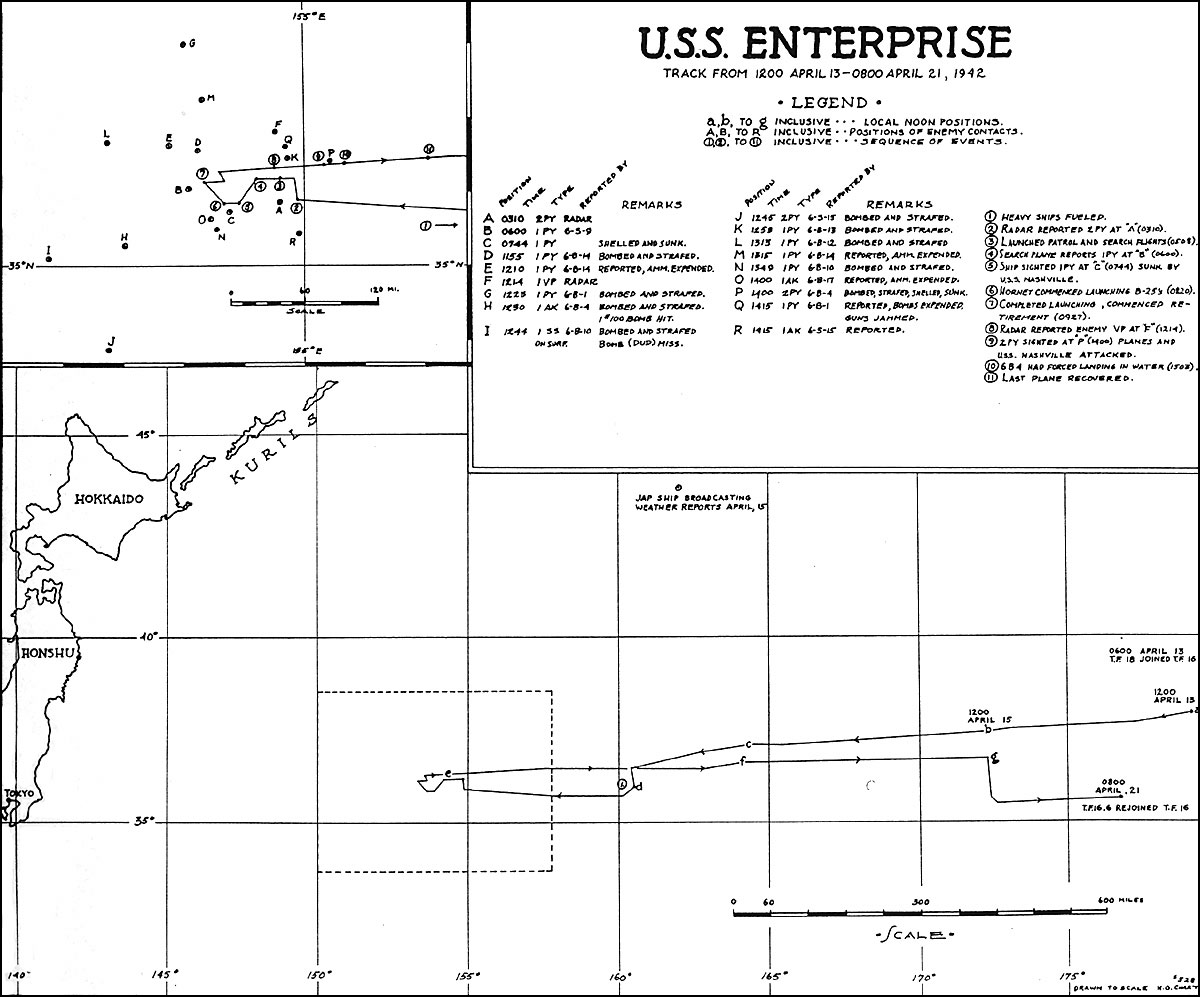
On april 18, the day it was planned to reach the 500 mile circle from Tokyo at about 1600, ENTERPRISE launched the usual dawn search flight and combat patrol. These were maintained continuously throughout the day. The contacts and action, indicated on the track chart by capital letters, were reported by pilots of these flights. Times indicated in connection with contacts and action, April 18, are Zone minus 10.
  • “At 0310 radar disclosed two enemy surface craft bearing 255°T., distance 21,000 yards, and at 0312 a light was seen approximately on that bearing. Ship went to General Quarters, set Material Condition Afirm and energized the degaussing gear. Course of the Force was changed to 350°T., and at 0341 the two enemy vessels went off the screen bearing 201°T., distance 27,000 yards. Our presence was apparently unnoticed by the enemy and a westerly course was resumed at 0415.
  • “At 0508 fighter patrol and search flight were launched. At 0715 one search plane returned and, by message drop, reported sighting an enemy patrol vessel in Latitude 36° 04' North and Longitude 153° 10' East at 0558 and that he believed he had been seen. Later developments indicate that this vessel made the original contact report.
  • “At 0744 an enemy patrol vessel was sighted bearing 221°T., distance approximately 10,000 yards. There was no doubt now that our force had been detected and almost certainly had been reported. NASHVILLE was ordered to sunk the patrol vessel by gunfire as the carriers turned into the wind (320°T., 26 knots); HORNET to launch Army B-25's for attack and ENTERPRISE to relieve patrol.s The first Army bomber was launched at 0820 approximately 650 miles from Tokyo, and the last one was off at 0921. At 0927 the Force commenced retirement on course 090°T., speed 25 knots.
  • “At 1214 radar reported enemy patrol plane bearing 020°T., distance 70,000 yards. This plane came within 64,000 yards of our force but passed off the screen at 1228 bearing 314°T., distance 83,000 yards.
  • “At 1400 two enemy patrol vessels were sighted and attacked by ENTERPRISE planes returning from search. One was sunk and the other damaged. By 1413 the enemy ship still afloat was in sight of our surface forces and NASHVILLE was ordered to attack and sink her. A white flag was broken in the enemy ship and after taking 5 prisoners, NASHVILLE sank her by gunfire. Apparently these two vessels were the same ones reported by radar at 0310.

Our force had been detected and almost certainly been reported...” sounds like speculation. But in a secure communications space in Enterprise, navy Communications Technician Ray Rundle was monitoring Japanese communications. He intercepted a warning message from a nearby patrol boat. Rundle's report caused Halsey to act.

Halsey had half of the US Navy's Pacific Fleet Carrier Force within range of Japanese shore-based bombers. As of mid-April, Yamamoto had 11 aircraft carriers at his disposal compared to Halsey's 4. USS Yorktown was operating in the Coral Sea area, and USS Lexington was in the shipyard at Pearl Harbor having her original 8-inch guns removed and replaced with modern antiaircraft weapons. The fifth Pacific Fleet carrier, USS Saratoga, was in drydock in Bremerton, having her hull repaired from a Japanese torpedo. The other aircraft carriers, the much smaller Ranger and Wasp, were in the Atlantic.

USS Essex was under construction at Newport News, and wouldn't be launched for three more months.

So Halsey had to weigh any risk of losing a carrier very carefully. Here is Halsey's account:

The necessity for launching the Army planes at 0820 on the 18th about 650 miles east of Tokyo was regrettable. The plan was to close to the 500 mile circle and there launch one plane to attack at dusk and this provide a target for the remaining planes which would strike about two hours later. This plan was evolved by Lieutenant Colonel Doolittle, in command of the Army flight, and was designed to inflict the greatest damage with the least risk. The remote location of the desired terminus for the flight was also a factor influencing the selection of this plan of attack. However, contacts with enemy surface vessels early in the morning compromised the secrecy of the operation, and after the third contact, at 0744, the decision was made to launch. Japanese radio traffic was intercepted indicating that the presence of the raiding force was reported. The prime consideration then was the launching of the Army planes before the arrival of Japanese bombers.
“The successful launching of the 16 Army bombers from the HORNET in unfavorable wind and sea conditions reflected great credit on the Army pilots and on the Commanding Officer of the HORNET.”
Here is the track of Task Force 16 to and from the launch point:


http://www.ghspaulding.com/B-25_Taking_off_carrier_frontal_view.jpg


http://upload.wikimedia.org/wikipedia/commons/thumb/d/d5/Doolittle_Raid_Final.pdf/page1-463px-Doolittle_Raid_Final.pdf.jpg

Sixteen planes, each with a five-man crew, took off that day. They reached their targets in the Tokyo area about six hours after launch, flying without an autopilot, using celestial navigation over water and visual navigation over land, then flew seven more hours to the vicinity of landing fields in China. They ran out of fuel before reaching the fields in unoccupied China, were flying after dark, and the fields were not transmitting homing signals. They had to ditch or bail out. All of the planes were lost, including one interned by the Soviet Union. Of the eighty crew members, 77 survived the raid, but Japanese executed three prisoners and one died of malnutrition and mistreatment.

I first learned of the raid by watching the movie, "Thirty Seconds Over Tokyo," starring Spencer Tracy and Van Johnson, at the Will Rogers Theater in Tulsa, Oklahoma in 1945.

It's still a great movie.

The raid took place four months and 11 days after Pearl Harbor.


Tuesday, April 17, 2012

Doolittle Raid April 17, 1942 - 1,000 Miles From Tokyo

On schedule on April 17, TF16 refueled the two aircraft carriers and four cruisers. The Captain of USS Enterprise after action report (April 23):

  1. "Fueling of the heavy vessels was undertaken April 17 when about 1000 miles east of Tokyo and was barely completed when the wind increased to gale force (wind south, 35 knots; sea rough, visibility 1 - 2 miles). At 1439 (L) the 2 CV, 3 CA and 1 CL proceeded independent of accompanying DD's [destroyers] and AO#s [fleet oilers] on a westerly course, averaging approximately 20 knots."


http://www.history.navy.mil/photos/images/g330000/g330659.jpg

Monday, April 16, 2012

Public Piety

Yet again in a nearby county a group of citizens who proclaim themselves to be Christians are protesting to be allowed to pray at government meetings, invoking the name of Jesus.

Perhaps they have not heard, read or understood the words of Jesus himself concerning acts of public piety, as recorded in the synoptic gospels. Here, from the gospel according to Matthew chapter 6, verses 1 to 34:

[New International Version 1984]

Giving to the Needy

1“Be careful not to do your ‘acts of righteousness’ before men, to be seen by them. If you do, you will have no reward from your Father in heaven.
2“So when you give to the needy, do not announce it with trumpets, as the hypocrites do in the synagogues and on the streets, to be honored by men. I tell you the truth, they have received their reward in full. 3But when you give to the needy, do not let your left hand know what your right hand is doing, 4so that your giving may be in secret. Then your Father, who sees what is done in secret, will reward you. 

Prayer

5“And when you pray, do not be like the hypocrites, for they love to pray standing in the synagogues and on the street corners to be seen by men. I tell you the truth, they have received their reward in full. 6But when you pray, go into your room, close the door and pray to your Father, who is unseen. Then your Father, who sees what is done in secret, will reward you. 7And when you pray, do not keep on babbling like pagans, for they think they will be heard because of their many words. 8Do not be like them, for your Father knows what you need before you ask him.
9“This, then, is how you should pray:
“‘Our Father in heaven,
hallowed be your name,
10your kingdom come,
your will be done
on earth as it is in heaven.
11Give us today our daily bread.
12Forgive us our debts,
as we also have forgiven our debtors.
13And lead us not into temptation,
but deliver us from the evil one.a
 
14For if you forgive men when they sin against you, your heavenly Father will also forgive you. 15But if you do not forgive men their sins, your Father will not forgive your sins. 

Fasting

16“When you fast, do not look somber as the hypocrites do, for they disfigure their faces to show men they are fasting. I tell you the truth, they have received their reward in full. 17But when you fast, put oil on your head and wash your face, 18so that it will not be obvious to men that you are fasting, but only to your Father, who is unseen; and your Father, who sees what is done in secret, will reward you. 

Treasures in Heaven

19“Do not store up for yourselves treasures on earth, where moth and rust destroy, and where thieves break in and steal. 20But store up for yourselves treasures in heaven, where moth and rust do not destroy, and where thieves do not break in and steal. 21For where your treasure is, there your heart will be also.
22“The eye is the lamp of the body. If your eyes are good, your whole body will be full of light. 23But if your eyes are bad, your whole body will be full of darkness. If then the light within you is darkness, how great is that darkness!
24“No one can serve two masters. Either he will hate the one and love the other, or he will be devoted to the one and despise the other. You cannot serve both God and Money. 

Do Not Worry

25“Therefore I tell you, do not worry about your life, what you will eat or drink; or about your body, what you will wear. Is not life more important than food, and the body more important than clothes? 26Look at the birds of the air; they do not sow or reap or store away in barns, and yet your heavenly Father feeds them. Are you not much more valuable than they? 27Who of you by worrying can add a single hour to his lifeb?
28“And why do you worry about clothes? See how the lilies of the field grow. They do not labor or spin. 29Yet I tell you that not even Solomon in all his splendor was dressed like one of these. 30If that is how God clothes the grass of the field, which is here today and tomorrow is thrown into the fire, will he not much more clothe you, O you of little faith? 31So do not worry, saying, ‘What shall we eat?’ or ‘What shall we drink?’ or ‘What shall we wear?’ 32For the pagans run after all these things, and your heavenly Father knows that you need them. 33But seek first his kingdom and his righteousness, and all these things will be given to you as well. 34Therefore do not worry about tomorrow, for tomorrow will worry about itself. Each day has enough trouble of its own.

April 16, 1942 - Task Force 16 At Sea

Task Force 16, USS Enterprise (CV-6), USS Hornet (CV-8), four cruisers, eight destroyers and the fleet oilers Sabine and Cimarron: west of the international dateline. Course 265, speed 16 knots, Tokyo bound.

"Except when bad weather prevented, continuous inner and intermediate air patrols were maintained during daylight and dawn and dusk search flights were conducted daily to 200 miles, 60° on each bow." - VADM W.F. Halsey action report dated 23 April, 1942.

A speed of 16 knots left little extra for the oilers, whose maximum speed was 18 knots. (Personal note - both oilers were still in service in the late 1960's; I refueled from Cimarron many times).

The plan was to refuel the carriers and cruisers on April 17 and detach them for a quick dash to arrive at the launch point at about 1600 (4:00 pm).

The carriers search radars and the aircraft searches weren't the only detection measures. In a hideaway aboard USS Enterprise, Communications Technicians with special radio receivers searched for Japanese radio communications.

European Economy Update

I haven't written lately about Europe. The news isn't good. While the European Central Bank has recently taken useful measures to ease the crisis, the political leadership is doing the opposite - seeking more austerity.

Are there no wise leaders in Europe? Apparently not.

If debt is the problem, it doesn't help people repay that debt when unemployment rises. In Spain, unemployment is close to 25% - for young people, it is 50%. By the way, before the economic crisis, Spain's budget surplus was greater than Germany's. The problem has been private, not public debt.

The whole problem in Europe, it has become clear, is caused by fixed exchange rate (inherent consequence of the Euro) and intellectual rigidity. The continent could easily descend into a new recession/depression. Economist Nouriel Roubini explains:

"The trouble is that the eurozone has an austerity strategy but no growth strategy. And, without that, all it has is a recession strategy that makes austerity and reform self-defeating, because, if output continues to contract, deficit and debt ratios will continue to rise to unsustainable levels. Moreover, the social and political backlash eventually will become overwhelming."

The US could easily avoid a similar fate by a robust fiscal stimulus, except one of our major political parties has effectively halted any effort by the administration to improve the economy. The only thing we have going for us is the Fed and its monetary measures, including quantitative easing. So far it seems to be working, but much too slowly.

Sunday, April 15, 2012

Greg Mankiw Endorses Democratic Policies (Maybe)

Economist Brad DeLong provides the following quote from economist Greg Mankiw:

Greg Mankiw: Economic View: If the government’s job is merely to provide services, like roads, schools and courts, competition among governmental producers may be… good…. But if government’s job is also to remedy many of life’s inequities, you may want a stronger centralized government, unchecked by competition. These are two fundamentally different visions. The next election, and to some degree every election, is about which one voters find more compelling.

A long discussion ensues on DeLong's blog. One of the most pointed comments:

Derelict said...
It's pretty clear that conservatives view government's essential role as collecting taxes from the middle and lower classes and funneling those proceeds into the pockets of the wealthy. As the record of the last 30-odd years amply demonstrates, providing for the commonweal in terms of infrastructure, social services, or even actual functioning military hardware and support is NOT part of the equation.

When Reagan said "government IS the problem," most of the people in today's GOP were impressionable youngsters who took that quite literally. Today, their motivating philosophy is to destroy the government of the United States. We used to call people like that the enemy; today, they're just Republicans.

Tornado In Woodward: Deja Vu All Over Again

Tonight's news broadcast showed scenes from last night's deadly tornado in Woodward, Oklahoma. No one has seen such destruction, the announcer explained.

Actually, I remember an even bigger tornado that hit Woodward. It was the 9th of April, 1947, just before my tenth birthday. We lived in Midwest City, Oklahoma, just across the highway from Tinker Air Force Base. The next day, the Daily Oklahoman was filled with photographs of the damage. At least 107 lives were lost in Woodward that night, and it looked like the town had been wiped off the map.

The 1947 tornado, rated as F5, killed 69 people in Texas before entering Oklahoma. It was almost two miles wide and stayed on the ground for a distance of 100 miles. It remains the most deadly tornado ever to strike Oklahoma.

Woodward came back after the 1947 twister, and it will do so again.

And in time a new generation will forget it ever happened.

Saturday, April 14, 2012

Titanic: Plus ça Change, Plus C'est La Même Chose

A century ago tonight, Royal Mail Ship Titanic struck an iceberg four days into her maiden crossing at 11:40 in the evening. She sank two and a half hours later, taking 1500 souls, including some of the world's wealthiest men, with her.

"Unsinkable ship sinks," the headlines declared.

To be fair, neither the engineers who designed her nor the builders who built her claimed that Titanic was unsinkable. That claim was the work of marketers and writers of advertising copy, who were no more dedicated to truth a century ago than they are today.

But the engineers were guilty of overoptimism about the number of lifeboats needed and the likelihood of rescue in event of a collision or sinking. The captain was guilty of proceeding at too high a speed even after small icebergs had been sighted.

Building a ship,operating it at sea and planning a voyage are always efforts at identifying and counteracting hazards of navigation. Such hazards are more easily identified after a disaster than before.

Planning ahead is an art. In my day, the navy had a word for the process of thinking through what to do in advance of the event: "forehandedness."  It's one of my favorite words.

In our own time, we have seen the loss of Challenger, Columbia, the French Concorde, and countless airliners. All were thought to be safe until the unthinkable happened. The Greeks had a word for the phenomenon of human overreach: hubris.

It is still with us.

Friday, April 13, 2012

Oriental Boat Show

Looks like a good weekend for the Oriental Boat Show. In addition to local boaters, the harbor has also filled up with cruising sailors headed north in the annual migration.

We even have a few shrimp boats in the harbor. Soon we should be back to normal.