Sunday, May 27, 2012

Personal Note: USS Iowa BB-61


Yesterday USS Iowa (BB-61), the first ship I ever went to sea on (summer training cruise of 1955), left San Francisco Bay on her way to her new home in Southern California. She is to be transformed into an interactive naval museum at San Pedro, Port of Los Angeles.

This weekend also was the 75th anniversary of completion of the Golden Gate bridge. The bridge and I are the same age.


USS Iowa (BB-61) Midshipman training Cruise 1955

70 Years Ago: May 27, 1942 - Japanese Carriers Underway

Admiral Nagumo’s carrier force (Akagi, Kaga, Hiryu and Soryu) got underway to provide carrier air support for the planned invasion of Midway. Escorting the force were two battleships, three cruisers and many destroyers. Including the invasion force, the Japanese fleet numbered about ninety vessels. Japanese planners were certain that the US only had two carriers available, and expected them to be in Pearl Harbor, unable to reach Midway in time.

The Japanese Navy was unaware that US Navy cryptographers had broken the fleet's operational code, known to US analysts as JN-25.

Military Experience And Politics

The Washington Post printed an interesting opinion piece a couple of days ago by retired army colonel John Nagl, "Does Military Service Still Matter For The Presidency?"

"In every presidential election since 1992," Nagle observes, "the candidate with the less distinguished military résumé has triumphed" (I would add 1972 and 1980 as well). Nagl sees this as a dramatic change, pointing out that "The crucible of combat not only created these United States but has also given us many of our most successful presidents." He lists some of those presidents with their military service.

Nagle might have pointed out, but did not, that twelve of the twenty-three presidents who served in the nineteenth century had previously served as army generals. But an even more interesting factoid is that none of the presidents who led the nation during five of our major wars had any significant military service:

1. James Madison (War of 1812);
2. James Knox Polk (War with Mexico);
3. Abraham Lincoln (Civil War - not declared);
4. Woodrow Wilson (World War I);
5. Franklin Delano Roosevelt (World War II)

Only President McKinley (Spanish American War) had significant military service. He had been a major during the Civil War.

On the face of it, then, lack of military service does not seem to have prevented past presidents from being effective leaders during our greatest wars. I am more disturbed by the fact that in today's America, only one percent of adults have served in the military. I mentioned a while ago my discomfort that service to the nation in a cause greater than one's own prosperity has become rare, rather than commonplace.

Last month, Thomas Ricks suggested in the Washington Post a concrete measure to address this problem: toss out the all-volunteer military. Reluctantly, my own thinking has been evolving in that direction.

Ricks explains: "Resuming conscription is the best way to reconnect the people with the armed services. Yes, reestablishing a draft, with all its Vietnam-era connotations, would cause problems for the military, but those could never be as painful and expensive as fighting an unnecessary war in Iraq for almost nine years. A draft would be good for our nation and ultimately for our military."

I think this is a conversation worth having.

Saturday, May 26, 2012

70 Years Ago: COMINT

When Japan attacked Pearl Harbor, they achieved surprise by effective use of several techniques:
1. Failure to declare war in advance of the attack;
2. Radio silence during transit;
3. Use of couriers for planning instead of radio;
4. Deceptive radio transmissions (spoofing);
5. Cryptosecurity measures, including changing codes just before the operation.

Items 2 - 5 fall in the category of communications security.

Japan had been a target of US Navy Signals Intelligence (SIGINT) since WWI. A small cadre of specialists intercepted Japanese high frequency (HF) radio communications  transmitted in a specialized Japanese Morse code for Japanese Kana characters. By 1941, the US Navy had about twenty intercept stations sharing their take with OP-20-G at the headquarters on Nebraska Avenue in Washington, DC. OP-20-G directed the effort to exploit these signals, (since the intercepted signals were mostly radio communications, the specialty was known as communications intelligence, or COMINT). The intercepted signals were analyzed by traffic analysts, who reviewed the patterns of communication and extracted an electronic order of battle or EOB.

Other experts reviewed the intercepts to determine how they had been coded and encrypted, and to identify any vulnerabilities that might allow the messages to be decrypted, or "broken." The first step was to determine if the message was a code or a cipher. Ciphers could be attacked using mathematical techniques. Codes were a bit more complicated.

To break either a code or a cipher required vast quantities of message traffic for analysis. Unfortunately for COMINT purposes, the Japanese Navy had used telephone, telegraph or courier for communications in their home waters. As a result, by December, 1941, US Navy cryptanalysts were only able to break about 10% of Japan's operating code known as JN-25.

After Pearl Harbor, though, as Japan's military invaded the Philippines, Borneo, Hong Kong, Singapore, the Dutch East Indies and elsewhere, they were forced to transmit vast quantities of radio traffic. By March 7, US Navy COMINT was able to break enough traffic for Admiral Nimitz to send the carriers Lexington and Yorktown to attack Japanese forces invading Salamaua and Lae on the north coast of New Guinea.

By early May, Nimitz was able to position Lexington and Yorktown in the Coral Sea and provide them with excellent information about Japanese forces and plans to invade Port Moresby on the south coast of New Guinea. This effectively halted Japanese advances in the Southwest Pacific.

By late May, 1942, COMINT provided Nimitz and the US Carrier task forces with complete information about Japanese plans to attack and invade Midway.

On May 26, 1942, Halsey's TF-16 with carriers Enterprise and Hornet steamed into Pearl Harbor, having missed the action in the Coral Sea by a day. After refueling and reprovisioning, Nimitz will send them back to sea under command of Raymond Spruance to take position to oppose Admiral Nagumo's four carriers approaching Midway.

The following day, USS Yorktown, heavily damaged at the battle of Coral Sea, limped into Pearl Harbor and went immediately into drydock. It was estimated that repairs would take three months. Yorktown was given three days.

Nimitz needed all three carriers, plus the additional Army, Navy and Marine Corps aircraft he had already sent to Midway as reinforcements.

He knew from COMINT what he was up against.

The attack on Midway was scheduled for June 4, 1942.

Friday, May 25, 2012

Explosive Growth In Spending? - Not

Rex Nutting, writing for Wall Street Journal's market watch, has this to say about growth in federal spending: "WASHINGTON (MarketWatch) — Of all the falsehoods told about President Barack Obama, the biggest whopper is the one about his reckless spending spree....Almost everyone believes that Obama has presided over a massive increase in federal spending, an “inferno” of spending that threatens our jobs, our businesses and our children’s future. Even Democrats seem to think it’s true.

"But it didn’t happen. Although there was a big stimulus bill under Obama, federal spending is rising at the slowest pace since Dwight Eisenhower brought the Korean War to an end in the 1950s."

Thursday, May 24, 2012

Remember

As we draw close to Memorial Day, I thought I would offer a link to one of my posts from a year ago. Here. It occurred to me that our recollection of time can become distorted by other experiences.

In particular, we may think it is OK for a war in a distant land to last for a decade or more. Didn't World War II go on and on? Actually, it only lasted 3 years and eight months. It just seems like it lasted forever because we still see World War II movies.

Conflict Between Military Professionals and Conservative Republicans?

In case you missed it, there's a good report in today's PostPartisan (Washington Post on line) calling attention to a number of issues where Republican positions cause problems for the military. Here is a link to the Post article. The article itself has a link to to an article by Heather Hurlburt in Democracy Arsenal. Hurlburt lists five issue: 1. Law of the Sea (I worked on this treaty thirty years ago - the Navy has always supported it); 2. Alternative energy; 3. Who jails terror suspects (professional military officers don't want to be jailers); 4. Iran (not a war the military wants); 5. Pentagon Budget (GOP wants some weapons the pentagon doesn't want).

I can think of other issues - GOP cares nothing for the troops, but a lot for contractors, for example.

As Memorial Day approaches, we should focus on the troops.

PTSD Film

Good article today in the Washington Post about a restored John Huston documentary about "shell shock" and its treatment in World War II.

We now call it PTSD and no longer consider it a psychoneurotic condition. In former times, senior officers (e.g. Patton) considered it "malingering" or worse. During World War I, British officers had more than three hundred soldiers shot for what may have been PTSD. Here is an account (possibly slanted) of how it came about that 306 British and Commonwealth soldiers were shot during that conflict.

PTSD and its effect on the lives of those suffering from it is certainly one of the cruelest consequences of war.

Wednesday, May 23, 2012

On Being Ready For War

A year and a half after we invaded Iraq, Secretary of Defense Rumsfeld was asked by a soldier why troops have to poke through dumpsters to find parts for their equipment. "We go to war with the army we have, not the army we wish we had," Rumsfeld replied. 

Six months after the Japanese attacked Pearl Harbor, the US Navy with a force of seven aircraft carriers against a Japanese fleet of ten carriers, had halted the Japanese advance toward Australia, bombed Tokyo,  attacked the Gilberts, the Marshalls, Marcus Island, Tulagi, Lae and Salamaua and sunk five Japanese carriers. In doing this, the Army and Navy used the forces they started with. The US lost one carrier at Coral Sea and another at Midway. 

A year later, the US Navy had added seven new carriers to the force (though they lost two carriers in the Solomons), replaced the obsolescent Douglas Devastator torpedo planes with the much more powerful TBF Avenger, fixed the troubling problems with the Mark 14 torpedo, replaced the Grumman Wildcat with the Grumman Hellcat, kicked Japan off of Guadalcanal and sank another Japanese carrier.  

In the meantime, the navy had developed a proximity fused projectile for its 5"/38 caliber guns, shooting down the first Japanese aircraft in January 1943. For the rest of the war, we continued making improvements in equipment, training and organization. 

Did we have deficiencies at the beginning of the war? You bet!  

But our forces were ready to do what needed to be done. 

It took them three years and eight months to win that war. 

Some say the United States wasn't ready for war in 1941. 

Balderdash! 

Tuesday, May 22, 2012

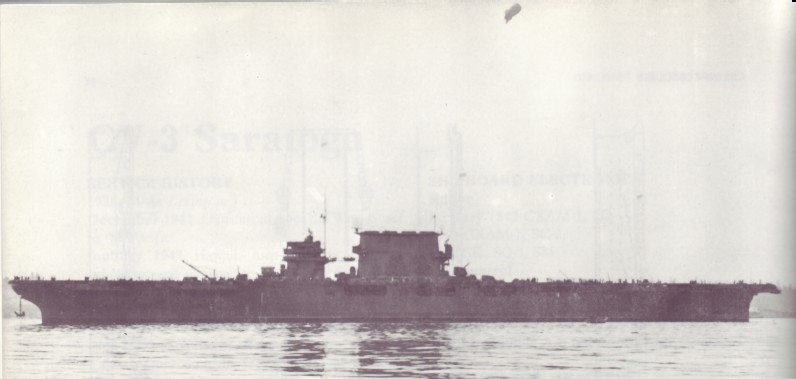
70 Years Ago Today: USS Saratoga (CV-3)

May 22, 1942: USS Saratoga leaves Bremerton Naval Shipyard in Puget Sound enroute to San Diego. Saratoga had undergone repairs for damage January 11, 1942 about 500 miles south of Oahu from a torpedo fired by Japanese submarine I-6. She underwent temporary repairs at Pearl Harbor, then proceeded to Puget Sound for repairs.

Her silhouette has been changed by removal of four twin 8" turrets, replacing them with twin 5"/38 mounts. She finally received the wider forward flight deck and the lengthened after flight deck first envisaged as early as 1936 and earlier provided to uss Lexington. A British-style open bridge was built atop the flag plot. The tripod foremast was replaced by pole mast. The distinctive tall stack was also lowered and she received a pair of Mk-37 5" directors (for the 5"/38 guns), with Mk-4 radars, and a secondary air search radar (SC) at the after end of the stack.

These modifications, as well as anti-torpedo blisters below the water line, greatly improved Saratoga's readiness for combat in the Pacific. 

http://www.navsource.org/archives/02/020343.jpg

Monday, May 21, 2012

A Commencement Address

Robert Reich, President Clinton's secretary of labor and currently a professor at Berkeley, has posted a commencement address. He titled it "the commencement address that won't be given." After you read it, you'll know why. [The following is censored. Be sure to read the original.]

He uses blunt language to describe the hurdles facing this years' college graduates:
1. Jobs - "you’re going to have a hell of a hard time finding a job. The job market you’re heading into is still bad. Fewer than half of the graduates from last year’s class have as yet found full-time jobs. Most are still looking"
2. Salary - "But even when you get a job, it’s likely to pay peanuts.
Last year’s young college graduates lucky enough to land jobs had an average hourly wage of only $16.81, according to a new study by the Economic Policy Institute. That’s about $35,000 a year – lower than the yearly earnings of young college graduates in 2007"
3. Career prospects - "But this parchment isn’t as valuable as it once was. So much of what was once considered “knowledge work” – the kind that college graduates specialize in – can now be done more cheaply by software. Or by workers with college degrees in India or East Asia, linked up by Internet."
4. Debt - "In a few moments, when you march out of here, those of you who have taken out college loans will owe more than $25,000 on average. Last year, ten percent of college grads with loans owed more than $54,000."
5. Future - "If unemployment stays high for many years, if the wages of young college grads continue to fall, if the costs of college continue to rise and state and local spending per college student continues to drop, and if the college debt burden therefore continues to explode – well, you do the math."

He offers some thoughts we should all consider: "You see, a college education isn’t just a private investment. It’s also a public good. This nation can’t be competitive globally, nor can we have a vibrant and responsible democracy, without a large number of well-educated people."

Reich is absolutely right, and that is the main reason it isn't good for my blood pressure when I hear the clever fools running legislatures in many states (including our own) talk as though it is only the students who are "customers" of education.

Balderdash!

To quote a former presidential candidate: "If you think education is expensive,try the cost of ignorance!"

On Labor And Capital

"Labour is prior to, and independent of capital. Capital is only the fruit of labour, and could never have existed if labour had not first existed. Labour is the superior of capital, and deserves much the higher consideration."

Abraham Lincoln

Seventy Years Ago: May 21, San Francisco

Here's an extract from the May 21 1942 edition of the San Francisco Chronicle:

"The San Francisco Chronicle:

"Last Japanese Leave San Francisco - 1942: For the first time in 81 years, not a single Japanese is walking the streets of San Francisco. The last group, 274 of them, were moved yesterday to the Tanforan assembly center. Only a scant half dozen are left, all seriously ill in San Francisco hospitals.

"Last night Japanese town was empty. Its stores were vacant, its windows plastered with "To Lease" signs. There were no guests in its hotels, no diners nibbling on sukiyaki or tempura. And last night, too, there were no Japanese with their ever present cameras and sketch books, no Japanese with their newly acquired furtive, frightened looks."

There was not a hint in the article that many of those being rounded up and transferred to concentration camps were American citizens. There was no mention of the fact that we were also at war with Germany and Italy. No mention of the fact that baseball star Joe Dimaggio's father had been a vocal supporter of Mussolini. There was no mention of any relocation of Italian Americans or German Americans.

This was a disgraceful episode in our history.

Can anyone tell me with a straight face that this was not racism at work?

Another Trail of Tears.

Second Primary

Last Tuesday was the official canvass of the North Carolina 2012 primary election. Candidates eligible to request a second primary election when the leading candidate received less than 40% of the vote, or candidates eligible to request a recount, had to submit their requests by lat Friday.

The second primary is scheduled for July 17. Here are the contests for which there will be a second primary or a recount:

Pursuant to GS 163-111 the following candidates have requested a 2nd Primary to be held on July 17, 2012: (Deadline for 2nd Primary requests is 05/17/2012 at 12 noon.)
Candidate Name - Office (date request received)

Scott Keadle - US HOUSE OF REPRESENTATIVES DISTRICT 8 - REP (05/10/2012)
Jim Pendergraph - US HOUSE OF REPRESENTATIVES DISTRICT 9 - REP (05/14/2012)
Vance Patterson - US HOUSE OF REPRESENTATIVES DISTRICT 11 - REP (05/11/2012)
Tony Gurley - NC LIEUTENANT GOVERNOR - REP (05/11/2012)*
Mike Causey - NC COMMISSIONER OF INSURANCE - REP (05/15/2012)*
Marlowe Foster - NC COMMISSIONER OF LABOR - DEM (05/14/2012)*
Kenn Gardner - NC SECRETARY OF STATE - REP (05/14/2012)*
Richard Alexander - NC SUPERINTENDENT OF PUBLIC INSTRUCTION - REP (05/10/2012)*
Ronald Rabin - NC STATE SENATE DISTRICT 12 - REP (05/14/2012)
Robert B. Clark III - NC STATE SENATE DISTRICT 21 - DEM (05/09/2012)
David Curtis - NC STATE SENATE DISTRICT 44 - REP (05/14/2012)
Arthur Williams - NC HOUSE OF REPRESENTATIVES DISTRICT 6 - REP (05/14/2012)
Jim Crawford - NC HOUSE OF REPRESENTATIVES DISTRICT 32 - DEM (05/17/2012)
Wil Neumann - NC HOUSE OF REPRESENTATIVES DISTRICT 109 - REP (05/10/2012)

Pursuant to GS 163-182.7 the following candidates have requested a recount:
Larry Shaw - NC STATE SENATE DISTRICT 21 - DEM (05/16/2012)
Stephen LaRoque - NC HOUSE OF REPRESENTATIVES DISTRICT 10 - REP (05/16/2012)
Richard Johnson - NC HOUSE OF REPRESENTATIVES DISTRICT 55 - REP (05/09/2012)
Danny E. Davis - NC HOUSE OF REPRESENTATIVES DISTRICT 119 - DEM (05/16/2012)


* Contests in second primary in Pamlico County: (1 Dem and 4 Rep)

Americans Elect: Crash On Takeoff

Last April 13, in the latest attempt to form a third political party, Americans Elect filed the requisite number of petition signatures to be listed as an official political party in North Carolina. On May 15, the party admitted that its on-line convention had failed to generate enough support under their own rules for any candidate to be nominated.

The party had been supported by high profile backers with deep pockets and had attained ballot access in more than half of the nation's fifty states. The effort to nominate a slate lasted just a bit longer than the Wright Brothers' first flight.

I have some advice for third party enthusiasts: forget about presidential elections. Start at the grass roots in one or more states that might be receptive. Go for the state legislature. The goal might be to elect enough legislators that your third party would be invited into a legislative coalition.

If you want to put an end to partisan politics, here is a Washington Post article on what won't work - and what might [but I wouldn't hold my breath].

Sunday, May 20, 2012

Jobs

"When a great many people are unable to find work, unemployment results."

- Calvin Coolidge

In some respects, Calvin Coolidge was more progressive than many Tea Party Republicans and their economist lackeys. These folks latterly have attributed unemployment not to the inability of workers to find jobs, but to their interest in taking a vacation. And Republicans in the Congress and in state legislatures have done their best to make it even harder for people who work for a living to find jobs.

Saturday, May 19, 2012

South Avenue Public Comments

There has been some reaction from citizens of the town about the town board's action to approve the proposed contract for a land swap. Today's Town Dock has three letters from citizens.

A lot of questions have been raised, not only by the general public, but also by members of the Parks and Rec committee.

I learned last week that the contract was finalized by attorney Scott Davis representing the town and attorney Steve Weeks representing Chris Fulcher. Steve Weeks is a competent attorney who aggressively protects his clients' interests. He is the attorney who saved the town's bacon when Scott Davis lost the suit against Mr. Lacy Henry over South Avenue at summary judgment - before ever getting to trial.

The best advice Scott Davis ever gave the town, back in 2002 when the town asked him to represent us in the suit against Lacy Henry over South Avenue, was to retain a litigator. He was right.

But Scott Davis not only isn't a litigator, he has not proven much of a negotiator and has not always provided the town with competent legal representation.

However the present negotiation is resolved, I think it is past time for the Town to retain a different lawyer or firm as town attorney.

Friday, May 18, 2012

Political Conventions

Since I am a member of the Pamlico County Board of Elections, I am prohibited from publicly advocating or opposing the election of any candidate or ballot measure appearing on the ballot. But I am specifically allowed to be a delegate to party conventions.

This coming weekend, I will serve as a delegate to my party's district convention. Later, there will be a state convention, and finally the week of September 3, the Democratic Party will hold its national convention at Charlotte.

People sometimes ask what my party stands for. I know no better source than the speech delivered by William Jennings Bryan 116 years ago at the Democratic Party Convention of 1896. The issues haven't changed, though details may differ. Here are some excerpts:

"When you come before us and tell us that we shall disturb your business interests, we reply that you have disturbed our business interests by your action. We say to you that you have made too limited in its application the definition of a businessman. The man who is employed for wages is as much a businessman as his employer. The attorney in a country town is as much a businessman as the corporation counsel in a great metropolis. The merchant at the crossroads store is as much a businessman as the merchant of New York. The farmer who goes forth in the morning and toils all day, begins in the spring and toils all summer, and by the application of brain and muscle to the natural resources of this country creates wealth, is as much a businessman as the man who goes upon the Board of Trade and bets upon the price of grain. The miners who go 1,000 feet into the earth or climb 2,000 feet upon the cliffs and bring forth from their hiding places the precious metals to be poured in the channels of trade are as much businessmen as the few financial magnates who in a backroom corner the money of the world.We come to speak for this broader class of businessmen....

"What we need is an Andrew Jackson to stand as Jackson stood, against the encroachments of aggregated wealth....

"Those who are opposed to this proposition tell us that the issue of paper money is a function of the bank and that the government ought to go out of the banking business. I stand with Jefferson rather than with them, and tell them, as he did, that the issue of money is a function of the government and that the banks should go out of the governing business....

"My friends, it is simply a question that we shall decide upon which side shall the Democratic Party fight. Upon the side of the idle holders of idle capital, or upon the side of the struggling masses? That is the question that the party must answer first; and then it must be answered by each individual hereafter. The sympathies of the Democratic Party, as described by the platform, are on the side of the struggling masses, who have ever been the foundation of the Democratic Party....

"There are two ideas of government. There are those who believe that if you just legislate to make the well-to-do prosperous, that their prosperity will leak through on those below. The Democratic idea has been that if you legislate to make the masses prosperous their prosperity will find its way up and through every class that rests upon it.

"If they dare to come out in the open field and defend the gold standard as a good thing, we shall fight them to the uttermost, having behind us the producing masses of the nation and the world. Having behind us the commercial interests and the laboring interests and all the toiling masses, we shall answer their demands for a gold standard by saying to them, you shall not press down upon the brow of labor this crown of thorns. You shall not crucify mankind upon a cross of gold."

OK, the rhetoric is a bit over the top by modern standards, but the underlying struggle is pretty much the same:

Trickle-down economics or rising tide economics?

YOYO's or WITTS?

Thursday, May 17, 2012

South Avenue Contract

We attended this morning's special meeting of the town board concerning the proposed contract to close certain town rights of way (Avenue A and part of South Avenue plus other historic bits and pieces) in return for Chris Fulcher donating a portion of his waterfront property.

This meeting was the first significant opportunity for many members of the public to express their views. I think it's fair to say that most attendees were opposed to the contract in its present form. Those who spoke during the public comment period asked a number of questions about the legality and the advisability of the proposal. Several speakers (I was one) expressed doubt that the town had received competent legal representation.

Several speakers questioned whether the town had a complete picture of what it can build on the site in view of DENR and CAMA regulations. Some questioned whether touted advantages of the deal (an almost-completed pier and two historic structures) were going to be an asset or a liability. There was widespread disbelief that the parcel the town would receive is wide enough. Various speakers wondered whether Mr. Fulcher might block navigation by private boats.

Some speakers had researched restrictions on the existing town right of way for South Avenue and asserted that there are ways to obtain legislative approval to build some of the desired structures.

Several speakers objected to the assertions that "these rights of way are of no value" that supporters of the proposal have made. I offered the view that, "in coastal North Carolina, nothing is more valuable to the public than public access to the water."

After public comments were heard, the board deliberated and by a vote of 4-1 approved proceeding with the contract. (Warren Johnson voted "no").

At an afternoon continuation of the meeting, the board voted 4-0 to hold public hearings on street closures at the regular meeting of July 3.

White Births In Minority

In the twelve-month period ending last July, according to the US Census Bureau, there were fewer white babies born in America than those of non white minorities.

Demographers had long expected this to occur, but weren't certain when.

I looked outside this morning. The sky has not yet fallen.

Wednesday, May 16, 2012

On Line Education

Occasionally Tom Friedman of the New York Times offers an interesting tidbit in his column. Today's tidbit is a reference to a very interesting new company offering high quality on-line education courses. The name of the company is Coursera.

It is worthwhile checking out Coursera's web site and at least looking at the syllabus of some of the course offerings. I saw several tempting courses. One course of particular interest to a wide range of people might be "Health Policy And The Affordable Care Act."

Check out Coursera's site.

In Extremis: Greece and Germany

In the ancient past (when I was learning the nautical rules of the road) we were taught that certain ships had the "right of way" when there was risk of collision while other ships were "burdened."

That terminology is no longer used, but the principal is much the same.

How do you know if there is risk of collision? If the other ship is CBDR - that is, on a constant bearing and decreasing range.

It was the duty of the ship having the right of way to maintain course and speed. It was the duty of the burdened vessel to maneuver to avoid collision.

What if both ships insist that they have the right of way and maintain course and speed? At some point, after sounding warning blasts on the ship's whistle, the ships become so close to each other that the only way to avoid collision is for both ships to act.

That situation was known as being "in extremis."

Greece and the European Central Bank have been on a collision course and now are in extremis. At least if the object is to keep Greece in the Eurozone, both vessels must put the helm over and take up a new course.

But no one is at the helm in Greece nor will anyone take the helm for at least a month. Nor is it apparent who is at the helm of the ECB, but it still looks like Germany has the conn.

Europe may be in for a humongous collision.

It's at least time to check out the life vests and life boats.

Nuclear Weapons Rethink?

Later today, Global Zero, a nuclear weapons organization, will issue a report calling for another significant reduction in our nuclear deterrence. Gen. James E. Cartwright, USMC, the retired vice chairman of the Joint Chiefs of Staff and a former commander of the United States’ nuclear forces, has joined with others  calling for reduction in the number of nuclear warheads below the levels set by agreements with Russia.

Five years ago, we learned of the shocking error in our own nuclear force when six nuclear-armed missiles were inadvertently flown from Minot SD to Barksdale AFB Louisiana on a B-52 whose crew thought they were transporting dummy warheads. As I recall, the aircraft and warheads were parked in the open, unguarded, for two days before the error was found.

This incident showed a worrisome degradation in the system of administrative controls in place for nuclear weapons. If you think administrative controls are just boring minutia, you might want to watch the movie "Doctor Strangelove" again.

But the Global Zero report addresses only our strategic weapons. We still have thousands of "tactical" nuclear weapons not only in Europe but also on ships and bases around the world. The smallest of these have nuclear yields on the same order as that of the bomb we dropped on Hiroshima in August, 1945.

Tactical nuclear weapons are not covered by any international arms control agreement. Poland and Norway have asked that NATO consider extending arms control to cover tactical nuclear weapons.

Not a bad idea.

Do we know where our nuclear weapons are?

Time To Undo The Euro?

My wife and I were living in Europe a decade ago when the Euro was introduced. Travel within the Eurozone was much more convenient with a single currency instead of having to convert after crossing every border. But I wondered how the inevitable differences in rates of economic growth would be accommodated.

The answer is now clear: not.

From the outset, some economists warned that the system wouldn't work. Here is an account of how Europe's political leaders ignored the warnings and chose to listen to economists who were more optimistic about the Euro.

The fall of the Euro still seems likely to begin in Greece. Greece's May 6 elections resolved nothing. It has proven impossible to form a government, so new elections will be held next month in hopes a government can be formed this time.

Will Greece default on its debts? It seems likely. Will Greece then leave the Euro zone and return to the drachma? It's really hard to see another realistic possibility.

Will such an event force the European Central Bank and, especially Germany, to rethink its policies of austerity?

Stay tuned.

Tuesday, May 15, 2012

US Health Care Costs - An Analysis

Why does the US spend more on health care costs than other advanced countries? Another fair question might be, why are our health care outcomes generally worse?

The first question is not of trivial significance. Our health care costs range from 50% to 100% more expensive than other countries offering comparable technological quality of medicine. This is important to current debates on budget priorities, because most of the projected increase in federal budget expenditures over the next few decades results from projected increases in health care costs.

Economist Timothy Taylor has taken a close look at several studies of health care costs here. His conclusion:

"The question of why the U.S. spends more than 50% more per person on health care than the next highest countries (Switzerland and Netherlands), and more than double per person what many other countries spend, may never have a simple answer. Still, the main ingredients of an answer are becoming more clear. The U.S. spends vastly more on hospitalization and acute care, with a substantial share of that going to high-tech procedures like surgery and imaging. The U.S. does a poor job of managing chronic conditions, which then lead to episodes of costly hospitalization. The U.S. also seems to spend vastly more on administration and paperwork, with much of that related to credentialing, documenting, and billing--which is again a particular important issue in hospitals. Any honest effort to come to grips with high and rising U.S. health care costs will have to tackle these factors head-on."

Monday, May 14, 2012

Economics Update - The Austerions

Tom Tomorrow cartoon about austerity

South Avenue Procedure

I understand from Town Dock.net that the Town of Oriental may hold a meeting Thursday, May 17 to hear public comments on the proposed contract with Chris Fulcher.

There are some chicken and egg issues involved here.

Before the town can complete the contract by closing streets, it must hold public hearings. Those hearings require public notice at least four weeks in advance. Here are the relevant provisions from North Carolina General Statutes:

§ 160A‑299.  Procedure for permanently closing streets and alleys.
(a)        When a city proposes to permanently close any street or public alley, the council shall first adopt a resolution declaring its intent to close the street or alley and calling a public hearing on the question.  The resolution shall be published once a week for four successive weeks prior to the hearing, a copy thereof shall be sent by registered or certified mail to all owners of property adjoining the street or alley as shown on the county tax records, and a notice of the closing and public hearing shall be prominently posted in at least two places along the street or alley.  If the street or alley is under the authority and control of the Department of Transportation, a copy of the resolution shall be mailed to the Department of Transportation. At the hearing, any person may be heard on the question of whether or not the closing would be detrimental to the public interest, or the property rights of any individualIf it appears to the satisfaction of the council after the hearing that closing the street or alley is not contrary to the public interest, and that no individual owning property in the vicinity of the street or alley or in the subdivision in which it is located would thereby be deprived of reasonable means of ingress and egress to his property, the council may adopt an order closing the street or alley.  A certified copy of the order (or judgment of the court) shall be filed in the office of the register of deeds of the county in which the street, or any portion thereof, is located.
(b)        Any person aggrieved by the closing of any street or alley including the Department of Transportation if the street or alley is under its authority and control, may appeal the council's order to the General Court of Justice within 30 days after its adoption.  In appeals of streets closed under this section, all facts and issues shall be heard and decided by a judge sitting without a jury.  In addition to determining whether procedural requirements were complied with, the court shall determine whether, on the record as presented to the city council, the council's decision to close the street was in accordance with the statutory standards of subsection (a) of this section and any other applicable requirements of local law or ordinance.
     No cause of action or defense founded upon the invalidity of any proceedings taken in closing any street or alley may be asserted, nor shall the validity of the order be open to question in any court upon any ground whatever, except in an action or proceeding begun within 30 days after the order is adopted. The failure to send notice by registered or certified mail shall not invalidate any ordinance adopted prior to January 1, 1989.
(c)        Upon the closing of a street or alley in accordance with this section, subject to the provisions of subsection (f) of this section, all right, title, and interest in the right‑of‑way shall be conclusively presumed to be vested in those persons owning lots or parcels of land adjacent to the street or alley, and the title of such adjoining landowners, for the width of the abutting land owned by them, shall extend to the centerline of the street or alley.
The provisions of this subsection regarding division of right‑of‑way in street or alley closings may be altered as to a particular street or alley closing by the assent of all property owners taking title to a closed street or alley by the filing of a plat which shows the street or alley closing and the portion of the closed street or alley to be taken by each such owner.  The plat shall be signed by each property owner who, under this section, has an ownership right in the closed street or alley.
(d)       This section shall apply to any street or public alley within a city or its extraterritorial jurisdiction that has been irrevocably dedicated to the public, without regard to whether it has actually been opened.  This section also applies to unopened streets or public alleys that are shown on plats but that have not been accepted or maintained by the city, provided that this section shall not abrogate the rights of a dedicator, or those claiming under a dedicator, pursuant to G.S. 136‑96.
(e)        No street or alley under the control of the Department of Transportation may be closed unless the Department of Transportation consents thereto.
(f)        A city may reserve its right, title, and interest in any utility improvement or easement within a street closed pursuant to this section. Such reservation shall be stated in the order of closing.  Such reservation also extends to utility improvements or easements owned by private utilities which at the time of the street closing have a utility agreement or franchise with the city.
(g)        The city may retain utility easements, both public and private, in cases of streets withdrawn under G.S. 136‑96.  To retain such easements, the city council shall, after public hearing, approve a "declaration of retention of utility easements" specifically describing such easements.  Notice by certified or registered mail shall be provided to the party withdrawing the street from dedication under G.S. 136‑96 at least five days prior to the hearing.  The declaration must be passed prior to filing of any plat or map or declaration of withdrawal with the register of deeds.  Any property owner filing such plats, maps, or declarations shall include the city declaration with the declaration of withdrawal and shall show the utilities retained on any map or plat showing the withdrawal. (1971, c. 698, s. 1; 1973, c. 426, s. 47; c. 507, s. 5; 1977, c. 464, s. 34; 1981, c. 401; c. 402, ss. 1, 2; 1989, c. 254; 1993, c. 149, s. 1.)

Germany Update

Even Germany isn't immune to political upheavals.

This last weekend's parliamentary elections in Germany's largest state, North Rhine-Westphalia, led to a substantial victory for the Social Democrats and defeat of Chancellor Angela Merkel's party, the Christian Democrats. Although many observers emphasize that this election was only local, The Christian Democratic party leader in North-Rhine/Westphalia had claimed during the campaign, that the election is a "referendum" on Angela Merkel's policies.

If so, Merkel lost the referendum.

The Christian Democrats also lost the previous weekend's election in Schleswig-Holstein.

The next scheduled German election is September 2013, but there is speculation Merkel may have to call early elections.

The Truth About Economists

If all the economists were laid end to end, they'd never reach a conclusion.

George Bernard Shaw

Who To Vote For?

Rev. Robert Jeffress, pastor of the First Baptist Church of Dallas, remarked a couple of days ago that "I think there's a realization among Christians that Jesus isn't on the ballot this year."  He went on to observe, "many times, voting is voting for the lesser of two evils."

I take exception to the "lesser of two evils" remark - it trivializes and misrepresents the issues and choices facing voters. Democracy isn't easy.

If the Rev. Jeffress means simply that there is no perfect candidate, that is true. But I was intrigued by the "Jesus isn't on the ballot" formula. What if He were? I wondered.  Would so-called fundamentalists or evangelicals vote for Him?

I suspect the answer is "no!" Instead, many of them would probably support the pro-death penalty, public-praying, ostentatious giving, pro-wealth, law and order candidates of the Pharisee party.

More On The Eurozone

In case you haven't been following events in Europe, things aren't looking so good. The UK is in a double dip recession. The government of Holland has fallen over proposed new austerity measures. The Greek government has been voted out of office. Spain has 23% unemployment, with unemployment among young workers at 50%. The cost of borrowing by the government of Italy has risen. President Sarkozy of France was defeated by a socialist who does not support further austerity.

At the end of this month, Ireland will have a referendum on whether to accept a new EU treaty imposing greater control of fiscal policy from Brussels. By the way, Ireland has declining GDP and high unemployment.

So where does Europe go from here? Some knowledgeable observers expect Greece to fall out of the Eurozone as early as next month. Here's Paul Krugman's take:

"Some of us have been talking it over, and here’s what we think the end game looks like:
1. Greek euro exit, very possibly next month.
2. Huge withdrawals from Spanish and Italian banks, as depositors try to move their money to Germany.
3a. Maybe, just possibly, de facto controls, with banks forbidden to transfer deposits out of country and limits on cash withdrawals.
3b. Alternatively, or maybe in tandem, huge draws on ECB credit to keep the banks from collapsing.
4a. Germany has a choice. Accept huge indirect public claims on Italy and Spain, plus a drastic revision of strategy — basically, to give Spain in particular any hope you need both guarantees on its debt to hold borrowing costs down and a higher eurozone inflation target to make relative price adjustment possible; or:
4b. End of the euro.
And we’re talking about months, not years, for this to play out."

In any event, it looks like the future of the Eurozone is mostly up to Germany, but may be up to European voters.

Sunday, May 13, 2012

Moral Man And Immoral Businessmen?

Interesting opinion piece in today's New York Times by William Deresiewicz: Capitalists and Other Psychopaths. To some extent, the article reprises themes in theologian Reinhold Neibuhr's moral Man and Immoral Society. But if anything, Deresiewicz takes a darker view, especially of businessmen.

"A recent study" Deresiewicz reports, "found that 10 percent of people who work on Wall Street are “clinical psychopaths,” exhibiting a lack of interest in and empathy for others and an “unparalleled capacity for lying, fabrication, and manipulation.” (The proportion at large is 1 percent.) Another study concluded that the rich are more likely to lie, cheat and break the law."

One can only wonder whether the corporate persons who have now been given the same First Amendment rights as natural persons (Citizens United) are the kind of persons Deresiewicz describes. The author addresses that very question: "There was a documentary several years ago called “The Corporation” that accepted the premise that corporations are persons and then asked what kind of people they are. The answer was, precisely, psychopaths: indifferent to others, incapable of guilt, exclusively devoted to their own interests."

To be sure, he points out that there are ethical corporations ethically managed. But the damage done by the others is considerable.  Even so,"ethics in capitalism is purely optional....Capitalist values are antithetical to Christian ones. (How the loudest Christians in our public life can also be the most bellicose proponents of an unbridled free market is a matter for their own consciences.) Capitalist values are also antithetical to democratic ones. Like Christian ethics, the principles of republican government require us to consider the interests of others. Capitalism, which entails the single-minded pursuit of profit, would have us believe that it’s every man for himself."

Which is why, in the nineteenth century, capitalists in the Age of Gold were so enamoured of Social Darwinism. They were, they contended, the fittest and therefore it was meet and right that they should monopolize the spoils.

Today they worship at the altar of Ayn Rand.


Saturday, May 12, 2012

J.P. Morgan: Mistakes Were Made

"Mistakes were made;

I didn't do it;

And if I did;

There's nothin' to it"

Jim Ragan - "For The People"


Mother and Politics

My mother was not vocal on partisan political matters. Even in family circles, she pretty much kept her views to herself.

The only time I remember her speaking out was a week before my eighth birthday in 1945. "You may not yet understand," she said, showing me the newspaper headline, "but I want you to remember that a great man died today." It was the day we learned that Franklin Delano Roosevelt had died.

I never forgot.