Friday, March 27, 2015

Cox Surrenders to Town Government's Taking

This is to let readers of my blog know that I have formally surrendered in the court case of Cox v. Town of Oriental in what I still view as a swindle.

I call it a swindle because when Town Government closed the terminus of South Avenue, they took my personal property right (and the right of other property owners in the Village) to an easement in that street and gave it to another citizen. Not because I say so, but because more than a hundred years of NC Supreme Court decisions say so. The Court of Appeals spelled it out in the second paragraph of their 2009 opinion in the case of Town of Oriental v. Henry: "Generally," the Court said, "where lots are sold and conveyed by reference to a map or plat which represents a division of a tract of land into subdivisions of streets and lots, such streets become dedicated to public use, and the purchaser of the lot or lots acquires the right to have each of the streets kept open...." 

I didn't surrender because the Town had the right to close South Avenue - they didn't. I surrendered because I no longer have the material and emotional resources to continue the fight, even though the prospects for a win at the Court of Appeals were excellent. But I had to face the possibility that even after a win I might face additional years of litigation.

I'm sorry the elected officials of the Town spent so much money on the effort to keep the legal issues from being ruled on by the Court of Appeals. I'm sorry the Town Government has done nothing to protect future public access to and ownership rights of the new Town Dock, as I urged them repeatedly to do.

From 2002 to 2009 the Town Government spent tens of thousands of dollars to defend its control of South Avenue and to defend the rights of its citizens to use that public way to access public trust waters. That effort sought to bring legal issues before the Court of Appeals. Now the Commissioners claim to have spent more than 80 thousand to abandon the fruits of that victory for the Town's citizens and property owners. This time the Town Government's purpose in the court fight was to keep the issues away from the Court of Appeals.
I am grateful to the Court of Appeals for spelling out in its opinion on Avenue A what I needed to do to win on South Avenue. I am also grateful to the Court that it did not affirm a single one of the Town's claims to have lawful authority to do what they did.

That being said, I could easily foresee two or three more years of effort to oppose this taking, with an uncertain outcome. I have other things to do.

I have abandoned the court fight, but I will not abandon my concern for public access to public trust waters.

Thanks for your support.

David Cox

Friday, March 20, 2015

Town of Oriental Press Release

Readers of The Pamlico News will know about the lengthy screed published on the front page of Wednesday's edition. The lead in paragraph described the screed as the "settlement agreement" between the Town and me.

It is not.

The document, described as a "Press Release," was forwarded to local press by Town Hall, with the following message:

"From: Town Manager <Manager@townoforiental.com>
Date: Tue, Mar 17, 2015 at 12:42 PM
Subject: PRESS RELEASE
To: editor@thepamliconews.com, Jeff@compassnews360.com, Charlie Hall <charlie.hall@newbernsj.com>, Town Dock <info@towndock.net>


Good Afternoon,
Please see attached Press Release. Any further comment from the Town can be solicited from Mayor Bill Sage at 252-670-8227.

David Cox Comment: The Town's "Press Release" is quoted below. I have been told by a usually reliable source who wrote the document, but until the author has the fortitude to sign it, I prefer to call the author "anonymous" or "concealed."

PRESS RELEASE
FOR IMMEDIATE RELEASE—March 17, 2015—Oriental, NC
To paraphrase Gerald Ford, “Our long David Cox nightmare is over.” A full release including a dismissal with prejudice of all lawsuits and appeals filed against the Town by Oriental resident David Cox has been executed by Cox and Oriental Mayor Bill Sage on behalf of the Town. The long and expensive ordeal began when Cox challenged the Town’s authority under state statutes to close the street rights-of-way at South Avenue’s western terminus at Raccoon Creek and all of Avenue A. Cox filed a lawsuit in August 2012 objecting to the Town’s closing of Avenue A, which was done by order of the Board of Commissioners after a public hearing in July 2012. After a hearing in Pamlico County Superior, Senior Resident Superior Court Judge Benjamin Alford, on April 6, 2013, dismissed all counts of the complaint filed by Cox . Cox had represented himself, pro se, in the court hearing. Cox then obtained an attorney who filed an appeal to the North Carolina Court of Appeals from Judge Alford’s order dismissing the case.
After the dismissal of the lawsuit, the Town entered an order to close the western end of South Avenue to the waters of Raccoon Creek. The order announced the intention of the Board to dedicate the property as a park providing public access to Raccoon Creek and public amenities to be constructed thereon. Picnic tables were purchased and placed on the property as part of the process of making it a first-class amenity for the Town citizens and visitors alike.
Notwithstanding that his case had been dismissed and an appeal filed, Cox (again acting pro se) filed a second lawsuit against the Town for the closing of a portion of South Avenue. This meant that the Town had to pay its attorneys not only for successfully obtaining dismissal of the first suit and to fully brief the issues to the Court of appeals, but now also to start the process again on the second lawsuit. The Town’s legal bills began mounting to tens of thousands of dollars. The Town filed motions similar to the earlier motions in the first case to dismiss the second and for sanctions against Cox for filing the second suit. Superior Court Judge John Nobles entered a stay of the second action pending the outcome of the appeal, on the grounds that the appeal would likely resolve the second case.
On the first of July 2014, the Court of Appeals filed its opinion and order affirming Judge Alford’s order dismissing the first lawsuit. The opinion found that Cox had no standing to bring the first suit. By this point, the Town had spent more than $60000 on the Cox lawsuits and the Town’s attorneys invited Cox to dismiss his second action in light of the Court of Appeals’ decision, to end the farce once and for all, warning Cox that sanctions would be pursued if he refused. Cox refused to take a dismissal and, therefore, the Town was obliged to file yet another exhaustive brief to the Superior Court and to renew its formal motions to dismiss. Judge Alford held a hearing on November 24, 2014 on the motions and subsequently issued his order dismissing all of the second lawsuit, another complete victory for the Town, but at considerable additional cost. Cox then did the unimaginable. He filed an appeal to the Court of Appeals of Judge Alford’s order dismissing the second case.
Judge Alford had indicated that the Town’s motion for sanctions was still ripe and that he would hear a motion if the Town pressed it. Further talks between the Town attorneys and Cox ensued and as deadlines at the Court of Appeals approached and passed, Cox finally agreed to dismiss the appeal and all matters and suits against the Town. The Town merely agreed not to pursue sanctions any further. The release and dismissal was signed and will be submitted to the Court this week. The total cost to the Town of Oriental of David Cox’s actions is likely to be in excess of $80000.
During this expensive and lengthy process, the Town proceeded with completing the partially built dock on the property obtained from Mr. Fulcher. We now enjoy a beautiful new eighty-foot public dock for visiting boaters to The Sailing Capital of North Carolina. In addition, the Town applied for and has been awarded grants for the construction of a public restroom facility on the property and for acquisition and placement on the property of a waste pumpout station for vessels visiting the new Town Dock Number Two. Plans are approved and construction is proceeding. The old historic boathouse on the property is to be fully renovated into a Visitors Center, adding yet another much needed amenity to the Town assets for visiting boaters and other tourists.
The Town Board of Commissioners and the Manager and her staff are about to enter the budget process for the next fiscal year. But for Mr. Cox and his lawsuits and appeals, there would be many more dollars available for Oriental to use in providing facilities and services to its citizens and visitors."

Diane H. Miller
Town Manager
Town of Oriental, NC
507 Church St PO Box 472
Oriental, NC 28571
Pursuant to NC General Statutes Chapter 132, Public Records, this electronic mail message and any attachments hereto, as well as electronic mail message(s) that may be sent in response to it may be considered a public record and as such are subject to request and review by anyone at any time."

David Cox Comment:

I urge any member of the public having questions about the document to follow the instructions and call Mayor Bill Sage.

Wednesday, March 11, 2015

Good For David Boren

David Boren, President of the University oF Oklahoma, has a moral compass.

He also knows how to take decisive action. Would that more of our leaders take heed.

David Boren is not a household name in most of the country. In fact, no University President anywhere across our land is likely to be as well known as the football or basketball coach. Nobel laureates on the faculty? Who cares!

David Boren is unusual. Former governor of the state of Oklahoma, former senator from Oklahoma, he resigned his senate seat to accept the position as President of OU. In his campaign for Oklahoma governor, he defeated James Inhofe. Boren was a Rhodes Scholar.

As for decisive action, he has expelled two members of SAE who were ringleaders in the racist chant, closed the SAE fraternity and forced them to move out of their building on campus.

"Sooners aren't bigots," he announced.

Tuesday, March 10, 2015

47 Senators Violate Logan Act

Is there something significant about the number 47? That's the same number Mitt Romney used to describe the percentage of Americans who weren't going to vote for him. Just sayin'.

Those curious about US law may have learned that the 47 Republican senators signing the letter to officials of Iran appear to have violated the Logan Act and be subject to 3 years in prison.

So who was Logan and why was the Act passed? Here's a good summary of the history of the Act. And it is a long history.

In 1798 a certain American citizen named Logan travelled to France and worked to improve US - French relations and to free Americans captured by France during the Quasi-War. Logan was a follower of Thomas Jefferson (of the Democratic-Republican party). President Adams, of the Federalist Party, was outraged.  This was not just about Constitutional prerogatives - Adams sought improved relations with Great Britain while Jefferson sought improved relations with France.

So much for the idea that "politics stops at the water's edge."

It never did.

In more than two centuries, there has never been a prosecution under the Logan Act, though there have been some close calls.

Monday, March 9, 2015

Powerful Words

In yesterday' Atlantic, James Fallows pays tribute to President Obama's words on the Pettus Bridge at Selma.

None of us can add to the President's eloquence and wisdom, but Fallows helps us fit the passages into our own hopes and dreams: http://www.theatlantic.com/politics/archive/2015/03/finally-i-hear-a-politician-explain-my-country-the-way-i-understand-it/387178/

There were, in the President's words, echoes of Lincoln. And of Jefferson - and of those who cobbled together a rickety Constitution to hold together a great nation whose citizens often didn't like each other much. But no matter.

We can overcome our divisions and do great things together - and have done so, on occasion.

We are not perfect - or even close, but we can become more perfect if we so choose.

I was also reminded in the President's words of the voice and vision of a great poet who celebrated

"the American muse, whose strong and diverse heart
So many men have tried to understand
But only made it smaller with their art,
Because you are as various as your land,"

Don't take my word for it, read John Vincent Benet's epic poem John Brown's Body  for yourself:
http://gutenberg.net.au/ebooks07/0700461.txt

Saturday, March 7, 2015

Yankee Station And Selma

Fifty years ago, my ship was boring holes in the South China Sea, firing projectiles into the jungles of South Vietnam at targets we couldn't see - some nine miles away. It was hard and challenging work and our sailors did it well, but in the end it had little effect.

Meanwhile, brave Americans marched to Selma, stood up for freedom in Greensboro, marched in Memphis, and changed America for the better. These were real patriots and I salute them.

And so did President Obama:  http://www.vox.com/2015/3/7/8168085/president-obama-selma-50

Monday, March 2, 2015

Nemtsov Memorial March

I was glad to see photos of crowds marching in Moscow in honor of Boris Nemtsov.

This march really took more courage than the "Je suis Charlie" demonstrations in France. Supporters of Nemtsov could be in real danger from the Russian state.

Good for them.

Saturday, February 28, 2015

Putin Opponent Slain

When I read about the shooting death of Boris Nemtsov, a critic of Putin, on the streets of Moscow, it reminded me of the 1934 assassination of Sergei Kirov.

Kirov was a rising star in the Communist Party of the Soviet Union, playing a significant role at the 17th Party Congress in 1934.

Since 1926, Kirov had headed the Leningrad Communist Party. At the 1934 Congress, Kirov received more positive votes than Stalin. That may have been his downfall. Stalin asked Kirov, who was becoming increasingly popular within the party, to come work for him in Moscow. But Stalin kept Kirov in Leningrad for 9 more months.

On December 1, 1934, an expelled party member named Leonid Nikolayev entered the Party headquarters at the Smolny Institute, waited in the hall for Kirov, and shot him down.

Stalin led that investigation, just as Putin is leading this one.

Stalin used the assassination as an excuse to round up all of his own opponents within the party. Few of them survived the subsequent purges.

A word to the wise for Nemtsov suppoters - it might be well to go into hiding.


Tuesday, February 3, 2015

Cox v Town Of Oriental

Quick update. Last week, I sent a letter to the Town Commissioners explaining my view of the law that applies and where things stand. I also outlined a possible resolution. I sent a more detailed letter to the Town's attorney. I expect they will go into closed session tonight to discuss it.

Friday, January 30, 2015

On Changing One's Mind

A foolish consistency is the hobgoblin of little minds, adored by little statesmen and philosophers and divines.
Ralph Waldo Emerson

"When the facts change, I change my mind. What do you do, sir?"
John Maynard Keynes
 
Mohandas K. Gandhi often changed his mind publicly. An aide once asked him how he could so freely contradict this week what he had said just last week. The great man replied that it was because this week he knew better.


Monday, January 12, 2015

Lamentations Of A Staff Officer (With Apologies To T.S. Eliot)


"No! I am not Prince Hamlet, nor was meant to be;
Am an attendant lord, one that will do
To swell a progress, start a scene or two,
Advise the prince; no doubt, an easy tool,
Deferential, glad to be of use,        115
Politic, cautious, and meticulous;
Full of high sentence, but a bit obtuse;
At times, indeed, almost ridiculous—
Almost, at times, the Fool."

Sunday, January 11, 2015

Vive La France

For the past couple of hours I have watched hordes of French citizens - Christians, Moslems and Jews, marching from Place de la Republique to Place de la Nacion, demonstrating national solidarity. It was a grand spectacle, more than a million, perhaps two million, demonstrators showing the best and most inspiring face of France.

Vladimir Lenin once observed, "it is the role of terrorists to terrorize!" If it was the purpose of the attack on Charlie Hebdo and the slaughter of journalists and cartoonists to terrorize France, they utterly failed.

The French president did not hide in a bunker waiting for the dust to settle. Neither did the French people.

Last Thursday, while the killers were still at large, the French public held their first rallies, displaying signs proclaiming "I am Charlie Hebdo."

Some random thoughts and observations:

1. One French journalist was amazed that, not even when France won the World Cup in 1998 were there such large demonstrations in Paris. I was more amazed to consider that the demonstration was more massive than those celebrating the liberation of Paris in 1944. I suppose it is a generational thing;

2. A TV reporter asked a French rabbi about Benjamin Netanyahu's invitation for French jews to emigrate to Israel. "We are jews, he replied,"but we are French. We live here. We will stay here. Today we have marched together with French Christians and French Muslims, marched for Liberty and for Unity. This is our country."

3. A handful of disgruntled terrorists, no matter how thorough their planning, can't intimidate a country that refuses to be intimidated. They can't take away the liberties of a people who refuse to give them up.

Vive la France!

Friday, December 26, 2014

The Last Man Killed (In the Great War)

When we lived in Belgium and traveled in northern France, we soon learned that Frenchmen had little to say about World War II. After all, we finally understood, to France, WWII consisted of two brief periods: one from the German invasion until Dunkirk and surrender, and eleven months between Normandy and the German surrender. The rest was German occupation.

The war of vivid French and Belgian memory was the "war of 14-18" as they call it. In 1980, we attended a wedding feast in Belgium, sitting across from an octagenerian who had been a young woman of twenty when the Germans (les Boches, she called them) invaded.  Her memory of those four years was as clear as if the events had happened yesterday. And she had no use for "les Boches."

Today's New York Times  has an article by Richard Rubin (author of The Doughboys) describing his search in the Argonne forest region for a monument he had seen years earlier. Finally, with the help of a local woman, he found it:

"It’s an unassuming marker, a stone just a few feet high. Someone had placed a bench next to it since the last time I’d visited, but [my guide] didn’t sit; perhaps she felt that would be irreverent. This, after all, was the very spot where the very last man was killed in the Great War: Pvt. Henry Nicholas Gunther of Baltimore, 23 years old, shot through the head at 10:59 a.m. on Nov. 11, 1918."

There is surely a story here. The Armistice was to begin at 11:00 a.m. November 11, 1918. Surly the Sergeants told their soldiers to keep their heads down. Why did Gunther stick his head up? What was the German shooter thinking? What was the point of pulling the trigger?

Rubin's article is worth reading for many reasons. He tours the battlefields and is impressed with the formidable and technologically advanced German installations. "How could Germany have lost?" He asks repeatedly.

Historians still grapple with that question. But when Rubin asks local Frenchmen how the Germans lost, their answer is succinct: "Les Americains."

It is worth reading Rubin's other New York Times articles touching on the same subject:

http://www.nytimes.com/2014/12/28/travel/in-france-vestiges-of-the-great-wars-bloody-end.html?hpw&rref=travel&action=click&pgtype=Homepage&module=well-region&region=bottom-well&WT.nav=bottom-well

http://www.nytimes.com/2014/08/24/travel/100-years-of-gratitude.html?action=click&contentCollection=Travel&module=RelatedCoverage&region=Marginalia&pgtype=article

http://www.nytimes.com/2014/09/21/travel/in-france-artifacts-of-americas-role-in-world-war-i.html

http://www.nytimes.com/2014/10/26/travel/where-americans-turned-the-tide-in-world-war-i.html?action=click&contentCollection=Travel&module=RelatedCoverage&region=Marginalia&pgtype=article

Wednesday, December 17, 2014

I'm Thinking It Over

From the March 24, 1948 broadcast of THE JACK BENNY PROGRAM.

--Hey, bud. Bud.
--Huh?
--Got a match?
--Match? Yes, I have one right here--
--Don't make a move, this is a stick-up.
--What?
--You heard me.
--Mister. Mister, put down that gun!
--Shaddup. Now, come on--your money or your life.
(Pause.)
(Laughter.)
--Look, bud! I said your money or your life!
--I'm thinking it over!
(Laughter.)

 Friends ask me what I am going to do about Judge Alford's dismissal of my complaint against the Town about the closing of South Avenue.

On top of that, there's the Town Attorney's threat to file a motion for sanctions and Judge Alford's e-mail declaring that he would be receptive. (The mugging).

Right now, I can only offer Jack Benny's reply.

More to follow.

Wednesday, November 26, 2014

Are You A Real American Or Are You Jewish?

Years ago, I read a magazine article by an American journalist who had travelled to South Africa, then under apartheid. He described being asked by an Afrikaner "are you a real American or are you Jewish?"

I don't recall knowing how the writer answered the question. I don't remember the writer's name, either, but that would do me little good. I mostly can't tell a Jewish name from any other.

Growing up in Oklahoma, I knew about the Trail of Tears. When I went to the movies, I often rooted for the Indians defending their homeland and way of life against thise who would take it from them. They were "real Americans," I knew, not the white guys.

But in a real sense, everyone whose ancestors made it here, whether decades or millenia in the past, is a "real American."

Soon after Columbus stole a hemisphere from its rightful owners, the interlopers decided that only white Europeans could be "real Americans" and ruled by divine right. That was the "white man's burden," as Kipling put it.

So what if you were a Ukrainian Jew relocating with your family to the US in the 1980's? Would you feel suddenly free to assert your Jewishness?

Apparently not so much.

In a new book, “A Backpack, a Bear and Eight Crates of Vodka,” Lev Golivkin, a Ukrainian jew, relates the hilarious and heartbreaking story of a Jewish family’s escape from oppression. As it turns out, as a nine-year old refugee, he knew little about Jewishness and had little interest in finding out more.

One paragraph in the New York Times review took my breath away. Lev asked his mother why she had been so insistent about leaving the Soviet Unionfor the US, where she had only been able to work as a security guard instead of the intellectual occupation she had been trained for.

“I didn’t want to be afraid of the government anymore, to live in fear of them going to my home,” she told him. “I didn’t want to watch my daughter suffer and be denied from school because she was Jewish. I didn’t want to stand on the schoolhouse steps and worry to death about explaining to my 9-year-old son why being a Jew was bad, and why he should prepare for a long and painful life.”

What do you suppose Michael Brown's mother would say about fear, suffering and denial - or Trayvon Martin's mother?

We must think on these things.

Sunday, November 23, 2014

Cox v Town Of Oriental November 24 Appearance

I've been very busy the past several days preparing for my court appearance tomorrow in my case against the Town of Oriental.

The town Really, Really, Really doesn't want to actually appear at a trial and litigate the issues. They have spent gobs of money to avoid that by persuading the judge to dismiss the case. And to defend their claimed right to sell streets. It would have been less expensive just to go to trial.

I have to prepare not only to address questions of fact and questions of law, but also to defend against what one observer at last week's County Commission meeting called the "razzle-dazzle" of the attorney's presentation.

I've never been known for razzle-dazzle, so it could be an uneven contest.

Also, I don't make stuff up.

Even so, I'll be on tap at Pamlico County Courthouse at 10:00 a.m. Monday, November 24, 2014.

Come on by.

David Cox, Plaintiff

Tuesday, November 11, 2014

Armistice Day, 2014

The calendar says today is Veterans' Day. History says today is Armistice Day - the 11th hour of the 11th day of the 11th month, when the guns that had roared in August, 1914 fell silent. The war that decimated Europe had come to an end not with victory, but with an Armistice. A truce.

There was still hope that this had been a "war to end wars."

But the Armistice had been a fiction. Germany was defeated, and the country was falling apart.

The failure of the Allies to insist on a German surrender was to create problems in the years ahead.

The peace was still being negotiated at Versaille. It was to be a draconian peace imposing harsh terms on Germany that, if fully implemented, would destroy the economy of Europe.

None of the belligerents was satisfied with the outcome. England and France wanted greater reparations payments, notwithstanding the damage this would do to their own economies. (John Maynard Keynes described what would happen in his book The Economic Consequences of The Peace.)

The only belligerent that achieved its war aims was Serbia (in the form of Yugoslavia) who started the whole thing in the first place.

Europe was in discord. Hungary didn't like the settlement and attacked Czechoslovakia. Poland didn't like the settlement and attacked the Soviet Union.

Russia (the Soviet Union) lost Poland, Latvia, Lithuania, Estonia and Finland, and for a time lost Ukraine. Central Asia did its best to avoid incorporation into the Soviet Union.

The United States intervened in the Russian Civil War in the Murmansk area and in Eastern Siberia. Japan tried to carve out a part of Siberia.

The Czechoslovak Legion fought its way west to Vladivistok and on by sea to the newly independent state of Czechoslovakia.

Great Britain, France, Belgium, Luxemburg, Italy, Germany and the remains of Austria licked their wounds and sulked.

It was a long way from a peaceful world (I won't mention the Far East), but still the Armistice brought hope.

Maybe I'm just old-fashioned, but I wish we still called it Armistice Day.

In memory of the hope the day brought.


Sunday, November 9, 2014

Back To Work

As most of you know, we had an election last week. I've been pretty preoccupied with that (as Chair of the Pamlico County Democratic Party) and haven't written much. I have a backlog of things I want to write about, and will get on with it as soon as I can.

But there are other things, as well.

On November 24 at 10:00, I will appear before a judge in Pamlico County Superior Court to present my case against the Town of Oriental in Cox v Town of Oriental, concerning the Town's closing of the end of South Avenue. Last Monday (the day before the election) I received more than 300 pages of the Town's memorandum of law supporting their motion to dismiss my complaint. That seems like a lot for a case that some commissioners have characterized as "frivolous" and that the Town's attorneys characterize as "without merit."

We'll see.

In the next few weeks, I will have comments on the recent election and observations on American Democracy, concepts of representation, economic realities and other election- related matters.

I was busy during the 70th anniversary of the near-sinking of USS Houston (CL-81) and the heroic saga of the ship's survival. I intend to tell that remarkable story.

Twenty-five years ago, the Berlin Wall was breached after standing in place for thirty years. I will have a few things to say about that. My wife and I visited (then East) Berlin in 1981. I will reflect on that experience.

As for Tuesday's election in North Carolina - it was a bad year for Democrats except in a few places. I have some ideas about that.

Then there is this thought:

Friday, October 24, 2014

October 25, 1944: Where Is Task Force 34? The World Wonders

Japan was in dire straits. Her navy fast disappearing. But it was not in disarray. Far from it. As US forces assaulted the Phillipines at Leyte Gulf, Japanese admirals planned an elaborate last-ditch gamble in an effort to disrupt the invasion.

One result, as the battle developed, was that Admiral Sprague, with a pitiful force of escort carriers ("baby flat-tops") confronted a powerful surface force of Japanese battleships and cruisers, who were first spotted as they drew within range of their big guns. The US battleships had drawn away from protecting the invasion force, chasing a toothless decoy force of Japanes carriers with almost no aircraft.

A handful of small surface ships, destroyers and destroyer escorts and a small force of carrier aircraft armed for a different mission had to do their best to keep "Taffy 3," Sprague's force of small, slow aircraft carriers alive.

Here is the story.

Saturday, October 18, 2014

The Election Is Here

Last Tuesday, the Pamlico County Board of Elections met to review the 32 absentee ballots by mail submitted so far. This is more than normal for the first week of absentee voting.

As we come closer to election day, various wise men and women explain various aspects of the issues at stake. I want to share some of them.

1. Robert Reich, Secretary of Labor in the Clinton Administration:

"Years ago I wrote that all elections in America center on four basic narratives:

(1) The triumphant individual who overcomes huge obstacles to eventually succeed (the Right says anyone with enough guts and gumption can make it; the Left focuses on equal opportunity.)

(2) The benevolent community that joins together to achieve the common good (the Right celebrates private charities such as "a thousand points of light;" the Left emphasizes public services).

3) The rot at the top, comprised of the privileged and powerful who conspire against the rest of us (the Right focuses on government; the Left, on big corporations and Wall Street).

(4) The mob at the gates that threaten us from beyond our borders (the Right worries about foreign powers; the Left worries more about global trade).

The first and second stories are about hope; the third and fourth about fear.

In the 2014 midterm elections, the two fearsome narratives predominate. Republican’s “rot at the top” is Obama and Obamacare; Democrat’s “rot at the top” should be big corporations suppressing wages and the Right suppressing votes, but they’re not telling that story.

Republicans’ “mob at the gates” are immigrants, terrorists, and Ebola. The Democrat’s “mob at the gates” should be growing totalitarianism and intolerance around the world, but they’re not telling that story, either.

Why aren't the Democrats telling their versions?"


Gene Nichol, writing in yesterday's News and Observer is more blunt:

"Where’s the fight in North Carolina’s Democratic Party?
October 16, 2014 

It is impossible to miss the fact that an election approaches. Commercials launch from every corner and platform. You couldn’t avoid them if you tried. I’ve tried.

But despite all the money, outside influence, debates, consultants, phone calls and ads, this election, and its accompanying politics, is oddly removed from our challenges. It’s no match for our urgencies. North Carolina faces a fight for its decency. Our politicians, somehow, have largely missed the bout. We’re in the struggle of our lives. Our leaders proceed with a whimper.

The General Assembly has brutally denied health care to half a million of our most vulnerable citizens. Many will die as a result. It has required women to undergo a coerced, medically unnecessary sonogram and a Soviet-style propaganda spiel to shame them from exercising reproductive freedom.
It has enacted the largest cut to an unemployment compensation program in American history. It’s taken great chunks of our education budget – already among the worst in the nation – to subsidize unaccountable, discriminatory, often absurd sectarian schools. It has launched a regime of environmental degradation and acted to assure the presence of guns in every venue.
It has eliminated the earned income tax credit, raising the rates of low-income workers, to finance tax cuts for the rich. It has betrayed our national promise by boldly attacking the right to vote. It will now spend hundreds of thousands of dollars to join a lawsuit that’s already over, to remind its base how much it detests lesbians and gay men.

Of all this, Republicans brag incessantly – declaring they’ve made “tough choices” to right the ship. Apparently it takes manly gusto to step on the necks of the marginalized. A clueless governor waved it all through. This is the worst, most destructive, record in modern North Carolina history. And we now lead the nation in a stunning effort to inter our defining aspiration to equality.
If that’s not enough to stir revolt, I’m not sure what would.

Still, most of our legislative races are low key – timid cobbling and patching. Democrats offer tepid support for education or environmental moderation or, on occasion, a woman’s right to choose. They announce that Republicans overplayed their hands, so an eventual return to power is assured. As if they care little for the destruction visited in the meantime. The fight of the century looks like a croquet match at the country club....

But North Carolina, itself, is on fire. Teachers and the parents of, and believers in, their students are intensely mobilized. Equality NC successfully presses the gay community and all those who believe in their full humanity. Planned Parenthood fights like the future of our freedom is in the balance, since it is. The AFL-CIO organizes tirelessly. The NC-NAACP is an energized and engaged activist force in every corner of the state. It makes our partisan groupings seem bloodless and lukewarm.
And, of course, the Moral Monday movement has emboldened the nation. The numbers who have taken to our streets to reclaim a humane mission for their homeland astonish. They know what’s at stake. And they act like it....

But despite the claims of its adversaries, Moral Monday is not a partisan, electoral enterprise. It doesn’t proffer and propose candidates. No politicians comprise its leadership. It is inspired by a brilliant and charismatic preacher and the hundreds of thousands who answer his call. It moves and ignites a people. It doesn’t run candidate campaigns....

Come Election Day, Carolina’s boldest hearts and brotherhoods will have to do the heaviest lifting."


Wednesday, October 8, 2014

What Are Republicans Up To? Tom Edsall Knows

I want to share the following quote from the New York Times columnist, Tom Edsall:

"Democrats today convey only minimal awareness of what they are up against: an adversary that views politics as a struggle to the death. The Republican Party has demonstrated a willingness to sacrifice principle, including its historical commitments to civil rights and conservation; to bend campaign finance law to the breaking point; to abandon the interests of workers on the factory floor; and to undermine progressive tax policy – in a scorched-earth strategy to postpone the day of demographic reckoning."

Edsall's column here  spells it all out.

Sunday, October 5, 2014

Seventy Years Ago: October 5, 1944 - Audie Murphy Gets Another Silver Star

Soldiers and sailors mostly understand that success in war involves a lot of luck. Who survives and who doesn't may depend on a slight difference in the ballistic trajectory of a warhead or the difference of a foot or so in where the soldier stands.

But some soldiers have more luck than others. Or perhaps enough skill and determination to make a difference.

Such a soldier was Audie Murphy.

Before he was a movie star, he won a lot of medals.

Here is part of his story: his second Silver Star in three days.

The Big Lie Technique in Action A Century Ago

Last August I published the link to an extract from Barbara Tuchman's Guns of August concerning the burning of Louvain in Belgium by German invaders. The loss of priceless historical documents and works of art from the incomparable Belgian library at the University should have concerned Germans in academia.

Rather than being outraged, though, ninety-three prominent German scholars, including winners of the Nobel Peace Prize, spoke out against the charges, defended the German invaders, and blamed it all on Belgium. Their lengthy rationalization is here.

Academics, seem no more inclined than the general public to question assertions of their national authorities in time of war. We see this again and again during World War I.

But Germany's policies of  treating occupied territories severely long predated World War I and can be documented during their occupation of Samoa in the 1880's.

Was our own treatment of Native Americans more enlightened?

Not so much.

And we can all remember more recent events of misrepresentation.

Wednesday, September 24, 2014

Antidote To Fear: FDR Address To Congress January 6, 1941

I remember 1941. My father was in the US Army Air Corps, stationed at what became McDill Air Force Base in Tampa.

When we went to a movie, the highlight was the news reels. We saw strutting German soldiers goose-stepping along the streets of conquered countries. We saw scenes of Japanese soldiers in China fighting the Chinese Nationalists. We saw scenes of London burning.

What I don't remember is fear.

If the adults around me had been fearful, I think I would have noticed.

War was in the air, but there was no sense that this was someone else's job. It was everyone's job.

A sense of the national attitude at the time was expressed in President Roosevelt's address to Congress on January 6, 1941. It is worth reading the whole speech, but here is an excerpt:

"....there is nothing mysterious about the foundations of a healthy and strong democracy. The basic things expected by our people of their political and economic systems are simple. They are:

"Equality of opportunity for youth and for others.
Jobs for those who can work.
Security for those who need it.
The ending of special privilege for the few.
The preservation of civil liberties for all.
The enjoyment of the fruits of scientific progress in a wider and constantly rising standard of living.

"These are the simple, basic things that must never be lost sight of in the turmoil and unbelievable complexity of our modern world. The inner and abiding strength of our economic and political systems is dependent upon the degree to which they fulfill these expectations.

"Many subjects connected with our social economy call for immediate improvement.

"As examples:
We should bring more citizens under the coverage of old-age pensions and unemployment insurance.
We should widen the opportunities for adequate medical care.
We should plan a better system by which persons deserving or needing gainful employment may obtain it.

"I have called for personal sacrifice. I am assured of the willingness of almost all Americans to respond to that call.

"A part of the sacrifice means the payment of more money in taxes. In my Budget Message I shall recommend that a greater portion of this great defense program be paid for from taxation than we are paying today. No person should try, or be allowed, to get rich out of this program; and the principle of tax payments in accordance with ability to pay should be constantly before our eyes to guide our legislation.

"If the Congress maintains these principles, the voters, putting patriotism ahead of pocketbooks, will give you their applause.

"In the future days, which we seek to make secure, we look forward to a world founded upon four essential human freedoms.

"The first is freedom of speech and expression - everywhere in the world.

"The second is freedom of every person to worship God in his own way - everywhere in the world.

"The third is freedom from want - which, translated into world terms, means economic understandings which will secure to every nation a healthy peacetime life for its inhabitants - everywhere in the world.

"The fourth is freedom from fear - which, translated into world terms, means a world-wide reduction of armaments to such a point and in such a thorough fashion that no nation will be in a position to commit an act of physical aggression against any neighbor - anywhere in the world.

"That is no vision of a distant millennium. It is a definite basis for a kind of world attainable in our own time and generation. That kind of world is the very antithesis of the so-called new order of tyranny which the dictators seek to create with the crash of a bomb.

"To that new order we oppose the greater conception - the moral order. A good society is able to face schemes of world domination and foreign revolutions alike without fear."

Saturday, September 20, 2014

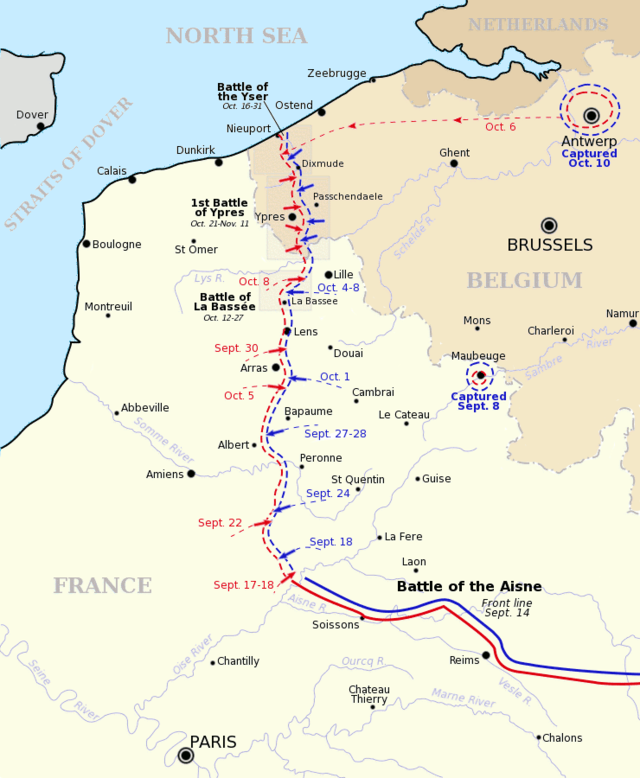
A Century Ago: Battles In Picardy; Beginning Of Trench Warfare

The pre-war German plan wasn't working. Belgium was supposed to have stood aside and let the Germans pass. It didn't happen.

That's often a problem with war plans. The enemy fails to cooperate.


Antwerp failed to fall on schedule. German generals kept trying to turn the cornerto surround the French. Each side just kept up the end run of the other, until, in late October, the trenches reached the North Sea.

Friday, September 19, 2014

Another Day At Arnhem: A Bridge Really Too Far - September 19, 1944; Some Heroic Tales

Anyone who has ever seen the movie, "A Bridge Too Far," knows something of the heroics of British, Polish and American paratrooperes, with very light equipment, attempting to hold a road through Holland leading to the Bridge at Arnhem.

These were very determined men. They had a job to do: hold the bridge for two days, until the tanks arrived. They did their very best, even when the tanks didn't come. They lasted four days.

In some respects, the operation was, as the Brits say, a "shambles." Still they persevered. Some say they fought for their country. Maybe so. But more importantly, they were fighting for their fellow soldiers.

None would ever to claim to be a hero. They just did what had to be done, and none fought for any kind of personal gain or glory. They had a job to do.

Here are some of the stories.

RAF aerial reconnaissance photo of the Arnhem road bridge on 19 September, showing signs of the British defence on the northern ramp and the wrecked German vehicles from the previous day's fighting.

Thursday, September 18, 2014

Seventy Years Ago: Another Day On Peleliu

*World War II Today: 16 September 1944: Peleliu: US Marines attack towards Bloody Nose Ridge:
It was already apparent that the landings on Peleliu were not going to be over within the four days originally anticipated. Despite the blasting that the entire island had received prior to the landings on the 15th most of the Japanese defenders had survived in their bunkers. Eugene B. Sledge, with the 3rd Battalion 5th Marines 1st Marine Division, was keeping notes of his experiences in his New Testament Bible. He was later to develop it into one of the classic memoirs of the war. After being selected for officer training he and many others had deliberately ‘flunked out’ so that they didn’t ‘miss the war’. So it was that he found himself as a Private in the middle of one of the bloodiest operations in the Pacific. After a sleepless night under shellfire they were all desperately thirsty, but men fell ill after drinking from a well. When water reached them in old oil drums it proved contaminated with rust and oil. That day it would reach 105 in the shade and, as Sledge points out, they were not in the shade. Their job was to attack across the airfield:
“Let’s go,” shouted an officer who waved toward the airfield. We moved at a walk, then a trot, in widely dispersed waves. Four infantry battalions — from left to right 2/1, 1/5, 2/5, and 3/5 (this put us on the edge of the airfield) – moved across the open, fire-swept airfield.

My only concern then was my duty and survival, not panoramic combat scenes. But I often wondered later what that attack looked like to aerial observers and to those not immersed in the firestorm. All I was aware of were the small area immediately around me and the deafening noise.
Bloody Nose Ridge dominated the entire airfield. The Japanese had concentrated their heavy weapons on high ground; these were directed from observation posts at elevations as high as three hundred feet, from which they could look down on us as we advanced. I could see men moving ahead of my squad, but I didn’t know whether our battalion, 3/5, was moving across behind 2/5 and then wheeling to the right. There were also men about twenty yards to our rear.

We moved rapidly in the open, amid craters and coral rubble, through ever-increasing enemy fire. I saw men to my right and left running bent as low as possible. The shells screeched and whistled, exploding all around us.
In many respects it was more terrifying than the landing, because there were no vehicles to carry us along, not even the thin steel sides of an amtrac for protection. We were exposed, running on our own power through a veritable shower of deadly metal and the constant crash of explosions.

For me the attack resembled World War I movies, I had seen of suicidal Allied infantry attacks through shell fire on the Westem Front. I clenched my teeth, squeezed my carbine stock, and recited over and over to myself, “The Lord is my shepherd; I shall not want. Yea, though I walk through the valley of the shadow of death, I will fear no evil, for Thou art with me; Thy rod and Thy staff comfort me…”

The sun bore down unmercifully, and the heat was exhausting. Smoke and dust from the barrage limited my vision. The ground seemed to sway back and forth under the concussions. I felt as though I were floating along in the vortex of some unreal thunderstorm. Japanese bullets snapped and cracked, and tracers went by me on both sides at waist height. This deadly small-arms fire seemed almost insignificant amid the erupting shells.
Explosions and the hum and the growl of shell fragments shredded the air. Chunks of blasted coral stung my face and hands while steel fragments spattered down on the hard rock like hail on a city street. Everywhere shells flashed like giant firecrackers.
Through the haze I saw Marines stumble and pitch forward as they got hit. I then looked neither right nor left but just straight to my front. The farther we went, the worse it got. The noise and concussion pressed in on my ears like a vise. I gritted my teeth and braced myself in anticipation of the shock of being struck down at any moment.

It seemed impossible that any of us could make it across. We passed several craters that offered shelter, but I remembered the order to keep moving. Because of the superb discipline and excellent esprit of the Marines, it had never occurred to us that the attack might fail.
[…]
How far we had come in the open I never knew, but it must have been several hundred yards. Everyone was visibly shaken by the thunderous barrage we had just come through. When I looked into the eyes of those fine Guadalcanal and Cape Gloucester veterans, some of America’s best, I no longer felt ashamed of my trembling hands and almost laughed at myself with relief.

To be shelled by massed artillery and mortars is absolutely terrifying, but to be shelled in the open is terror compounded beyond the belief of anyone who hasn’t experienced it. The attack across Peleliu’s airfield was the worst combat experience I had during the entire war. It surpassed, by the intensity of the blast and shock of the bursting shells, all the subsequent horrifying ordeals on Peleliu and Okinawa.
See E. B. Sledge: With the Old Breed: At Peleliu and Okinawa

Comments

1
Sherparick said...
E. B. Sledge's book I have come to see as the Great Book of WWII. If you have not read it, please do.
Today, September 17, is also the 152 anniversary of the Battle of Antietam.
"I had just got myself pretty comfortable when a bomb burst over me and completely deafened me. I felt a blow on my right shoulder and my jacket was covered with white stuff. I felt mechanically whether I still had my arm and thank God it was still whole. At the same time I felt something damp on my face; I wiped it off. It was bloody. Now I first saw that the man next to me, Kessler, lacked the upper part of his head, and almost all his brains had gone into the face of the man next to him, Merkel, so that he could scarcely see. Since any moment the same could happen to anyone, no one thought much about it."
Christoph Niederer, 20th New York Infantry, 6th Corps"
For us historically minded humans, with our lives of numerals that end in "0" and "5," we have 200th anniversaries of the War of 1812 (Star Spangled Banner), the 150th anniversary of the Civil War (Sheridan's victory at 3rd Winchester is on 19 September), 100th anniversary of the Great War (the 1st Battle of Aisne had ended and the Race to the Sea has begun as the Western Front stalemates), the 70th and 75th anniversaries for WWII (a six year war produces such terrible double anniversries for "live blogging"), and now the beginning of 50th anniversaries for Vietnam, and next summer the 25th anniversary for the Gulf War I, and we have been in war continuously since September 11, 2001
And we are now going to do it again, and again, and again.

2
KenL said...
Don't forget the section where Sledge runs into Paul Douglas. Yes that Paul Douglas. The fighting economist.

The Best Laid Plans Gang Aft Agley

Scotland votes today on the referendum to leave the United Kingdom. Yes or No?

The polls don't reveal how the vote will go. Earlier this week opinion seemed to run slightly in favor of staying in the UK.

I sympathize with the Scots who want independence. Staying in a union run by Tories isn't a great prospect. On the other hand, leaving the union while keeping the British Pound (as the proposal would do) is madness. The fate of an independent country with no currency of its own is in the hands of others. Every experiment along those lines in the past has turned out badly, including the present European experiment with the Euro.

Staying in the union is a more rational choice.

Then work to rid the UK of Cameron.

Wednesday, September 17, 2014

Seventy Years Ago: A Bridge Too Far (Market Garden)

Imagine you are dressed in your best parachute, flying over Holland enroute to a bridge over the Nederrijn at Arnhem. 70,000 years earlier, Neanderthals had lived nearby. It seems like the war in Europe is coming to an end.
  NewImage
It is September 17, 1942.
Landing at Arnhem, the objective deepest into German occupied territory, were the British First Airborne Division. John Frost, commanding 2nd Parachute Battalion who were to spearhead the attack, was pleased to find that the landings had gone nearly as well as could be expected. He and the Parachute Regiment had come a long way since the Bruneval Raid in 1942. It was a warm Sunday afternoon and he reflected how the countryside and the neat Dutch houses were not so very different from the outskirts of Aldershot, home town of the British Army. He describes the early stages in the operation as the paratroopers collected together at their rendezvous point in a wood:
It was by now about half-past two in the afternoon and quite hot. The sweat was pouring off the cheerful faces of the men as they filed past me into the wood. Wireless sets seemed to be the only casualties from the drop, among them the brigade set, but fortunately a spare was available. Just as I was beginning to feel that on the whole things could not be going better, the sound of firing broke out in the woods not more than three hundred yards from where I was standing and I moved to a track junction in the middle of the wood, which was where we had planned to set up Battalion Headquarters.
A battle at our rendezvous in the woods was one of the things to be feared most of all. It was vital that we should be able to move off without delay and equally vital that our ammunition should not be expended unduly early when we had so much to do. At first it was hard to tell what the trouble was, but we didn’t let it interfere with the process of forming up and getting ready to move. The troops and anti-tank guns allotted to us arrived punctually, also most of our airborne transport, consisting of five jeeps and a bren carrier. I passed some anxious moments while they were being sorted out. All army drivers have a predilection for driving into the middle of a headquarters, thereby causing the utmost confusion, and our drivers were no exception to the rule. To the tune of vigorous cursing, order was restored.
The companies reported in over ninety-five per cent, and the firing turned out to be caused by a small party of Germans who had driven up in a lorry with one armoured car as escort. By the time I thought of moving off, the armoured car had fled, leaving the lorry and several prisoners. Soon after three o’clock a message came from Brigade Headquarters telling us to move on with all possible speed, without waiting for stragglers, and just as the message went to ‘A’ Company, who were the vanguard, firing broke out afresh from their area. However, there was no delay, and as we passed their old positions we found two lorries and three motor-cars in various stages of destruction, also an untidy little bunch of dead and wounded Germans. It seemed a pity that the vehicles were now unusable, but there had been no time to arrange a road-block.
It was however a very encouraging start. Approximately thirty Germans, including officers among them, and valuable transport, accounted for without loss to ourselves. We marched towards Arnhem. A man and a woman on bicycles made as if to ride on past the column and seemed quite surprised at being ordered to turn back.
See Major General J. Frost: A Drop Too Many

Tuesday, September 16, 2014

Seventy Years Ago: USS Houston At Peleliu, September 1944

USS Houston, assigned to RADM Bogen's Task Group 38.2, left Eniwetok August 30 to screen aircraft carriers against Japanese aircraft while they attacked the Palaus on September 6. The TG then provided naval gunfire support on Anguar, Ngesebus and Peleliu islands.


First wave of LVTs moves toward the invasion beaches - Peleliu.jpg


Houston provided naval gunfire support to forces invading Peleliu from 17 to 19 September. She then went to Saipan to replenish her ammunition magazines and proceeded to the vast anchorage at Ulithi, recently captured from Japan.

Monday, September 8, 2014

Oriental New Town Dock - What Might Have Been

Three years ago, the Town of Oriental submitted a grant proposal for Federal Boating Infrastructure funds to build a pier for transient recreational boats at the end of South Avenue.

The plans show six boat slips and a width on the water of 80 feet. Plenty of room for visiting boats to go around other boats to get alongside either side of the dock.

Just take a look here, download the proposal, and compare the proposal to what we have.

Sunday, September 7, 2014

Senate Race As Of Early September

PEC - Princeton Election Consortium; Dkos - Daily KOS; WaPo - Washington Post; 538 -Five Thirty-Eight; Upshot - New York Times


Sunday, August 31, 2014

Col. Wilkerson: The Truth

Col. Wilkerson, who served as Secretary of State Powell's Chief of Staff during the George W. Bush administration is the epitome of the military staff officer. He is honest, forthright, even blunt. But he's not afraid to tell the truth.

Here's what he says about his party:


Saturday, August 30, 2014

Another "Chiffon de Papier" A Century Later?

On August 4, 1914, Germany attacked neutral Belgium. Great Britain protested that the invasion violated Germany's treaty obligation to respect Belgian neutrality. Germany's Chancellor replied that the treaty was only "a chiffon de papier" - (a scrap of paper). That same day, the United Kingdom declared war on Germany.

On Friday, speaking to a group of Russian youth at a camp, Vladimir Putin said, "We must always be ready to repel any aggression against Russia and (potential enemies) should be aware ... it is better not to come against Russia as regards a possible armed conflict." In the same appearance, he claimed that Russia is improving its nuclear arsenal.

December 5, 1994, when Ukraine, which then held a substantial arsenal of nuclear weapons, agreed to join the non-proliferation treaty, the Presidents of Ukraine, Russian Federation and United States of America, and the Prime Minister of the United Kingdom signed three memorandums (UN Document A/49/765) on December 5, 1994, with the accession of Ukraine to the Treaty on the Non-Proliferation of Nuclear Weapons. Through this agreement, these countries (later to include China and France in individual statements) gave national security assurances to Belarus, Kazakhstan and Ukraine. The Joint Declaration by the Russian Federation and the United States of America of December 4, 2009 confirmed their commitment.

Highlights of the 1994 Declaration:

"Welcoming the accession of Ukraine to the Treaty on the Non-Proliferation of Nuclear Weapons as a non-nuclear-weapon State,

Taking into account the commitment of Ukraine to eliminate all nuclear weapons from its territory within a specified period of time,

Noting the changes in the world-wide security situation, including the end of the cold war, which have brought about conditions for deep reductions in nuclear forces,
Confirm the following:

1. The Russian Federation, the United Kingdom of Great Britain and Northern Ireland and the United States of America reaffirm their commitment to Ukraine, in accordance with the principles of the Final Act of the Conference on Security and Cooperation in Europe, to respect the independence and sovereignty and the existing borders of Ukraine;

2. The Russian Federation, the United Kingdom of Great Britain and Northern Ireland and the United States of America reaffirm their obligation to refrain from the threat or use of force against the territorial integrity or political independence of Ukraine, and that none of their weapons will ever be used against Ukraine except in self-defence or otherwise in accordance with the Charter of the United Nations;

3. The Russian Federation, the United Kingdom of Great Britain and Northern Ireland and the United States of America reaffirm their commitment to Ukraine, in accordance with the principles of the Final Act of the Conference on Security and Cooperation in Europe, to refrain from economic coercion designed to subordinate to their own interest the exercise by Ukraine of the rights inherent in its sovereignty and thus to secure advantages of any kind;

4. The Russian Federation, the United Kingdom of Great Britain and Northern Ireland and the United States of America reaffirm their commitment to seek immediate United Nations Security Council action to provide assistance to Ukraine, as a non-nuclear-weapon State party to the Treaty on the Non-Proliferation of Nuclear Weapons, if Ukraine should become a victim of an act of aggression or an object of a threat of aggression in which nuclear
weapons are used;

5. The Russian Federation, the United Kingdom of Great Britain and Northern Ireland and the United States of America reaffirm, in the case of Ukraine, their commitment not to use nuclear weapons against any non-nuclearweapon State party to the Treaty on the Non-Proliferation of Nuclear Weapons, except in the case of an attack on themselves, their territories or dependent territories, their armed forces, or their allies, by such a State in association or alliance with a nuclear-weapon State;

6. Ukraine, the Russian Federation, the United Kingdom of Great Britain and Northern Ireland and the United States of America will consult in the event a situation arises that raises a question concerning these commitments.

This Memorandum will become applicable upon signature.
Signed in four copies having equal validity in the Ukrainian, English and Russian languages.

For Ukraine:
(Signed) Leonid D. KUCHMA

For the Russian Federation:
(Signed) Boris N. YELTSIN

For the United Kingdom of Great
Britain and Northern Ireland:
(Signed) John MAJOR

For the United States of America:
(Signed) William J. CLINTON


 OK. Russia has clearly violated provisions 1, 2 and 3 of the memorandum, and therefore provision 6 should be invoked.

Last week's meeting in Minsk accomplished little, but it was apparently not called forthrightly in connection with alleged violations of the 1994 memorandums.

It may be time.

We don't need another "chiffon de papier" like the one in 1914.

This is serious stuff.

Here is what I said last March about the problem.

And here's what I said in April.

Now Ukraine is apparently going to formally request admission to NATO.

I hope there is some serious conversation going on behind the scenes.


Where have all the flowers gone?

When will they ever learn?


Wednesday, August 27, 2014

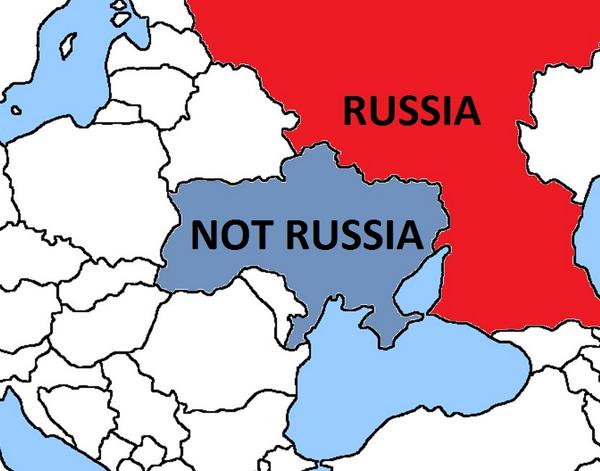
Canadian Forces Clear Up Russian Confusion About Ukraine

Here is a link to a Canada NATO tweet clearing up Russian confusion about Map of Ukraine and Russia.

Geography can be tough. Here’s a guide for Russian soldiers who keep getting lost & ‘accidentally’ entering

Tuesday, August 26, 2014

Russian Corporal Of Airborne Forces Captured And Interrogated In Donetsk Oblast Of Ukraine

This is a link to a YouTube video of a Russian Corporal being interrogated by Ukrainian military intelligence after capture near Donetsk August 25.

https://www.youtube.com/watch?v=Hh9bBr_oIlc

Sunday, August 24, 2014

Seventy Years Ago: Paris, August 24, 1944 - The Night Before Liberation

Matthew Halton was a Canadian reporter travelling with General Le Clerc’s tanks that were approaching Paris. During the day he was to broadcast:
"Wherever we drive, in the areas west and south-west of the capital, people shout: “Look, they are going to Paris! ” But then we run into pockets of resistance here or there and are forced to turn back. It’s clear that we are seeing the disintegration of the German Army — but we never know when we are going to be shot at.
"There are still some units of the German Army, fanatical men of the SS or armoured divisions, who are willing to fight to the last man. They are moving here and there all over this area, trying to coalesce into strong fighting forces…
The people everywhere are tense with emotion. Their love of freedom is so very deep, and a nightmare is lifting from their lives; and history races down the roads towards Paris."
The first of LeCerc's arrived in the capital at 11 o’clock that night. It was clear that Paris would be liberated the next day.

French radio announcer Pierre Crénesse announced over the newly liberated French public radio:
"Tomorrow morning will be the dawn of a new day for the capital. Tomorrow morning, Paris will be liberated, Paris will have finally rediscovered its true face.
"Four years of struggle, four years that have been, for many people, years of prison, years of pain, of torture and, for many more, a slow death in the Nazi concentration camps, murder; but that’s all over…
"For several hours, here in the centre of Paris, in the Cité, we have been living unforgettable moments. At the Préfecture, my comrades have explained to you that they are waiting for the commanding officers of the Leclerc Division and the American and French authorities.
"Similarly, at the Hotel de Ville the Conseil National de la Résistance has been meeting for several hours. They are awaiting the French authorities. Meetings will take place, meetings which will be extremely symbolic, either there or in the Prefecture de Police — we don’t yet know where."
 It would be a sleepless night in Paris.

Friday, August 22, 2014

Quote Of The Day

The clock on life is ticking. If you wait for life to be fair you may be waiting until life is over.
 - Charles M. Blow

A Century Ago: Germans In Lorraine

Today's New York Times on line publishes the account of a young German soldier's experiences with the German Army in Lorraine August 22, 1914 and afterward.

The story is told by an American woman living in Paris whose grandfather was among the invaders of the little village of Mercy-le-Haut. But she also tells the story of what happened to the villagers when the Germans came.

One villager, Marthe Mandy, recounted her mother’s tales of those years as if she had lived it all herself. Her eyes welled up as she told of an uncle she never met who was executed by the Germans that night. The uncle, Léon Mandy, was 17. He had been ordered to gather the bodies of nine of his neighbors who died as the Germans stormed the village and to bury them in a mass grave. When Léon had finished his grim task shortly before dawn, he was shot.

Many accounts of World War I claim that the war was fought in a chivalrous fashion at the outset, but became more inhumane as time went by. Tell that to the French and Belgians along the frontier! The invasion did not seem so humane to them.

Why did the Germans shoot Leon Mandy?

They shot countless Frenchmen and Belgians in the early days of the war, sometimes for being impolite to the invaders.

What is the moral of the story?

In the end, Germany lost. A quarter century later they attacked again and lost again.

Tuesday, August 19, 2014

Glory To Ukraine

On February 23 2014 in Sofia, Bulgaria, unknown artists decorated the memorial to Soviet soldiers in the national colors of Ukraine in honor of the Ukrainian revolution. They painted the slogan "Glory to Ukraine."

Russians object to it as "vandalism."  No, it is irreverent humor, not vandalism.

Three cheers for irreverence!


A Century Ago: Belgian Populace Impolite To Invading Germans - Germans Offended And Execute Resisters

Today Economist Brad Delong publishes Barbara Tuchman's account of Belgian resistance to German invasion of 1914 and German countermeasures:

"The Belgians even more than von Bülow tried von Kluck’s temper. Their army by forcing the Germans to fight their way through delayed the schedule of march and by blowing up railroads and bridges disrupted the flow of ammunition, food, medicine, mail, and every other supply, causing the Germans a constant diversion of effort to keep open their lines to the rear. Civilians blocked roads and worst of all cut telephone and telegraph wires which dislocated communication not only between the German armies and OHL but also between army and army and corps and corps. This “extremely aggressive guerrilla warfare,” as von Kluck called it, and especially the sniping by franc-tireurs at German soldiers, exasperated him and his fellow commanders. From the moment his army entered Belgium he found it necessary to take, in his own words, “severe and inexorable reprisals” such as “the shooting of individuals and the burning of homes” against the “treacherous” attacks of the civil population." Tuchman, Guns of August.

It is worth reading the entire excerpt: Germans Retaliate.

In 1980 at a wedding dinner in Belgium, we sat across from a woman in her 90's who had been about 20 when the Germans invaded. She called them "le Boches." And had never come to view Germans as allies.

German ill treatment of civilians in invaded countries was nothing new. In 1889, Germany intervened in a civil war with Samoa. When opponents of their Samoan puppet fought back, Germany issued a proclamation:

In conformity with section 58 of the German Military Laws, the following offenses will be punished by death:
1. Any person or persons who will purposely assist the enemy, or attempt to injure German troops;
2. Any person or persons who will lead the enemy for military purposes against Germans, or confederated troops, or will mislead German or confederated troops;
3.Any person or persons who will venture to give information to the enemy, either verbally or in writing, about matters which are connected with the waging of war, and all who may act on behalf of such persons;
4. Any person or persons who will instigate or incite German troops against law and order, by any means, as, for instance, informing them of proclamations of the enemy, etc. etc;
5.In not very serious cases the offender will be punished by imprisonment, not less than 10 years or for life.”

Thus did Germany seek to win the hearts and minds of the Samoans. And the Belgians.

Monday, August 18, 2014

August 18, 1920: Famous Day In History

On August 18, 1920, Tennessee ratified the 19th Amendment giving women the right to vote. Yeah, remember ladies, at one time, you were not allowed to vote!!! Think about it.

Sunday, August 17, 2014

A Century Ago: Germany Invades Belgium

On July 28, 1914, Austria-Hungary declared war on Serbia. Russia mobilizes. Following events came on hot and heavy. July 31, Germany warns Russia not to mobilize. Russia responds they are only mobilizing against Austria. August 1, Germany declares war on Russia. August 2, Germany invades neutral Luxemburg. August 3, Germany declares war on France. Neutral Belgium denies Germany permission to pass through to the French border. August 4, Germany attacks neutral Belgium, Great Britain protests, Germany replies that the treaty guaranteeing Belgian neutrality is just a chiffon de papier. The United Kingdom declares war on Germany.

Thus a week after Austria declares war on Serbia, war is well underway on the Western Front.

August 4 Germany begins its siege of Belgium's fortresses at Liege. Surprisingly effective Belgian defense slows German advance. Germans do not capture Liege fortresses until August 16.

August 16-19, Serbs defeat Austria Hungary at the Battle of Cer.

August 17, Russians invade East Prussia. Two weeks into the war the Eastern Front begins to take shape.

Saturday, August 16, 2014

Stonekettle Station: Reader Links and Open Thread

http://mile181.blogspot.com/Stonekettle Station: Reader Links and Open Thread: This page is now permanently pinned to the main page of Stonekettle Station. It's your place to add a link to another site. You may post...

Friday, August 15, 2014

Thursday, August 14, 2014

Fifty Years Ago: Tonkin Gulf

Last week I neglected to call attention to the fiftieth anniversary of the supposed night time attack by North Vietnamese PT boats on US Navy destroyers Maddox and Turner Joy. Here are my recollections of that night.

The attack apparently never happened. Even so, the Johnson administration used it to justify the Tonkin Gulf Resolution.

Wednesday, August 13, 2014

Friday The Thirteenth Actually Falls On Wednesday This Month

Every now and then, Walt Kelly was right.

On Knowledge And Wisdom

"Supposing is good, but finding out is better." - Mark Twain

For some reason, newspapers and blogs today are full of discussions about knowledge, facts, wisdom, stupidity, and how to tell the difference.

Nicholas Kristoff: Don't dismiss the humanities: http://www.nytimes.com/2014/08/14/opinion/nicholas-kristof-dont-dismiss-the-humanities.html?partner=rssnyt&emc=rss

Noah Smith: I'm with stupid - and Paul Krugman: http://www.bloombergview.com/articles/2014-08-12/i-m-with-stupid-and-paul-krugman

Simon Wren-Lewis: Policy-Based Evidence Making, a play on the opposite side of evidence-based policy;

Joshua Smith: EPI And AEI Agree: Cutting Jobless Benefits Did Not Boost Employment; [the case of North Carolina figures in this discussion].

Friday, August 8, 2014

How Can The Town Board Nullify A Vote Without Holding Another Public Meeting?

I hope today's report on Town Dock is erroneous:

"Oriental’s Town Board meets for a quick meeting on Tuesday August 12 at 5:30p to take another vote on who will be appointed to the newly formed Harbor Waterfronts Committee. The vote the Board took on August 5, has since been nullifed because the Commissioners did not have before them all the names of residents willing to serve. Town Hall says that was “due to an unfortunate administrative oversight…several candidates were left off of the ballot issued to the Commissioners for voting.” There will be 11 names on the ballot Tuesday. The 5 who were elected in the now nullified vote were: Art Tierney, Ed Bliss, Lisa Thompson, Bill Hines and Gerry Crowley. They remain on the ballot along with, Dave Brookman, Elizabeth Buckman, Bob Dillard, Jim Edwards, Steve Leech and Pat Stockwell."

"Has since been nullified" by whom?