Saturday, June 25, 2011

Coastal Economics [Wal(rus) Street at Work]

The Walrus and The Carpenter

Lewis Carroll

(from Through the Looking-Glass and What Alice Found There, 1872)

The sun was shining on the sea,
Shining with all his might:
He did his very best to make
The billows smooth and bright--
And this was odd, because it was
The middle of the night.

The moon was shining sulkily,
Because she thought the sun
Had got no business to be there
After the day was done--
"It's very rude of him," she said,
"To come and spoil the fun!"
The sea was wet as wet could be,
The sands were dry as dry.
You could not see a cloud, because
No cloud was in the sky:
No birds were flying overhead--
There were no birds to fly.

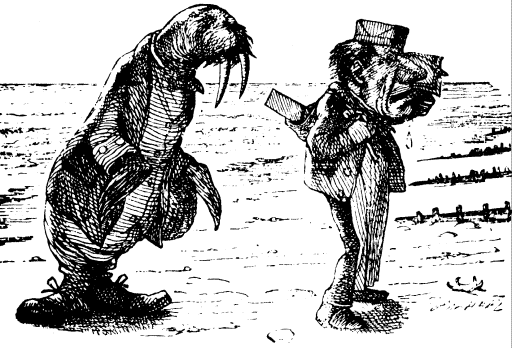
The Walrus and the Carpenter
Were walking close at hand;
They wept like anything to see
Such quantities of sand:
"If this were only cleared away,"
They said, "it would be grand!"

"If seven maids with seven mops
Swept it for half a year.
Do you suppose," the Walrus said,
"That they could get it clear?"
"I doubt it," said the Carpenter,
And shed a bitter tear.

"O Oysters, come and walk with us!"
The Walrus did beseech.
"A pleasant walk, a pleasant talk,
Along the briny beach:
We cannot do with more than four,
To give a hand to each."

The eldest Oyster looked at him,
But never a word he said:
The eldest Oyster winked his eye,
And shook his heavy head--
Meaning to say he did not choose
To leave the oyster-bed.

But four young Oysters hurried up,
All eager for the treat:
Their coats were brushed, their faces washed,
Their shoes were clean and neat--
And this was odd, because, you know,
They hadn't any feet.

Four other Oysters followed them,
And yet another four;
And thick and fast they came at last,
And more, and more, and more--
All hopping through the frothy waves,
And scrambling to the shore.
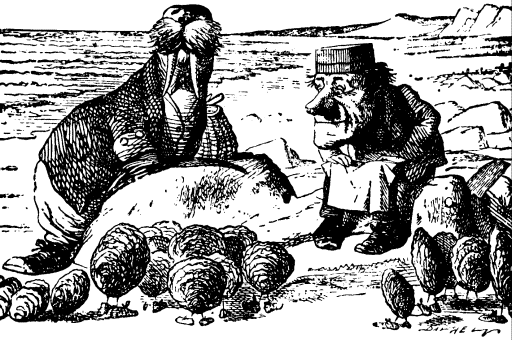
The Walrus and the Carpenter
Walked on a mile or so,
And then they rested on a rock
Conveniently low:
And all the little Oysters stood
And waited in a row.

"The time has come," the Walrus said,
"To talk of many things:
Of shoes--and ships--and sealing-wax--
Of cabbages--and kings--
And why the sea is boiling hot--
And whether pigs have wings."

"But wait a bit," the Oysters cried,
"Before we have our chat;
For some of us are out of breath,
And all of us are fat!"
"No hurry!" said the Carpenter.
They thanked him much for that.

"A loaf of bread," the Walrus said,
"Is what we chiefly need:
Pepper and vinegar besides
Are very good indeed--
Now if you're ready, Oysters dear,
We can begin to feed."

"But not on us!" the Oysters cried,
Turning a little blue.
"After such kindness, that would be
A dismal thing to do!"
"The night is fine," the Walrus said.
"Do you admire the view?
"It was so kind of you to come!
And you are very nice!"
The Carpenter said nothing but
"Cut us another slice:
I wish you were not quite so deaf--
I've had to ask you twice!"

"It seems a shame," the Walrus said,
"To play them such a trick,
After we've brought them out so far,
And made them trot so quick!"
The Carpenter said nothing but
"The butter's spread too thick!"

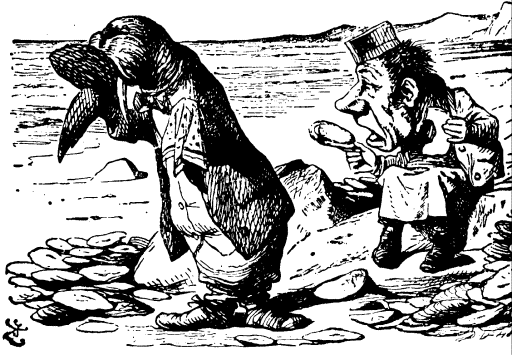
"I weep for you," the Walrus said:
"I deeply sympathize."
With sobs and tears he sorted out
Those of the largest size,
Holding his pocket-handkerchief
Before his streaming eyes.

"O Oysters," said the Carpenter,
"You've had a pleasant run!
Shall we be trotting home again?'
But answer came there none--
And this was scarcely odd, because
They'd eaten every one.

dshaw@jabberwocky.com

Return to Lewis Carroll
Return to Jabberwocky

Friday, June 24, 2011

Election Law Pot-Pourri

As I previously posted, Governor Perdue has vetoed the legislature's bill to require photo ID for voting.

That is by no means the only important election law issue.

In this session, there were about forty-one bills introduced, with the goal of extensively modifying North Carolina election law.

As an aside,your Pamlico County Board of Elections will enforce whatever changes become law. I have informed both Representative Sanderson and Senator Preston of my concerns about the effect of one of the proposed amendments, and had a useful discussion with Senator Preston's staff. The bill is not yet ratified, but has been ordered engrossed.

That being said, as I have previously noted, North Carolina election law as it presently exists is highly regarded in other states and at the US Department of Justice. I hope we retain that positive reputation.

Of the forty-one bills, Senate Bill 47 began life under the title "Restore Partisan Judicial Elections." The conservative Civitas Institute advocated partisan judicial elections because "including a party affiliation would give them some information about the candidates, and could lead to greater participation by the voters." As we will see, this logic wasn't necessarily applied to other election legislation.

Senate Bill 47 has now been retitled "An Act to Make Various Amendments to the Election Administration Laws, and Other Conforming Changes." In other words, it has become a legislative pot-pourri, incorporating measures from most of the forty-one bills concerning election law. As Churchill might have observed, "this bill has no theme." So we can only list the changes it makes.

Here they are:

1. Special elections can only be held on the same day as general and primary elections;

2. Establishes a term of office for chair of the State Board of Elections, with a two- term limit;

3. Repeals same day registration and voting (many first time voters used this in 2008);

4. Prohibits paying any person to assist or encourage voters to fill out registration forms, including payment per application completed;

5. Repeals right of a person who becomes eligible to vote after registration deadline but before election day to vote on election day - a provision that allows newly-naturalized citizens sworn in just before election to vote;

6. Repeals the mandated voter registration and preregistration drives at high schools and statewide registration drives; and even repeals the authorization for school boards to participate in such drives;

7. Introduces more stringent candidate treasurer requirements;

8. Makes candidates personally liable for civil penalties against campaigns;

9. Eliminates non-partisan judicial elections;

10. Removes requirement that provisional ballots not be marked to identify the voter;

11. Requires rotation of order of parties on ballots every four years (in apparent contradiction to requirement in same section that parties be in alphabetical order);

12. Eliminates straight party voting;

13. Provides elaborate details to insure "faithful presidential electors," limiting appointments to a single alternate for each elector (did not amend section 163-1 which requires first and second alternates);

14. Reduces period of one-stop early voting by one-third (two-thirds of Pamlico County voters voted during one-stop in 2008);

15. Repeals present requirement that only a near relative can request an absentee ballot for another person, and repeals provision for requester with handicap or illiteracy to receive assistance from an individual of requester's choice;

16. Permits compelling testimony from witness while subjecting witness to penalty and forfeiture for acts testified to;

17. Repeals instant runoff voting;

18. Repeals Voter Owned Election Act and associated funding of candidates;

19. Severely limits political contributions by State Vendors;

20. Under the guise of limiting allowed contributions to political parties, allows parties to receive contributions of up to $250,000 from any individual, political committee (other than a candidate committee), referendum committee, person or other entity in any election;

21. Applies balances in Voter Owned Election Fund to pay for voter ID equipment mandated by the Voter ID Act that Governor Perdue has already vetoed.

Those are the important ingredients in the pot-pourri.

More Debt Can Solve a Debt Problem, After All

The public keeps hearing confident assertions that "debt can't solve debt." As it turns out, it can.

Here is the clearest explanation that I know of how it would work. Furthermore, the new debt would be very cheap: interest rate not much above zero percent or in some cases less than zero.

Paul Krugman:

June 8, 2011, 11:22 am

Sam, Janet, and Debt

In the discussion of Richard Koo, I’m seeing a number of people asserting (a) debt can’t be the solution to debt (b) inflation can’t possibly be helpful. I guess that’s the problem with blogging: even if you explain your position clearly, after a few months people enter the discussion without knowing about or having forgotten the earlier discussion.

So let me repost in its entirety my take on the balance-sheet recession issue. There’s a more formal treatment of the ideas, plus a bunch of further results, in my work with Gauti Eggertsson.

The original post:

Sam, Janet, and Fiscal Policy

One of the common arguments against fiscal policy in the current situation – one that sounds sensible – is that debt is the problem, so how can debt be the solution? Households borrowed too much; now you want the government to borrow even more?

What’s wrong with that argument? It assumes, implicitly, that debt is debt – that it doesn’t matter who owes the money. Yet that can’t be right; if it were, we wouldn’t have a problem in the first place. After all, to a first approximation debt is money we owe to ourselves – yes, the US has debt to China etc., but that’s not at the heart of the problem. Ignoring the foreign component, or looking at the world as a whole, the overall level of debt makes no difference to aggregate net worth – one person’s liability is another person’s asset.

It follows that the level of debt matters only if the distribution of net worth matters, if highly indebted players face different constraints from players with low debt. And this means that all debt isn’t created equal – which is why borrowing by some actors now can help cure problems created by excess borrowing by other actors in the past.

To see my point, imagine first a world in which there are only two kinds of people: Spendthrift Sams and Judicious Janets. (Sam and Janet who? If you’d grown up in my place and time, you’d know the answer: Sam and Janet evening / You will see a stranger … But actually, I’m thinking of the two kinds of agent in the Kiyotaki-Moore model.)

In this world, we’ll assume that no real investment is possible, so that loans are made only to finance consumption in excess of income. Specifically, in the past the Sams have borrowed from the Janets to pay for consumption. But now something has happened – say, the collapse of a land bubble – that has forced the Sams to stop borrowing, and indeed to pay down their debt.

For the Sams to do this, of course, the Janets must be prepared to dissave, to run down their assets. What would give them an incentive to do this? The answer is a fall in interest rates. So the normal way the economy would cope with the balance sheet problems of the Sams is through a period of low rates.

But – you probably guessed where I’m going – what if even a zero rate isn’t low enough; that is, low enough to induce enough dissaving on the part of the Janets to match the savings of the Sams? Then we have a problem. I haven’t specified the underlying macroeconomic model, but it seems safe to say that we’d be looking at a depressed real economy and deflationary pressures. And this will be destructive; not only will output be below potential, but depressed incomes and deflation will make it harder for the Sams to pay down their debt.

What can be done? One answer is inflation, if you can get it, which will do two things: it will make it possible to have a negative real interest rate, and it will in itself erode the debt of the Sams. Yes, that will in a way be rewarding their past excesses – but economics is not a morality play.

Oh, and just to go back for a moment to my point about debt not being all the same: yes, inflation erodes the assets of the Janets at the same time, and by the same amount, as it erodes the debt of the Sams. But the Sams are balance-sheet constrained, while the Janets aren’t, so this is a net positive for aggregate demand.

But what if inflation can’t or won’t be delivered?

Well, suppose a third character can come in: Government Gus. Suppose that he can borrow for a while, using the borrowed money to buy useful things like rail tunnels under the Hudson. The true social cost of these things will be very low, because he’ll be putting resources that would otherwise be unemployed to work. And he’ll also make it easier for the Sams to pay down their debt; if he keeps it up long enough, he can bring them to the point where they’re no longer so severely balance-sheet constrained, and further deficit spending is no longer required to achieve full employment.

Yes, private debt will in part have been replaced by public debt – but the point is that debt will have been shifted away from severely balance-sheet-constrained players, so that the economy’s problems will have been reduced even if the overall level of debt hasn’t fallen.

The bottom line, then, is that the plausible-sounding argument that debt can’t cure debt is just wrong. On the contrary, it can – and the alternative is a prolonged period of economic weakness that actually makes the debt problem harder to resolve.

L'etat, C'est Nous

So, what are elections about, anyhow?

To Louis XIV of France, elections and parliaments were irrelevant. "L'etat, c'est moi," he declared.

We started our nation with a different idea.

"We hold these truths to be self-evident," we declared, "that all men are created equal, that they are endowed by their Creator with certain unalienable rights, that among these are life, liberty and the pursuit of happiness. That to secure these rights, governments are instituted among men, deriving their just powers from the consent of the governed."

In this country, that is what elections are about: to grant or withhold the consent of the governed. That is, in today's America, the consent of all its citizens, each of whom has the right to vote.

Or, to put it another way, "l'etat, c'est nous."

Voter ID Bill

Thursday afternoon, Governor Perdue vetoed the voter ID bill passed by the Republican state legislature.

I have commented previously on the purpose of voter ID laws, as revealed by a Republican Party official in Texas.

I am reviewing Senate Bill 47, which incorporates a wide range of election law modifications. I expect to have an informational post up by noon.Link

Thursday, June 23, 2011

Municipal Elections

I still hear grumbling about Oriental town government.

Just a reminder: candidate filing for municipal office opens at the Pamlico County Board of Elections office in Bayboro at noon, Friday, July 1, 2011. Candidate filing ends at noon, July 15, 2011.

Now is the time to start organizing for your campaign.

Wednesday, June 22, 2011

Do We Need a Third Party?

Columnist Thomas Friedman, in today's New York Times, called for a third party to enter the 2012 presidential election campaign.

His reason? Our political system has evolved to the condition that makes it impossible for any president to accomplish anything except during the initial 100 days of the administration.

Friedman makes a lot of good points. He also admits that there is no chance that a third party candidate would actually win. He doesn't mention it, but the only time in our history that a third party affected the outcome of an election was in 1912, when Teddy Roosevelt ran as the "Bull Moose" party (Progressive Party) candidate and won more votes than incumbent President Taft. That put Woodrow Wilson in the White House.

Republicans hoped for a repeat in 1948 when two third parties (Henry Wallace's Progressive Party and Strom Thurmond's States Rights Party) split from the Democratic Party. Despite that, Harry Truman won the election.

The Pew Research Center for People and the Press finds eight or nine groupings of political thought. Each of these groupings could form the basis of a political party, except for one thing: our elections are held on a "winner-take-all" basis. This system, unlike countries with proportional representation, can sustain no more than two parties.

If Friedman really advocates third parties, they have a better chance of success at the state level and in congressional elections than they do for presidential elections.

I am not at all persuaded by Friedman's article, but it is worth reading. Even more interesting are readers' comments.

Tuesday, June 21, 2011

Can Americans Make Anything Besides Deals?

Interesting column by Harold Meyerson in last week's Washington Post.

The question Meyerson addresses is whether the United States can learn from the example of others - in this case, Germany. The first part of the question is whether there is anything to be learned from other countries. Clearly there is.

The second part of the question is whether we are capable of learning from the successes of other countries. That's an open question.

Meyerson comments on the German model: "German manufacturers, particularly the midsize and small-scale ones that often dominate global markets in specialized products, don’t seek funding from capital markets (there’s a local banking sector that handles their needs) and don’t answer to shareholders. They make things, while we make deals, or trades, or swaps."

David Leonhardt, the New York Times economics columnist, wrote last week that Germany owed its edge in global competitiveness to a range of policies that could not be more different than ours: limiting home ownership, improving education (including vocational and technical education) and keeping unions strong — which is why “middle-class pay,” he noted, “has risen at roughly the same rate as top incomes.”

The German model differs from the laissez-faire approach to globalization that has dominated U.S. policy and discourse for decades, dooming many American workers to penury. Meyerson's article emphasizes the crucial distinctions between Germany’s stakeholder capitalism, which benefits the many, and our shareholder capitalism, which increasingly benefits only the few.

Can we learn from others? Let's give it a try.Link