
Sometimes memory plays tricks.
In my memory, I never cared much for cowboy movie star Roy Rogers. He sang too much and paid entirely too much attention to Dale Evans. Even Gabby Hayes was more interesting.
Didn't care much for Gene Autry, either.
This evening on Turner Classic Movies I watched a 1945 Roy Rogers movie that I first watched 65 years ago at the Will Rogers Movie Theater in Tulsa Oklahoma. The movie didn't get any better in the intervening decades. Still, I found I could sing along with Roy Rogers and the Sons of the Pioneers when they sang "Don't Fence Me In" and "Tumbling Tumbleweed." I was surprised that I remembered the words after all these years.
I still preferred Hopalong Cassidy.
Friday, July 1, 2011

Pamlico County Municipal Elections Candidate Filing
The candidate filing period for Pamlico County municipal elections opened today at noon at the Board of Elections office at the county court house in Bayboro. The filing period ends at noon on July 15.
As of 3:00 this afternoon, July 1, 2011, no candidates have filed.
As of 3:00 this afternoon, July 1, 2011, no candidates have filed.
Thursday, June 30, 2011
Oriental Town Commissioners and Management
Some Oriental Town Commissioners seem to have great difficulty grasping the proper role of the board of commissioners. Let's try again.
The Town of Oriental has a council-manager form of government. That means the board of commissioners exercises a legislative role by providing general direction and control over town government, adopting general personnel rules, regulations, policies or ordinances and providing oversight over the Town Manager's activities.
The Town Manager is the chief administrator of the town. He is responsible to the board of commissioners for all municipal affairs. His powers and duties are spelled out in North Carolina General Statutes.
The manager supervises and directs all departments of Town Government, including appointing, suspending or removing ALL city officers and employees not elected by the people (subject in some cases to other provisions of the law).
In brief, the town board gets to hire the town manager. The board has NO statutory authority to hire or fire any employee subordinate to the manager. To be sure, the board can establish general personnel rules, regulations and policies.
Commissioners have NO operational role in the town's administration. No supervisory role and no authority over employees. No individual commissioner has any administrative or disciplinary authority over the manager or any other employee. Neither does the mayor.
We saw at today's agenda meeting the sort of problem that can arise when an individual commissioner takes on the task of obtaining cost estimates, "bids," making design decisions, and attempting to move forward with a project instead of asking the entire board to task the manager with the project. In this case, the project that seems unnecessarily muddled is the pier at the end of South Avenue.
There have been other matters unnecessarily muddled by commissioner meddling in the past year and a half.
The board needs to address this. It is a procedural issue.
The Town of Oriental has a council-manager form of government. That means the board of commissioners exercises a legislative role by providing general direction and control over town government, adopting general personnel rules, regulations, policies or ordinances and providing oversight over the Town Manager's activities.
The Town Manager is the chief administrator of the town. He is responsible to the board of commissioners for all municipal affairs. His powers and duties are spelled out in North Carolina General Statutes.
The manager supervises and directs all departments of Town Government, including appointing, suspending or removing ALL city officers and employees not elected by the people (subject in some cases to other provisions of the law).
In brief, the town board gets to hire the town manager. The board has NO statutory authority to hire or fire any employee subordinate to the manager. To be sure, the board can establish general personnel rules, regulations and policies.
Commissioners have NO operational role in the town's administration. No supervisory role and no authority over employees. No individual commissioner has any administrative or disciplinary authority over the manager or any other employee. Neither does the mayor.
We saw at today's agenda meeting the sort of problem that can arise when an individual commissioner takes on the task of obtaining cost estimates, "bids," making design decisions, and attempting to move forward with a project instead of asking the entire board to task the manager with the project. In this case, the project that seems unnecessarily muddled is the pier at the end of South Avenue.
There have been other matters unnecessarily muddled by commissioner meddling in the past year and a half.
The board needs to address this. It is a procedural issue.
Wednesday, June 29, 2011
Town of Oriental Personnel Procedures: Due for Amendment?
This morning at their 11:15 special meeting, the town board of commissioners passed a motion to offer Dwaine Moore, who is a corrections officer at the prison in Pamlico County. Moore, a resident of Oriental, has been working for months as an unpaid auxiliary officer for the Town of Oriental. The board also offered an unpaid position as auxiliary police officer to Bob Lyons, a marine patrol officer for the state.
From the subsequent discussion, it was unclear to me whether the board would decide to conduct a formal search for a permanent Chief of Police to replace the retiring Chief Casasa.
After the meeting, I decided to reread what North Carolina General Statutes have to say about hiring personnel. Here is what I found:
"Section 160A-148. Powers and Duties of Manager.
The manager shall be the chief administrator of the city. He shall be responsible to the council for administering all municipal affairs placed in his charge by them, and shall have the following powers and duties:
(1) He shall appoint and suspend or remove all city officers and employees not elected by the people, and whose appointment or removal is not otherwise provided for by law, except the city attorney, in accordance with such general personnel rules, regulations, policies or ordinances as the council may adopt.
(2) He shall direct and supervise the administration of all departments, offices, and agencies of the city, subject to the general direction and control of the council, except as otherwise provided by law.
(3) etc."
Among the officers who may be appointed by a city, presumably in this case by the manager, is the chief of police and other police officers (NCGS 160A-281.)
Another interesting provision of NCGS is the following:
"Section 160A-165. Personnel board.
The council may establish a personnel board with authority to administer tests designed to determine the merit and fitness of candidates for appointment or promotion, to conduct hearings on the appeal of employees who have been suspended, demoted or discharged, and hear employee grievances."
In other words, it appears that under NCGS, the board appoints the manager and the manager makes all other personnel decisions, possibly as supported by a personnel board if one is established.
And by the way, town commissioners have no legal authority to provide any degree of supervision or direction over any town employees.
Maybe it's time to review how the town does business.
From the subsequent discussion, it was unclear to me whether the board would decide to conduct a formal search for a permanent Chief of Police to replace the retiring Chief Casasa.
After the meeting, I decided to reread what North Carolina General Statutes have to say about hiring personnel. Here is what I found:
"Section 160A-148. Powers and Duties of Manager.
The manager shall be the chief administrator of the city. He shall be responsible to the council for administering all municipal affairs placed in his charge by them, and shall have the following powers and duties:
(1) He shall appoint and suspend or remove all city officers and employees not elected by the people, and whose appointment or removal is not otherwise provided for by law, except the city attorney, in accordance with such general personnel rules, regulations, policies or ordinances as the council may adopt.
(2) He shall direct and supervise the administration of all departments, offices, and agencies of the city, subject to the general direction and control of the council, except as otherwise provided by law.
(3) etc."
Among the officers who may be appointed by a city, presumably in this case by the manager, is the chief of police and other police officers (NCGS 160A-281.)
Another interesting provision of NCGS is the following:
"Section 160A-165. Personnel board.
The council may establish a personnel board with authority to administer tests designed to determine the merit and fitness of candidates for appointment or promotion, to conduct hearings on the appeal of employees who have been suspended, demoted or discharged, and hear employee grievances."
In other words, it appears that under NCGS, the board appoints the manager and the manager makes all other personnel decisions, possibly as supported by a personnel board if one is established.
And by the way, town commissioners have no legal authority to provide any degree of supervision or direction over any town employees.
Maybe it's time to review how the town does business.
Baby Boomers Strike Again and Stay Put
It's no news that there have been few recent real estate closings in Oriental and elsewhere in Pamlico County.
The question is "why?" and "will this be a long term trend?"
Yesterday's Washington Post provided an explanation: retiring baby boomers are staying put and not moving to Florida, Nevada, and other sandy locations further south. Will this trend affect North Carolina and Pamlico County? I wouldn't bet against it.
So maybe we need to get busy with an economic development plan that recruits younger workers with families instead of more affluent retired folks who don't seem to be moving here any more anyhow.
The question is "why?" and "will this be a long term trend?"
Yesterday's Washington Post provided an explanation: retiring baby boomers are staying put and not moving to Florida, Nevada, and other sandy locations further south. Will this trend affect North Carolina and Pamlico County? I wouldn't bet against it.
So maybe we need to get busy with an economic development plan that recruits younger workers with families instead of more affluent retired folks who don't seem to be moving here any more anyhow.
Sunday, June 26, 2011
What to do in Hard Times
If we need to know what to do in times of prosperity and times of famine, we could do worse than to consult the Bible. The story of Joseph and the Pharoah makes the concept clear:
Genesis 41:
17 Then Pharaoh said to Joseph, “In my dream I was standing on the bank of the Nile, 18 when out of the river there came up seven cows, fat and sleek, and they grazed among the reeds. 19 After them, seven other cows came up—scrawny and very ugly and lean. I had never seen such ugly cows in all the land of Egypt. 20 The lean, ugly cows ate up the seven fat cows that came up first. 21 But even after they ate them, no one could tell that they had done so; they looked just as ugly as before. Then I woke up.
Genesis 41:
17 Then Pharaoh said to Joseph, “In my dream I was standing on the bank of the Nile, 18 when out of the river there came up seven cows, fat and sleek, and they grazed among the reeds. 19 After them, seven other cows came up—scrawny and very ugly and lean. I had never seen such ugly cows in all the land of Egypt. 20 The lean, ugly cows ate up the seven fat cows that came up first. 21 But even after they ate them, no one could tell that they had done so; they looked just as ugly as before. Then I woke up.
22 “In my dream I saw seven heads of grain, full and good, growing on a single stalk. 23 After them, seven other heads sprouted—withered and thin and scorched by the east wind. 24 The thin heads of grain swallowed up the seven good heads. I told this to the magicians, but none of them could explain it to me.”
25 Then Joseph said to Pharaoh, “The dreams of Pharaoh are one and the same. God has revealed to Pharaoh what he is about to do. 26 The seven good cows are seven years, and the seven good heads of grain are seven years; it is one and the same dream. 27 The seven lean, ugly cows that came up afterward are seven years, and so are the seven worthless heads of grain scorched by the east wind: They are seven years of famine.
28 “It is just as I said to Pharaoh: God has shown Pharaoh what he is about to do. 29 Seven years of great abundance are coming throughout the land of Egypt, 30 but seven years of famine will follow them. Then all the abundance in Egypt will be forgotten, and the famine will ravage the land. 31 The abundance in the land will not be remembered, because the famine that follows it will be so severe. 32 The reason the dream was given to Pharaoh in two forms is that the matter has been firmly decided by God, and God will do it soon.
33 “And now let Pharaoh look for a discerning and wise man and put him in charge of the land of Egypt. 34 Let Pharaoh appoint commissioners over the land to take a fifth of the harvest of Egypt during the seven years of abundance. 35 They should collect all the food of these good years that are coming and store up the grain under the authority of Pharaoh, to be kept in the cities for food. 36 This food should be held in reserve for the country, to be used during the seven years of famine that will come upon Egypt, so that the country may not be ruined by the famine.”
Now we are not dealing with famine, and we have a monetary economy in place of a barter economy, but the principle is the same: store up surpluses in good times and use those surpluses in bad times. The technical term for this is a counter cyclical policy.
The problem is, we did not store up surpluses in good times. In truth, every US president from Truman through Nixon left office with reduced debt as a percentage of gross domestic product. So did Presidents Carter and Clinton. Presidents Ford, Reagan, G.H.W. Bush and G.W. Bush did not. In fact, they quadrupled our existing debt.
Now if we want to put people and other resources back to work, we need to borrow the resources to do so, which we can do at very low interest rates.
Here is Mark Thoma's plan for how to make such financial policy automatic. Good luck getting it adopted.
Orwellian Political Economy
I am not an economist, though I once stayed at a Holiday Inn Express.
Joking aside, I did study International Economics as a part of my studies in International Law and Diplomacy in the late 1960's. But the core of my academic background was political science and history.
It was a time when public disputes centered around issues of war and peace, civil rights, women's rights, not about economics. Among academic economists there were some eccentric scholars calling for a return to the gold standard and some calling for flexible exchange rates. But in general, there was a widespread Keynesian consensus.
At that time, we had fixed exchange rates under the international payments system established at Bretton Woods near the end of World War II and designed (by Keynes) mainly to ensure economic recovery of both winners and losers of that conflict. Internationally, we had a gold-exchange standard and issues of "balance of payments" were described in terms of gold flow among nations.
It was a period of economic prosperity for both management and labor, with CEO's earning about 30 to 40 times the wages of the lowest paid employees. Pension benefits were fixed. Workers were responsible for doing their jobs and management took care of pensions and other benefits.
That all changed in the 1970's. Nixon abolished the gold exchange standard and the US adopted flexible exchange rates. Companies switched to "defined contribution" pensions rather than "defined benefit" pensions. After Nixon, the Federal Government began stripping away the financial controls that had maintained financial stability for more than three decades.
I recently decided to read up on current economic thinking. In the days of the internet, there is no better way to follow the discourse than to read economist's blogs.
I have had to learn or relearn such things as liquidity preference, propensity to consume, propensity to save, the problems of the zero bound, and IS and LM curves.
I also have learned the difference between "saltwater economists" [a school to which I adhere] and "freshwater economists." And it has become clear that when communicating with each other, economists can be a very sarcastic bunch of scholars.
Mark Thoma, a professor of economics at University of Oregon, recently started a thread on his blog dealing with Investment Saving/Liquidity preference Money supply issues. The discussion veered into the issue of "confidence" and the lack of clarity as to what the term means.
One participant, identified as "stunney," contributed the following:
Sunday, June 19, 2011 at 11:36 A
The reference, of course, is to George Orwell's novel 1984.
Joking aside, I did study International Economics as a part of my studies in International Law and Diplomacy in the late 1960's. But the core of my academic background was political science and history.
It was a time when public disputes centered around issues of war and peace, civil rights, women's rights, not about economics. Among academic economists there were some eccentric scholars calling for a return to the gold standard and some calling for flexible exchange rates. But in general, there was a widespread Keynesian consensus.
At that time, we had fixed exchange rates under the international payments system established at Bretton Woods near the end of World War II and designed (by Keynes) mainly to ensure economic recovery of both winners and losers of that conflict. Internationally, we had a gold-exchange standard and issues of "balance of payments" were described in terms of gold flow among nations.
It was a period of economic prosperity for both management and labor, with CEO's earning about 30 to 40 times the wages of the lowest paid employees. Pension benefits were fixed. Workers were responsible for doing their jobs and management took care of pensions and other benefits.
That all changed in the 1970's. Nixon abolished the gold exchange standard and the US adopted flexible exchange rates. Companies switched to "defined contribution" pensions rather than "defined benefit" pensions. After Nixon, the Federal Government began stripping away the financial controls that had maintained financial stability for more than three decades.
I recently decided to read up on current economic thinking. In the days of the internet, there is no better way to follow the discourse than to read economist's blogs.
I have had to learn or relearn such things as liquidity preference, propensity to consume, propensity to save, the problems of the zero bound, and IS and LM curves.
I also have learned the difference between "saltwater economists" [a school to which I adhere] and "freshwater economists." And it has become clear that when communicating with each other, economists can be a very sarcastic bunch of scholars.
Mark Thoma, a professor of economics at University of Oregon, recently started a thread on his blog dealing with Investment Saving/Liquidity preference Money supply issues. The discussion veered into the issue of "confidence" and the lack of clarity as to what the term means.
One participant, identified as "stunney," contributed the following:
Sunday, June 19, 2011 at 11:36 A
The reference, of course, is to George Orwell's novel 1984.
Saturday, June 25, 2011
Coastal Economics [Wal(rus) Street at Work]
The Walrus and The Carpenter
Lewis Carroll
(from Through the Looking-Glass and What Alice Found There, 1872) The sun was shining on the sea,
Shining with all his might:
He did his very best to make
The billows smooth and bright--
And this was odd, because it was
The middle of the night.
The moon was shining sulkily,
Because she thought the sun
Had got no business to be there
After the day was done--
"It's very rude of him," she said,
"To come and spoil the fun!"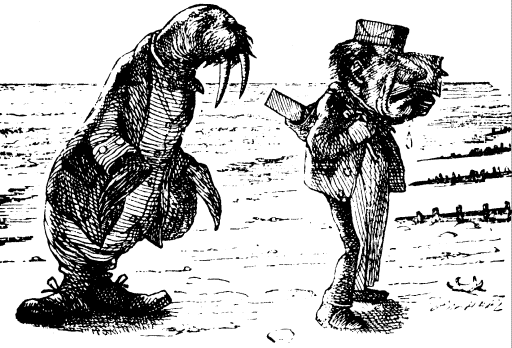
The sea was wet as wet could be,
The sands were dry as dry.
You could not see a cloud, because
No cloud was in the sky:
No birds were flying overhead--
There were no birds to fly.
The Walrus and the Carpenter
Were walking close at hand;
They wept like anything to see
Such quantities of sand:
"If this were only cleared away,"
They said, "it would be grand!"
"If seven maids with seven mops
Swept it for half a year.
Do you suppose," the Walrus said,
"That they could get it clear?"
"I doubt it," said the Carpenter,
And shed a bitter tear.
"O Oysters, come and walk with us!"
The Walrus did beseech.
"A pleasant walk, a pleasant talk,
Along the briny beach:
We cannot do with more than four,
To give a hand to each."
The eldest Oyster looked at him,
But never a word he said:
The eldest Oyster winked his eye,
And shook his heavy head--
Meaning to say he did not choose
To leave the oyster-bed.
But four young Oysters hurried up,
All eager for the treat:
Their coats were brushed, their faces washed,
Their shoes were clean and neat--
And this was odd, because, you know,
They hadn't any feet.
Four other Oysters followed them,
And yet another four;
And thick and fast they came at last,
And more, and more, and more--
All hopping through the frothy waves,
And scrambling to the shore.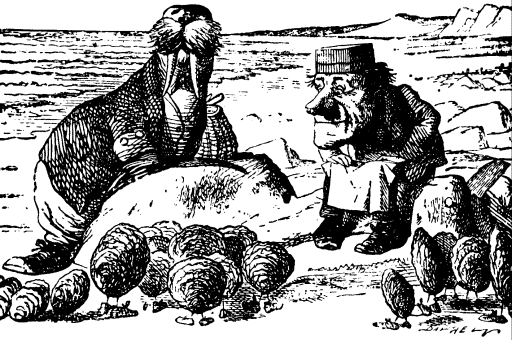
The Walrus and the Carpenter
Walked on a mile or so,
And then they rested on a rock
Conveniently low:
And all the little Oysters stood
And waited in a row.
"The time has come," the Walrus said,
"To talk of many things:
Of shoes--and ships--and sealing-wax--
Of cabbages--and kings--
And why the sea is boiling hot--
And whether pigs have wings."
"But wait a bit," the Oysters cried,
"Before we have our chat;
For some of us are out of breath,
And all of us are fat!"
"No hurry!" said the Carpenter.
They thanked him much for that.
"A loaf of bread," the Walrus said,
"Is what we chiefly need:
Pepper and vinegar besides
Are very good indeed--
Now if you're ready, Oysters dear,
We can begin to feed."
"But not on us!" the Oysters cried,
Turning a little blue.
"After such kindness, that would be
A dismal thing to do!"
"The night is fine," the Walrus said.
"Do you admire the view?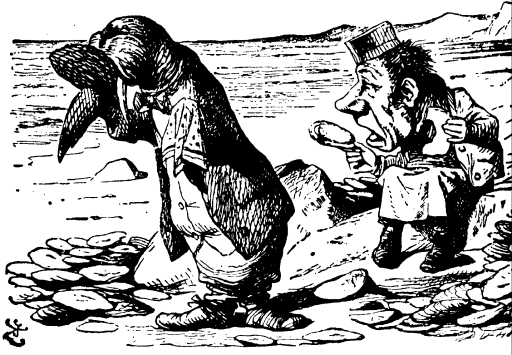
"It was so kind of you to come!
And you are very nice!"
The Carpenter said nothing but
"Cut us another slice:
I wish you were not quite so deaf--
I've had to ask you twice!"
"It seems a shame," the Walrus said,
"To play them such a trick,
After we've brought them out so far,
And made them trot so quick!"
The Carpenter said nothing but
"The butter's spread too thick!"
"I weep for you," the Walrus said:
"I deeply sympathize."
With sobs and tears he sorted out
Those of the largest size,
Holding his pocket-handkerchief
Before his streaming eyes.
"O Oysters," said the Carpenter,
"You've had a pleasant run!
Shall we be trotting home again?'
But answer came there none--
And this was scarcely odd, because
They'd eaten every one.
dshaw@jabberwocky.com
Return to Lewis Carroll
Return to Jabberwocky
Subscribe to:
Posts (Atom)

 Posts
Posts


I think that among not just billionaires, but multimillionaires in general, confidence is pretty high right now. In particular, they're confident that the financial crisis will be borne by the lower echelons, and that capitalism is being made safer and safer for unbridled rapacity.
They're also confident a large reserve army of unemployed labor will persist for a long time, ensuring that downward pressure on wages will not be relieved by any silly jobs program or other needed public investment
Their confidence that the massive military/industrial/national security expenditures of recent decades will continue is high.
Plutocratic confidence that trade agreements will be focused on making it as easy as possible to ruthlessly exploit cheap labor oversees without having to worry about workplace safety or environmental nonsense, while cracking down on foreign competitors via enforcement of intellectual property claims, whining about state subsidies, or whining about competitors' non-compliance with US regulatory standards.
Finally, they're confident that the socialistic insanity of Social Security, Medicare, and other forms of coddling US citizens will be progressively dismantled so that the richest can slave-drive the rest with utter abandon and, indeed, get them to vote for ever more savage forms of their own enslavement, abasement, degradation, and pauperization.
"Always, at every moment, there will be the thrill of victory, the sensation of trampling on an enemy who is helpless. If you want a picture of the future...
http://youtu.be/-YXWl6i2GBg
WAR IS PEACE, FREEDOM IS SLAVERY, and IGNORANCE IS STRENGTH!