
Monday, April 23, 2012
More On Europe And The US
Good article in today's Guardian concerning the economic and political turmoil in Europe and the continued intransigence of her economic leaders. The author, Robin Wells, predicts the US may suffer collateral damage.

Spain In Recession
It was announced this morning that Spain is officially in recession. Not a surprise. Spain, like other countries in the periphery of Europe, has been pressed by Germany and the European Central Bank to pursue policies of economic austerity. This is guaranteed to make things worse. Paul Krugman recently (and accurately) identified what was happening in Spain as insane.
But the insanity is not confined to Spain. It is happening everywhere in Europe, but voters are beginning to push back. Spain's unemployment rate, by the way is 23.6% and among young people about 50%. Austerity will make this worse. Is Europe committing economic suicide? Or just political suicide?
In the Netherlands, already in recession, the government has resigned after failing to get approval for further austerity measures.
Guess what? The economic measures causing such distress in Europe are just like the ones contained in Paul Ryan's budget.
Two years ago, the Republican narrative was that it was the budget deficit that caused the economic decline and loss of jobs. I would call that an intentional lie, except there are some voodoo economists playing for team Republican who still hawk those wares.
But it isn't true. It is true that economic crises and the resulting loss of jobs and income causes budget deficits. More government spending is still the most effective and speedy remedy for declines in aggregate demand that result from unemployment, even while spending on such safety net measures as extended unemployment benefits protects businesses from even more precipitous declines in their customer base.
But the insanity is not confined to Spain. It is happening everywhere in Europe, but voters are beginning to push back. Spain's unemployment rate, by the way is 23.6% and among young people about 50%. Austerity will make this worse. Is Europe committing economic suicide? Or just political suicide?
In the Netherlands, already in recession, the government has resigned after failing to get approval for further austerity measures.
Guess what? The economic measures causing such distress in Europe are just like the ones contained in Paul Ryan's budget.
Two years ago, the Republican narrative was that it was the budget deficit that caused the economic decline and loss of jobs. I would call that an intentional lie, except there are some voodoo economists playing for team Republican who still hawk those wares.
But it isn't true. It is true that economic crises and the resulting loss of jobs and income causes budget deficits. More government spending is still the most effective and speedy remedy for declines in aggregate demand that result from unemployment, even while spending on such safety net measures as extended unemployment benefits protects businesses from even more precipitous declines in their customer base.
Sunday, April 22, 2012
Europe On The Edge
This weekend's elections in France may portend a serious shakeup in European politics. Nicolas Sarkozy lost the first round of elections to the Socialist candidate, Francois Hollande. There will be a runoff election between these two leading candidates on May 6.
I had previously suggested that the first decade of the Euro could well be the last. For awhile, it appeared that the Greek government might be the most vulnerable in Europe to a repudiation by the electorate of austerity measures. Clearly this past weekend, French voters sent a strong signal. It seems increasingly likely that European voters in other countries will reject the austerity forced on them by the European Central Bank under the strong influence of Germany.
"It [the election] may also represent the first stirrings of a challenge to the German-dominated narrative of the euro crisis, which holds that public debt and runaway spending are the main culprits and that austerity must precede growth." - NY Times.
It has been obvious to what I would call the sensible economists (those of a Keynesian bent) for a long time that austerity in a time of recession will not lead to growth. It should have been equally obvious to political leaders that intentionally causing a depression in one's own country is not a recipe for reelection.
Over the weekend, the Dutch government failed to gain majority support for austerity measures, and more Czechs turned out to protest a tax increase and budget cuts than any protest since 1989.
I had previously suggested that the first decade of the Euro could well be the last. For awhile, it appeared that the Greek government might be the most vulnerable in Europe to a repudiation by the electorate of austerity measures. Clearly this past weekend, French voters sent a strong signal. It seems increasingly likely that European voters in other countries will reject the austerity forced on them by the European Central Bank under the strong influence of Germany.
"It [the election] may also represent the first stirrings of a challenge to the German-dominated narrative of the euro crisis, which holds that public debt and runaway spending are the main culprits and that austerity must precede growth." - NY Times.
It has been obvious to what I would call the sensible economists (those of a Keynesian bent) for a long time that austerity in a time of recession will not lead to growth. It should have been equally obvious to political leaders that intentionally causing a depression in one's own country is not a recipe for reelection.
Over the weekend, the Dutch government failed to gain majority support for austerity measures, and more Czechs turned out to protest a tax increase and budget cuts than any protest since 1989.
Other countries whose voters increasingly press for growth instead of austerity include Great Britain, Spain and Italy.
It may be possible to rescue the Euro, but it looks more and more difficult.
Friday, April 20, 2012
Chickens In Cary
Just noted in the News and Observer:
"Cary is set to legalize backyard chickens as
early as this summer. A 5-2 majority of the Cary Town Council has
endorsed a plan to allow six hens per house in backyard coops across
town.
"The governing board on Thursday night suggested that residents pay a $50 initial fee and an as-yet undetermined annual fee for the chicken-keeping priviledge.
Mayor Harold Weinbrecht and Councilman Jack Smith voted against the overall idea of backyard chicken legalization, but will help shape a compromise ordinance. The new rules would take effect immediately upon adoption in June or July."
Some of us on Oriental's town board tried three years ago to modify our ordinance, (a disguised anti-chicken provision) to allow backyard chickens in our small rural town, population 900, at the end of the highway. I was astounded at the opposition.
If Cary, a town of 94,000 with an urban/suburban environment can have chickens, how come we can't?
"The governing board on Thursday night suggested that residents pay a $50 initial fee and an as-yet undetermined annual fee for the chicken-keeping priviledge.
Mayor Harold Weinbrecht and Councilman Jack Smith voted against the overall idea of backyard chicken legalization, but will help shape a compromise ordinance. The new rules would take effect immediately upon adoption in June or July."
Some of us on Oriental's town board tried three years ago to modify our ordinance, (a disguised anti-chicken provision) to allow backyard chickens in our small rural town, population 900, at the end of the highway. I was astounded at the opposition.
If Cary, a town of 94,000 with an urban/suburban environment can have chickens, how come we can't?
Thursday, April 19, 2012
Town Of Oriental Announcement
Just in - or at least I just noticed:
Special Parks & Recreation Board Meeting - April 24, 2012 8:00 am to begin on the corner of South Ave. and Ave. A.
Parks & Recreation Board will begin their
meeting at 8 am near the corner of South Ave and Ave A to discuss design
concepts for a new town pier/dock. Meeting will continue at 8:30 am in
the Baptist Church on Broad Street.
For more information please contact town hall at 249-0555.
For more information please contact town hall at 249-0555.
Secret Police In The Heart Of Europe
Here's the latest report from Hungary. On the theory that if something walks like a duck and quacks like a duck, it probably is a duck, this sounds like a dictatorship under construction.
Can Europe stand up to Hungary? The world wonders.
Can Europe stand up to Hungary? The world wonders.
Ladies And Gentlemen: Cast Your Ballots!
The 2012 election is underway in Pamlico County. Tuesday this week, the county board of elections held its first weekly absentee meeting of the primary and validated four absentee ballots cast by mail. These ballots are safeguarded and will not be counted until May 8.
In the meantime, "one-stop" voting started today at the board of elections office in Bayboro. These votes also will not be counted until May 8.
Many Pamlico County residents have found that one stop voting is more convenient than waiting until election day. In fact, at the 2008 general election, about two-thirds of the votes were cast at one-stop.
The election has begun.
In the meantime, "one-stop" voting started today at the board of elections office in Bayboro. These votes also will not be counted until May 8.
Many Pamlico County residents have found that one stop voting is more convenient than waiting until election day. In fact, at the 2008 general election, about two-thirds of the votes were cast at one-stop.
The election has begun.
Wednesday, April 18, 2012
April 18, 1942 Western Pacific
April 18, 1942 – Task Force 16
consisting of USS Enterprise (VADM
William F. Halsey, Commander Carriers Pacific embarked), USS
Hornet (carrying 16 US Army
B-25's under command of Lcol James Doolittle) and cruisers
Northampton, Salt Lake City, Vincennes and
Nashville, heading
265, speed 20 knots, bound for Tokyo, distance about 700 miles.
Early
morning, unexpected events began to pop. In the words of the
participants:
Commanding
Officer, USS Enterprise:
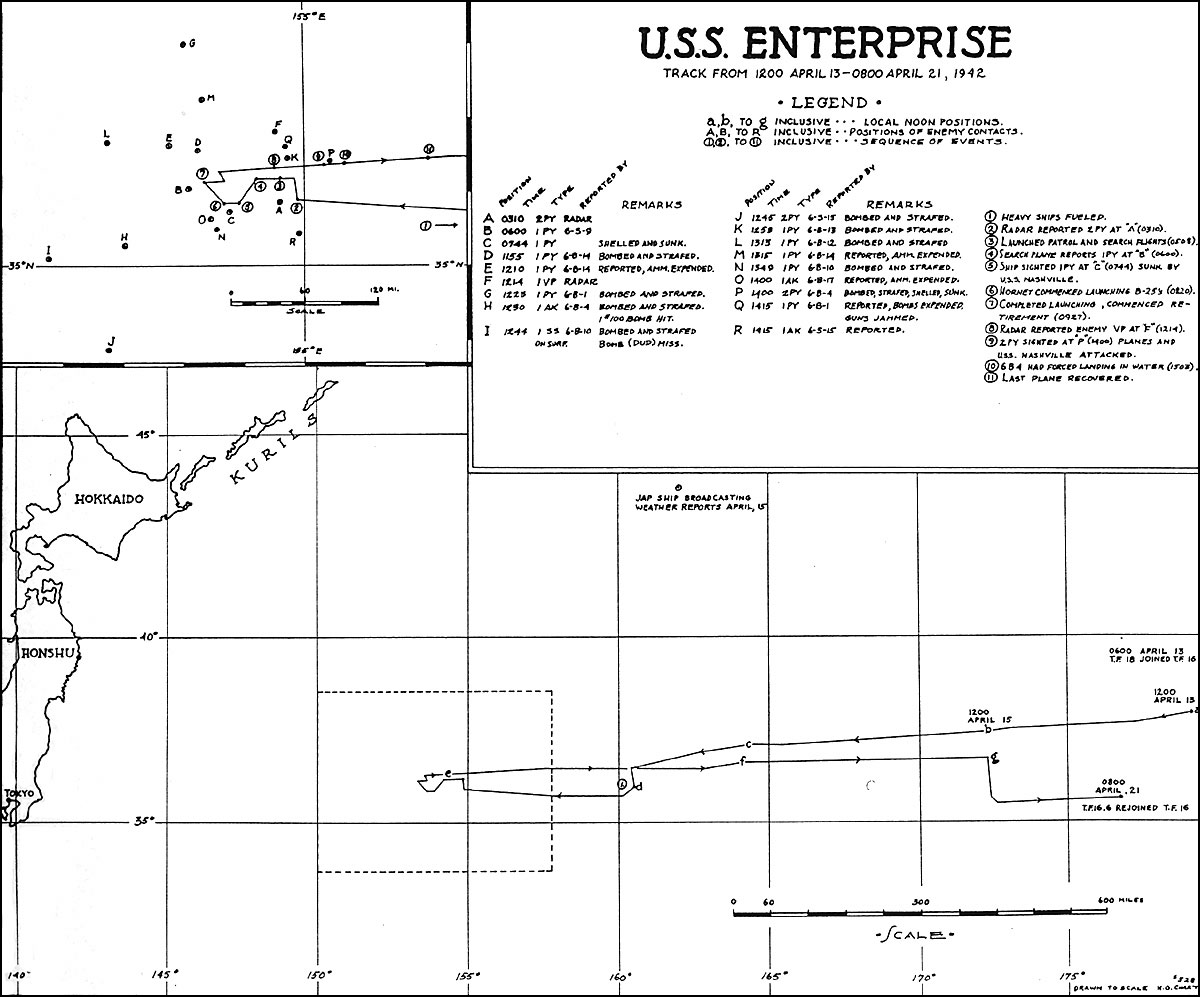
- “At 0310 radar disclosed two enemy surface craft bearing 255°T., distance 21,000 yards, and at 0312 a light was seen approximately on that bearing. Ship went to General Quarters, set Material Condition Afirm and energized the degaussing gear. Course of the Force was changed to 350°T., and at 0341 the two enemy vessels went off the screen bearing 201°T., distance 27,000 yards. Our presence was apparently unnoticed by the enemy and a westerly course was resumed at 0415.
- “At 0508 fighter patrol and search flight were launched. At 0715 one search plane returned and, by message drop, reported sighting an enemy patrol vessel in Latitude 36° 04' North and Longitude 153° 10' East at 0558 and that he believed he had been seen. Later developments indicate that this vessel made the original contact report.
- “At 0744 an enemy patrol vessel was sighted bearing 221°T., distance approximately 10,000 yards. There was no doubt now that our force had been detected and almost certainly had been reported. NASHVILLE was ordered to sunk the patrol vessel by gunfire as the carriers turned into the wind (320°T., 26 knots); HORNET to launch Army B-25's for attack and ENTERPRISE to relieve patrol.s The first Army bomber was launched at 0820 approximately 650 miles from Tokyo, and the last one was off at 0921. At 0927 the Force commenced retirement on course 090°T., speed 25 knots.
- “At 1214 radar reported enemy patrol plane bearing 020°T., distance 70,000 yards. This plane came within 64,000 yards of our force but passed off the screen at 1228 bearing 314°T., distance 83,000 yards.
- “At 1400 two enemy patrol vessels were sighted and attacked by ENTERPRISE planes returning from search. One was sunk and the other damaged. By 1413 the enemy ship still afloat was in sight of our surface forces and NASHVILLE was ordered to attack and sink her. A white flag was broken in the enemy ship and after taking 5 prisoners, NASHVILLE sank her by gunfire. Apparently these two vessels were the same ones reported by radar at 0310.
“Our
force had been detected and almost certainly been reported...”
sounds like speculation. But in a secure communications space in
Enterprise, navy
Communications Technician Ray Rundle was monitoring Japanese
communications. He intercepted a warning message from a nearby patrol
boat. Rundle's report caused Halsey to act.
Halsey
had half of the US Navy's Pacific Fleet Carrier Force within range of
Japanese shore-based bombers. As of mid-April, Yamamoto had 11
aircraft carriers at his disposal compared to Halsey's 4. USS
Yorktown was operating in the
Coral Sea area, and USS Lexington was
in the shipyard at Pearl Harbor having her original 8-inch guns
removed and replaced with modern antiaircraft weapons. The fifth
Pacific Fleet carrier, USS Saratoga,
was in drydock in Bremerton, having her hull repaired from a Japanese
torpedo. The other aircraft carriers, the much smaller Ranger
and Wasp,
were in the Atlantic.
USS Essex
was under construction at Newport News, and wouldn't be launched for
three more months.
So
Halsey had to weigh any risk of losing a carrier very carefully. Here
is Halsey's account:
“The successful launching of the 16 Army bombers from the HORNET in unfavorable wind and sea conditions reflected great credit on the Army pilots and on the Commanding Officer of the HORNET.”
Here is the track of Task Force 16 to and from the launch point:


Sixteen planes, each with a five-man crew, took off that day. They reached their targets in the Tokyo area about six hours after launch, flying without an autopilot, using celestial navigation over water and visual navigation over land, then flew seven more hours to the vicinity of landing fields in China. They ran out of fuel before reaching the fields in unoccupied China, were flying after dark, and the fields were not transmitting homing signals. They had to ditch or bail out. All of the planes were lost, including one interned by the Soviet Union. Of the eighty crew members, 77 survived the raid, but Japanese executed three prisoners and one died of malnutrition and mistreatment.
I first learned of the raid by watching the movie, "Thirty Seconds Over Tokyo," starring Spencer Tracy and Van Johnson, at the Will Rogers Theater in Tulsa, Oklahoma in 1945.
It's still a great movie.
The raid took place four months and 11 days after Pearl Harbor.
Subscribe to:
Posts (Atom)

 Posts
Posts

