Sunday, December 2, 2012

Seventy Years Ago: 27th Air Depot Group In Australia

The 27th Air Depot Group had set up a temporary headquarters at Amberly Airfield, west of Ipswich not far from Brisbane. The Group refined their organization, conducted training and unloaded and sorted equipment in preparation for their planned move to New Guinea. They obtained heavy equipment to use for building their own warehouses, camps and hangars once they arrived in New Guinea. They were even to build their own airstrips.

But things were still unsettled in New Guinea.

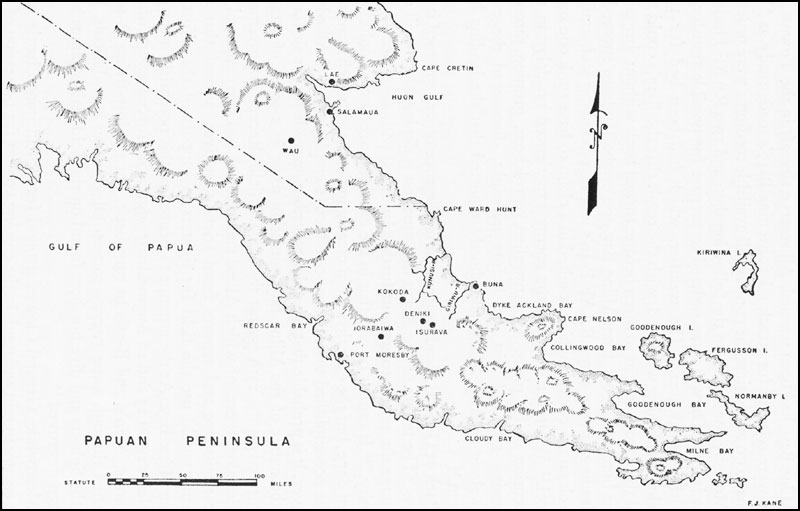
http://www.ibiblio.org/hyperwar/AAF/IV/maps/AAF-IV-6.jpg

During the early days days of September the Directorate of Air Transport had pressed every available plane, whether civil or military, into service to ferry an Australian regiment from Brisbane to Port Moresby. By 15 September, the exhausted troops facing the Japanese in the ridges above Port Moresby had been reinforced by three fresh Australian battalions; and on that same day the first American infantrymen to reach New Guinea, Company E, 126th Infantry of the 32d Division, landed by transport plane at Seven-Mile Airdrome. This had been a test flight to determine the feasibility of moving units by air transport, and by 24 September the 128th Infantry Regiment, less artillery, had been flown to Port Moresby, where the remainder of the 126th Infantry came in by water on 28 September. On that day the reinforced Australians launched an attack which broke the enemy's defenses on Iorabaiwa Ridge and then in the face of tenacious resistance forced their way back toward Kokoda. Though it would take over a month to reach that place, with its useful airfield, the turning point in the Japanese attempt to take Port Moresby from the rear had come. Bitter fighting lay ahead, but the battle soon would be for Buna instead of for Moresby.

It had been necessary for army air force leaders to divide their attention between operations and reorganization. General Kenney had been preceded to Australia by Brig. Gens. Ennis C. Whitehead, an experienced fighter commander, and Kenneth N. Walker, expert in bombardment aviation; Brig. Gen. Donald Wilson, whom Kenney proposed to use as chief of staff, soon followed. Plans, on which General Kenney had been briefed in Washington, called for organization of American units into a distinct air force that would be largely free of obligations for the immediate defense of Australia in order to concentrate on support of a rapidly moving offensive to the north. On 7 August, three days after Kenney assumed command in Australia, MacArthur requested authorization for an American air force and suggested the designation of Fifth Air Force in honor of his fighter and bomber commands in the Philippines. This request was promptly granted, and the Fifth Air Force was officially constituted on 3 September. Kenney immediately assumed command, retaining in addition his command of the Allied Air Forces.

Problems of maintenance loomed large. In August Kenney described maintenance on his B-17's: "We are salvaging even the skin for large patchwork from twenty millimetre explosive fire; to patch up smaller holes we are flattening out tin cans and using them. Every good rib and bulkhead of a wrecked airplane is religiously saved to replace shot up members of other airplanes. Lack of bearings for Allison engines grounded many fighters; requisitioned in August, the bearings were not available for shipment until October, by which time main bearings in five out of six engines needed changing. Improper tools for Pratt & Whitney engines delayed repair of grounded B-26's and transports. Most discouraging of all was the difficulty getting the P-38's ready for combat. By October approximately sixty of these fighters had reached the theater, but none had seen combat. First, the fuel tanks began to leak, requiring repair or replacement, and then superchargers, water coolers, inverters, and armament all required major adjustment or repair. As a consequence, it was not until late in December that P-38's flew a major combat mission over New Guinea.

While preparing for the eventual move to New Guinea, the 27th Air Depot Group, trained and organized to rebuild aircraft, joined in the effort to keep the aircraft flying. 

Social Security And The Deficit

I listened to about as much as I could take of Meet The Press this morning. The conversation about negotiations over the Fiscal Cliff was particularly inane.

Worse than that, it was dangerous for the future of American working people.

Let me try to put it clearly:

1.  Our budget deficits have not caused a loss of jobs;

2.  Our loss of jobs has caused the budget deficits;

3.  Job one is jobs;

4.  Reduced federal spending right now will increase unemployment;

5.  The super rich don't create jobs;

6.  Spending by ordinary citizens does create jobs;

7.  Republicans do not now and never have been concerned about deficit spending - their concern is that ordinary people rather than the super wealthy might benefit;

8.  Social Security does not contribute to the deficit.

Here are some recent blog posts that address the issues. Rather than attempt to summarize them, I'll just post the links:


http://baselinescenario.com/2012/11/28/social-security-and-the-national-debt/

http://jaredbernsteinblog.com/when-youre-trying-to-decide-if-we-need-to-renew-the-payroll-tax-break-picture-this/

http://economistsview.typepad.com/economistsview/2012/12/should-we-extend-the-payroll-tax-cut.html

http://www.huffingtonpost.com/jonathan-weiler/republican-party-zero-credibility_b_2219085.html

http://krugman.blogs.nytimes.com/2012/12/02/the-full-mcconnell/

http://economistsview.typepad.com/economistsview/2012/12/lets-get-serious-about-getting-serious.html

http://swampland.time.com/2012/11/30/fiscal-cliff-fictions-lets-all-agree-to-pretend-the-gop-isnt-full-of-it/ 

http://www.nytimes.com/2012/12/03/opinion/krugman-the-big-budget-mumble.html?ref=opinion

http://economistsview.typepad.com/economistsview/2012/11/the-outlook-has-already-improved.html 

http://www.motherjones.com/kevin-drum/2012/11/no-social-security-trust-fund-isnt-fiction

Read them all. There are more, but these are enough to get the idea. From the Republican point of view, the only proposals that qualify as "serious" are those that hurt poor and middle class citizens and benefit the well off. They and their supporters are willing to spend big bucks promoting such ideas and opposing ideas that benefit working people.

The only way ordinary working people can stand up to the plutocrats and their stooges and dupes is to use the vote.

Friday, November 30, 2012

Sixty-Eight Years Ago: Buried Spitfires

In August, 1945, Royal Air Force troops in Burma had received perhaps as many as 140 brand new Spitfires in shipping crates. No longer needed for the war effort, and with faster aircraft coming off the production lines, what to do with them?

Apparently it was decided to bury them in their shipping crates.

Nearly seventy years later, following British abandonment of Burma as a colony and decades of political turmoil, improving relations have led to discovery of some of those aircraft after a sixteen-year search by a British farmer and aviation enthusiast.

There are various versions of the story and a number of curious aspects. For example, apparently the burying was done by the US Army. The project was helped along by the intervention of the British Prime Minister with Myanmar officials.

It is expected that excavation will begin after the first of the year. Only then will the presence of the aircraft be confirmed. The first site excavated will be near the runway at the Yangon (formerly known as Rangoon) international airport. There may be other burial sites as well.

Stand by for further news.

Thursday, November 29, 2012

Seventy Years Ago: Battle Of Tassafaronga

Japanese Army forces on Guadalcanal were desperately short of food and on November 26, 1942, radioed pleading for more. The previous three weeks, only submarines had been able to deliver supplies. Each submarine delivered about a days' supply, but the difficulty of offloading and delivering the food through the jungle reduced what reached the troops. The troops were living on one-third rations.

Japan had resorted to submarines because they were unable to rely on surface ships. A combination of US aircraft operating from Henderson Field on Guadalcanal, US PT Boats operating from Tulagi and US surface warships had prevented Japanese resupply operations by ship.

The Japanese developed a new plan. Resupply by high speed destroyers carrying floating drums of food and medical supplies. The drums, connected to each other by line, were to be carried on the decks of six destroyers, escorted by two more. The destroyers would approach at high speed, drop the drums overboard and return to base. Soldiers would swim out and recover the drums.

Following the Naval Battle of Guadalcanal, Admiral Halsey, Commander of the Southern Pacific Command, reorganized his surface warfare forces, forming a new Task Force, TF 67, at Espiritu Santo in the New Hebrides, about 580 miles from Guadalcanal. The Task Force, initially under RADM Kinkaid, was reassigned to RADM Carleton H. Wright on November 28.

TF 67's job: intercept and destroy any Japanese surface force coming to the aid of Japanese forces on Guadalcanal.

The U.S. victory at the Battle of Guadalcanal had cost Halsey 18 ships sunk or so badly damaged that extensive repairs were required. With the exception of destroyers, Halsey's only available surface units were the carrier Enterprise, the battleship Washington, and the light cruiser San Diego at Noumea and the heavy cruisers Northampton and Pensacola at Espiritu Santo.

Several other ships were en route to the South Pacific. By 25 November, as intelligence was piecing together a clearer picture of Japanese plans, Halsey had assembled a force adequate to counter the expected offensive. At Nandi in the Fijis lay the carrier Saratoga, the battleships North Carolina, Colorado, and Maryland, and the light cruiser San Juan. The heavy cruisers New Orleans, Northampton, and Pensacola, and the light cruiser Honolulu were stationed at Espiritu Santo. These last two, together with the heavy cruiser Minneapolis which arrived on the 27th, had come from Pearl Harbor. Here also on the 27th were the destroyers Drayton (which had accompanied the Minneapolis), Fletcher Maury, and Perkins.
 
On 27 November, these 5 cruisers and 4 destroyers at Espiritu Santo were grouped in to a separate task force, Task Force William, under the command of Rear Admiral Thomas C. Kinkaid, with general instructions from Halsey to intercept any Japanese surface forces approaching Guadalcanal. Admiral Kinkaid prepared a detailed set of operational orders for the Force, but, before he could go over them with his captains, he was ordered to other duty. He was replaced by Rear Admiral Carleton H. Wright, who had just made port in the Minneapolis.

Task Force William consisted of four heavy cruisers: Minneapolis, New Orleans, Northampton and Pensacola. Admiral Wright was embarked in Minneapolis;
One light cruiser: Honolulu, with RADM Tisdale embarked; Four destroyers: Drayton, Fletcher, Maury, Perkins. USS Fletcher was the fleet's newest and most powerful destroyer. Her CO, Commander William M. Cole, was in charge of the destroyer unit.


On 29 November the Task Force was moored at Espiritu Santo on 12 hours notice for getting underway. Admiral Wright held a conference, attended by Admiral Tisdale and the commanding officers of the 9 ships, at which the operation plan drawn up by Admiral Kinkaid was "briefly discussed."

At 1940 Admiral Wright received orders to prepare to depart with his force at the earliest possible moment, and to proceed at the best possible speed to intercept an enemy group of 6 destroyers and 6 transports which was expected to arrive off Guadalcanal the next night. He directed Task Force WILLIAM to make all preparations necessary to get under way immediately, and advised COMSOPAC that his ships would be ready to sortie at midnight.

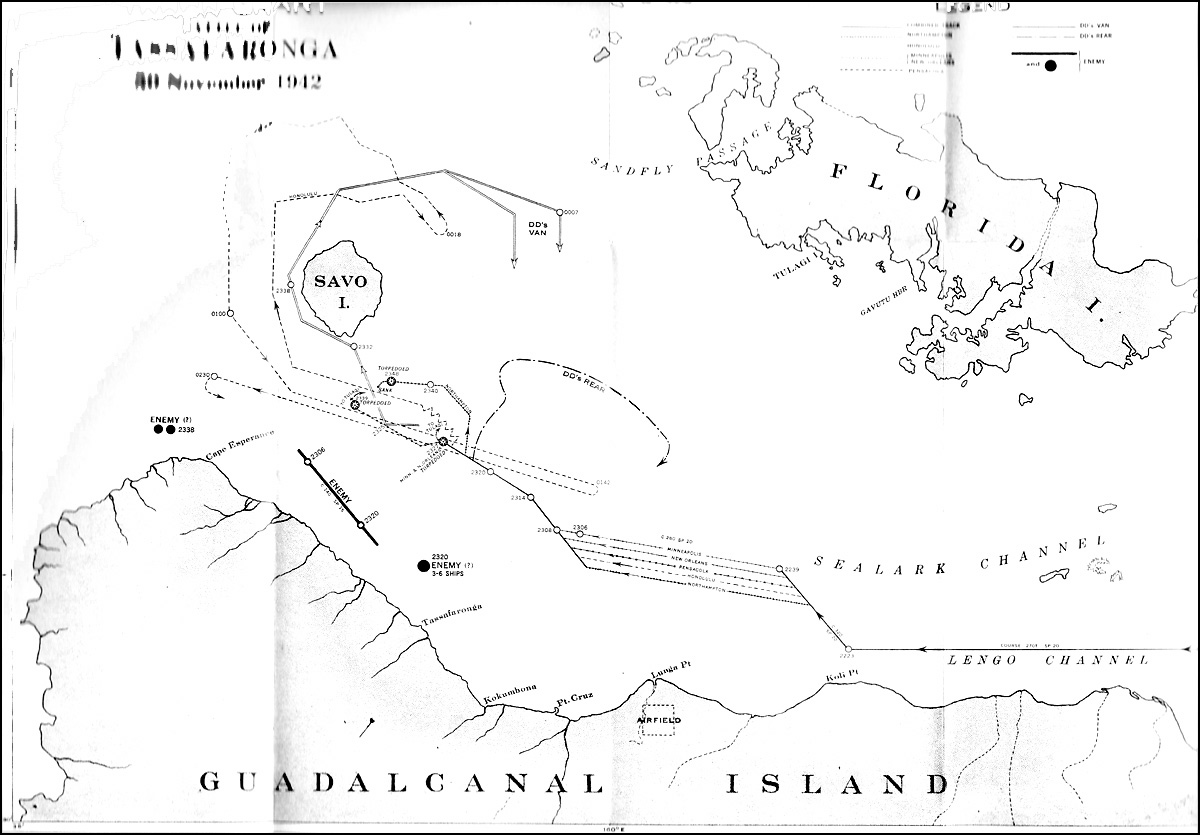
Three hours later COMSOPAC ordered Admiral Wright to proceed with all available units, pass through Lengo Channel (between Guadalcanal and Florida Islands), and intercept the Japanese off Tassafaronga on the northwestern shore of Guadalcanal. Later, Admiral Wright received information that enemy combatant ships might be substituted for the transports, or that the Japanese force might consist wholly of destroyers, and that a hostile landing might be attempted off Tassafaronga earlier than 2300, 30 November. He received no further advices respecting the size or composition of the opposing units.

Admiral Wright promptly put into effect, with minor modifications, Admiral Kinkaid's operation plan, and set midnight as the zero hour for his ships to sortie. Actually the destroyers got under way at 2310, the cruisers at 2335. The whole Force cleared the well-mined, unlighted harbor of Espiritu Santo without incident and shaped its course to pass northeast of San Cristobal Island.
http://www.ibiblio.org/hyperwar/USN/USN-CN-Tassafaronga/maps/USN-CN-Tassafaronga-1.jpg

 Task Force WILLIAM cleared Lengo Channel at 2225 at a speed of 20 knots. Its average speed made good from midnight, 29 November, when it left Espiritu Santo until it entered Lengo Channel at 2140, 30 November, was 28.2 knots. The cruisers steamed in column, 1,000 yards apart, while the destroyers in the van bore 300° T., 4,000 yards from the Minneapolis. The night was very dark, the sky completely overcast. Maximum surface visibility was not over 2 miles.

Admiral Wright had prepositioned sea planes from the cruisers at Tulagi. Their instructions were to take off in time to patrol the area between Cape Esperance and Lunga Point starting at 2200. They carried flares to drop at Admiral Wright's command. The rest of Admiral Wright's plan depended on using the Navy's new SG surface search radar to gain the advantage of surprise. The four destroyers were in the van (ahead), followed by the cruisers steaming in column 1,000 yards apart. Two additional destroyers, Lamson and Lardner, joined the force at 2100, bringing up the rear. Lamson's CO, Commander Abercrombie, was senior to Cole, but had no copies of the plan, no surface radar, and no knowledge of what was going on. He was therefore unable to assume command of the destroyer force.

At 2306, Minneapolis' SG radar picks up two objects off Cape Esperance. At 2316, Cdr Cole, in accordance with the plan, requested permission to launch torpedo attack on enemy formation of 5 ships, distant 7,000 yards.

About 2321, Admiral Wright ordered ships to commence firing star shells (for illumination) and explosive shells. Apparently TF 67 had caught the Japanese by surprise. The force engaged eight Japanese destroyers or cruisers using fire control radar for aiming. After a few minutes, four of the radar targets disappeared from the radar and some were visually seen to explode and sink.

There was some confusion in attempts to correlate ranges and bearings of Japanese ships, but as of 2326, it appeared that TF67 had won a great victory.

At 2327 a Japanese torpedo struck Minneapolis', blowing off her bow. The ship kept firing until her engineering plant failed and lost power. At 2328, New Orleans was torpedoed, losing her bow as far aft as Turret II. At 2329, a torpedo struck Pensacola on the port side aft, the ship erupted in flames, and fire raged for hours. At 2348, Northampton was torpedoed. Despite valiant efforts to save her, she finally sank about 0300.

Thus, within a few minutes, what had seemed a great victory turned into a resounding loss. One US heavy cruiser sunk, three out of action for months, 395 sailors killed.

As it turned out, only one Japanese destroyer was lost and 197 killed.

Even so, TF67 succeeded in preventing Japanese resupply of their troops on Guadalcanal.

The battle revealed continuing shortcomings in the use of radar.

The surface force was not yet aware that reliability problems affecting submarine torpedoes also applied to those launched by surface ships. Corrective action was many months away.

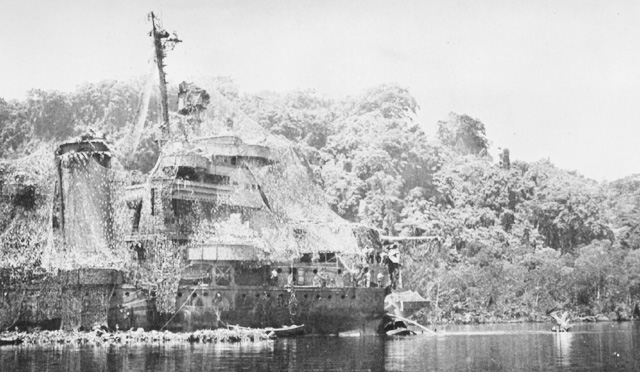
But damage control and firefighting crews performed magnificently. It is almost inconceivable that Minneapolis, New Orleans and Pensacola were saved and lived to fight another day.
http://www.ibiblio.org/hyperwar/USN/USN-CN-Tassafaronga/img/USN-CN-Tassafaronga-2.jpg
New Orleans at Tulagi

http://upload.wikimedia.org/wikipedia/commons/7/7f/USS_Minneapolis_after_Tassafaronga.jpg

 Minneapolis at Tulagi

 The US Navy still did not know how powerful and effective Japanese type 93 surface-launched torpedoes were. Admiral Wright, in his after action report, still thought the sips had been torpedoed by undetected submarines. There were, after all, no Japanese surface ships within what we believed to be torpedo range.

We would not learn of their technological superiority until later in 1943, when intact torpedoes were captured.

Tuesday, November 27, 2012

Another Good Piece By Bruce Bartlett

I've been reading articles by Bruce Bartlett recently with a sense of wonder. As in, I wonder when and why he started to make good sense.

Here, he answers that question in an article in The American Conservative.

I admire writers and thinkers who are concerned with policies that work (or could work) instead of personalities or doctrine.

Good for Bruce Bartlett.

As for his revelations about the Murdoch empire - suspicions confirmed.

Monday, November 26, 2012

Lincoln - Go See The Movie

We went to see "Lincoln" this afternoon. Everyone should see it. Not because of the great acting, though that was at least serviceable.

See it for the politics.

If you still think that the present exchange of vitriole among American political figures is unusual in our history, the movie should disabuse you of that notion.

The plot is centered on events leading to approval by the House of Representatives of the Thirteenth Amendment to abolish slavery. You might think this would be a slam dunk for Union politicians, especially Republicans. You'd be wrong.

See the movie and find out why.

Sunday, November 25, 2012

Seventy Years Ago: Nationwide Gas Rationing

There's a war on, you know! The soldiers need gasoline. And rubber is in short supply. November 26 saw nationwide gas rationing.

Take a look here at rationing books, stickers, stamps and rules.

Saturday, November 24, 2012

Scratching My Head Over GMO Amendment

I just took a look at the agenda for the Oriental Town Board meeting on December 4. A public hearing has been announced to discuss Growth Management Ordinance amendments addressing Adult Bookstores, Adult Entertainment, Internet Sweepstakes/Electronic Gaming, and Tattoo Parlors.

You can find the proposed texts here. Be sure to check it out soon - postings on the town web site are frequently removed rather quickly.

I'm sure there's a rational explanation for why the town is expending so much effort and concern on this subject, but danged if I can figure it out.

Tony Tharp, one of our erstwhile journalists, has tried to figure it out as well. Here's his take on it.

I could be wrong, but as far as I can tell, there is no place inside the town limits of Oriental that meets all the criteria set forth in the draft ordinances.

On the off chance that I'm wrong, one proposed ordinance measure for internet sweepstakes requires a $5,000 fee for a permit and a $2,500 fee per terminal or connection point, including wireless. The maximum number of terminals allowed is six. That adds up to $20,000 in fees just to get started. Plus a proposed annual tax of $2,500 per business and $500 per gaming machine in operation or stored on the premises. That adds up to $5,500.

By the way, we do not currently tax any business. For the past several years one of our board members repeatedly claimed that our fee for a sign permit ($25) was driving businesses out of Oriental.

Surely someone can explain all of this to me.