Japanese Army forces on Guadalcanal were desperately short of food and on November 26, 1942, radioed pleading for more. The previous three weeks, only submarines had been able to deliver supplies. Each submarine delivered about a days' supply, but the difficulty of offloading and delivering the food through the jungle reduced what reached the troops. The troops were living on one-third rations.
Japan had resorted to submarines because they were unable to rely on surface ships. A combination of US aircraft operating from Henderson Field on Guadalcanal, US PT Boats operating from Tulagi and US surface warships had prevented Japanese resupply operations by ship.
The Japanese developed a new plan. Resupply by high speed destroyers carrying floating drums of food and medical supplies. The drums, connected to each other by line, were to be carried on the decks of six destroyers, escorted by two more. The destroyers would approach at high speed, drop the drums overboard and return to base. Soldiers would swim out and recover the drums.
Following the Naval Battle of Guadalcanal, Admiral Halsey, Commander of the Southern Pacific Command, reorganized his surface warfare forces, forming a new Task Force, TF 67, at Espiritu Santo in the New Hebrides, about 580 miles from Guadalcanal. The Task Force, initially under RADM Kinkaid, was reassigned to RADM Carleton H. Wright on November 28.
TF 67's job: intercept and destroy any Japanese surface force coming to the aid of Japanese forces on Guadalcanal.
The U.S. victory at the Battle of Guadalcanal had cost Halsey 18 ships sunk or so badly damaged that extensive repairs were
required. With the exception of destroyers, Halsey's only
available surface units were the carrier
Enterprise, the
battleship
Washington, and the light cruiser
San Diego
at Noumea and the heavy cruisers
Northampton and
Pensacola
at Espiritu Santo.
Several other ships were en route to the South Pacific. By 25
November, as intelligence was piecing together a clearer picture of Japanese plans, Halsey
had assembled a force adequate to counter the expected offensive. At
Nandi in the Fijis lay the carrier
Saratoga, the battleships
North Carolina, Colorado, and
Maryland, and the
light cruiser
San Juan. The heavy cruisers
New Orleans,
Northampton, and
Pensacola, and the light cruiser
Honolulu were stationed at Espiritu Santo. These last two,
together with the heavy cruiser
Minneapolis which arrived on
the 27th, had come from Pearl Harbor. Here also on the 27th were the
destroyers
Drayton (which had accompanied the
Minneapolis),
Fletcher Maury, and
Perkins.
On 27 November, these 5 cruisers and 4 destroyers at Espiritu Santo were
grouped in to a separate task force, Task Force William, under the command of Rear
Admiral Thomas C. Kinkaid, with general instructions from Halsey to
intercept any Japanese surface forces approaching Guadalcanal.
Admiral Kinkaid prepared a detailed set of operational orders for the
Force, but, before he could go over them with his captains, he was
ordered to other duty. He was
replaced by Rear Admiral Carleton H. Wright, who had just made port
in the
Minneapolis.
Task Force William consisted of four heavy cruisers:
Minneapolis, New Orleans, Northampton and
Pensacola. Admiral Wright was embarked in
Minneapolis;
One light cruiser:
Honolulu, with RADM Tisdale embarked; Four destroyers:
Drayton, Fletcher, Maury, Perkins. USS
Fletcher was the fleet's newest and most powerful destroyer. Her CO, Commander William M. Cole, was in charge of the destroyer unit.
On 29 November the Task
Force was moored at Espiritu Santo on 12 hours notice for getting underway. Admiral
Wright held a conference, attended by Admiral Tisdale and the
commanding officers of the 9 ships, at which the operation plan drawn
up by Admiral Kinkaid was "briefly discussed."
At
1940 Admiral Wright received orders to prepare to depart with his
force at the earliest possible moment, and to proceed at the best
possible speed to intercept an enemy group of 6 destroyers and 6
transports which was expected to arrive off Guadalcanal the next
night. He directed Task Force WILLIAM to make all preparations
necessary to get under way immediately, and advised COMSOPAC that his
ships would be ready to sortie at midnight.
Three
hours later COMSOPAC ordered Admiral Wright to proceed with all
available units, pass through Lengo Channel (between Guadalcanal and
Florida Islands), and intercept the Japanese off Tassafaronga on the
northwestern shore of Guadalcanal. Later, Admiral Wright received
information that enemy combatant ships might be substituted for the
transports, or that the Japanese force might consist wholly of
destroyers, and that a hostile landing might be attempted off
Tassafaronga earlier than 2300, 30 November. He received no further
advices respecting the size or composition of the opposing units.
Admiral
Wright promptly put into effect, with minor modifications, Admiral
Kinkaid's operation plan, and set midnight as the zero hour for
his ships to sortie. Actually the destroyers got under way at 2310,
the cruisers at 2335. The whole Force cleared the well-mined,
unlighted harbor of Espiritu Santo without incident and shaped its
course to pass northeast of San Cristobal Island.
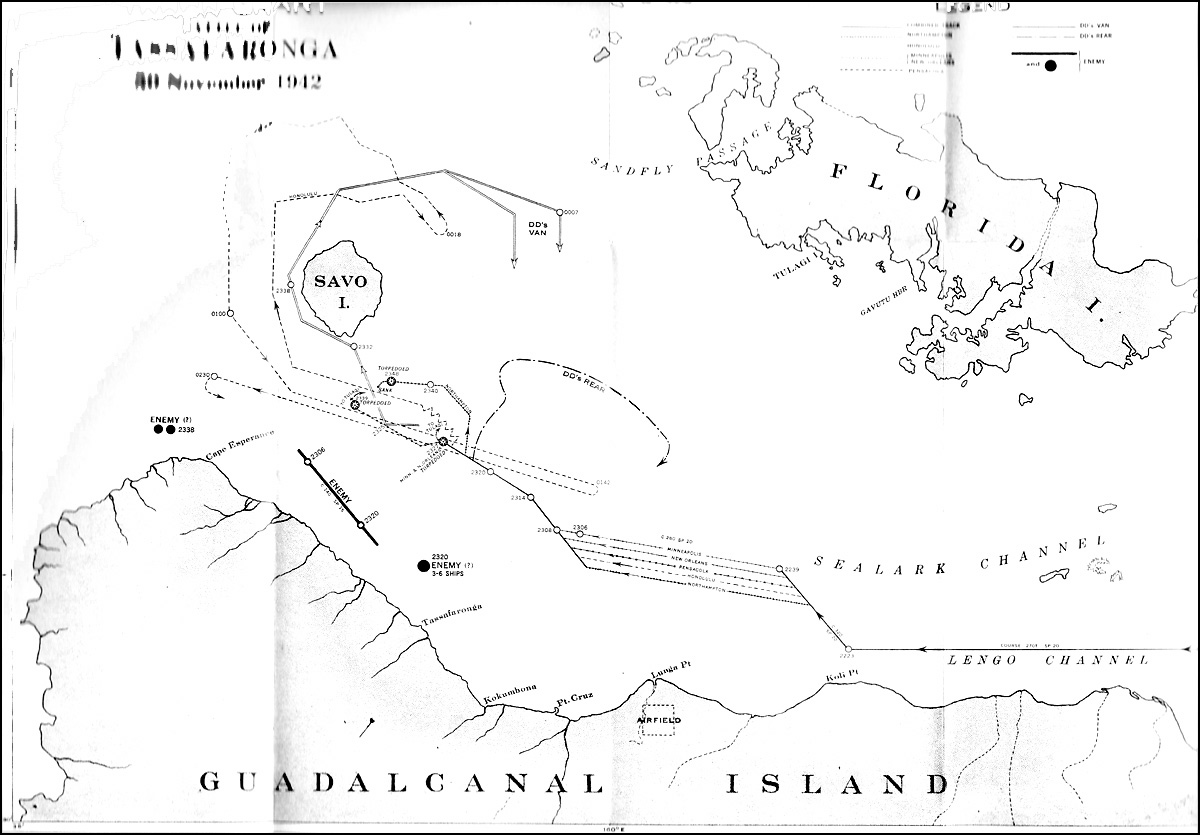
Task Force WILLIAM cleared Lengo Channel at 2225 at a speed of 20 knots.
Its average speed made good from midnight, 29 November, when it left Espiritu Santo until it
entered Lengo Channel at 2140, 30 November, was 28.2 knots. The
cruisers steamed in column, 1,000 yards apart, while the destroyers
in the van bore 300° T., 4,000 yards from the
Minneapolis.
The night was very dark, the sky completely overcast. Maximum
surface visibility was not over 2 miles.
Admiral Wright had prepositioned sea planes from the cruisers at Tulagi. Their instructions were to take off in time to patrol the area between Cape Esperance and Lunga Point starting at 2200. They carried flares to drop at Admiral Wright's command. The rest of Admiral Wright's plan depended on using the Navy's new SG surface search radar to gain the advantage of surprise. The four destroyers were in the van (ahead), followed by the cruisers steaming in column 1,000 yards apart. Two additional destroyers,
Lamson and
Lardner, joined the force at 2100, bringing up the rear.
Lamson's CO, Commander Abercrombie, was senior to Cole, but had no copies of the plan, no surface radar, and no knowledge of what was going on. He was therefore unable to assume command of the destroyer force.
At 2306,
Minneapolis' SG radar picks up two
objects off Cape Esperance. At 2316, Cdr Cole, in accordance with the plan, requested
permission to launch torpedo attack on enemy formation of
5 ships, distant 7,000 yards.
About 2321, Admiral Wright ordered ships to commence firing star shells (for illumination) and explosive shells. Apparently TF 67 had caught the Japanese by surprise. The force engaged eight Japanese destroyers or cruisers using fire control radar for aiming. After a few minutes, four of the radar targets disappeared from the radar and some were visually seen to explode and sink.
There was some confusion in attempts to correlate ranges and bearings of Japanese ships, but as of 2326, it appeared that TF67 had won a great victory.
At 2327 a Japanese torpedo struck
Minneapolis', blowing off her bow. The ship kept firing until her engineering plant failed and lost power. At 2328,
New Orleans was torpedoed, losing her bow as far aft as Turret II. At 2329, a torpedo struck
Pensacola on the port side aft, the ship erupted in flames, and fire raged for hours. At 2348,
Northampton was torpedoed. Despite valiant efforts to save her, she finally sank about 0300.
Thus, within a few minutes, what had seemed a great victory turned into a resounding loss. One US heavy cruiser sunk, three out of action for months, 395 sailors killed.
As it turned out, only one Japanese destroyer was lost and 197 killed.
Even so, TF67 succeeded in preventing Japanese resupply of their troops on Guadalcanal.
The battle revealed continuing shortcomings in the use of radar.
The surface force was not yet aware that reliability problems affecting submarine torpedoes also applied to those launched by surface ships. Corrective action was many months away.
But damage control and firefighting crews performed magnificently. It is almost inconceivable that
Minneapolis, New Orleans and
Pensacola were saved and lived to fight another day.
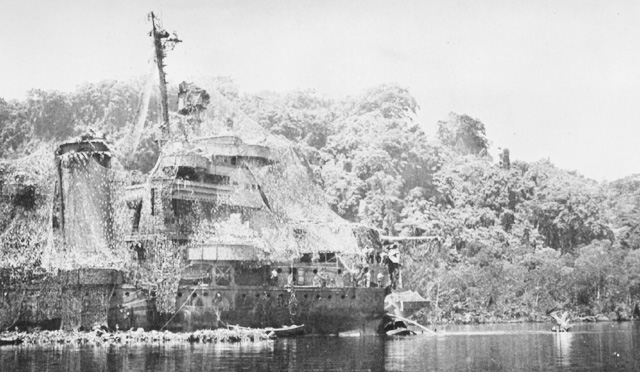
New Orleans at Tulagi

Minneapolis at Tulagi
The US Navy still did not know how powerful and effective Japanese type 93 surface-launched torpedoes were. Admiral Wright, in his after action report, still thought the sips had been torpedoed by undetected submarines. There were, after all, no Japanese surface ships within what we believed to be torpedo range.
We would not learn of their technological superiority until later in 1943, when intact torpedoes were captured.



 Posts
Posts

